
 MIN RATNA BAJRACHARYA |
On a stormy day on the top of the world back in 1996, eight climbers lost their lives. The story of how a lifetime's dream for some (and a lucrative business for others) went horribly wrong has been ably recounted by Jon Krakauer in 'Into Thin Air'. His bestseller, unlike many other mountaineering accounts that focus on the pioneering exploits of elite climbers, charted the folly and plain bad luck of rival expeditions pushing to get their clients to the top of Everest. In common with the likes of 'Annapurna' and 'Touching the Void' however, Krakauer's book highlighted the perils involved in high-altitude climbing for even the fittest and most determined people on the planet.
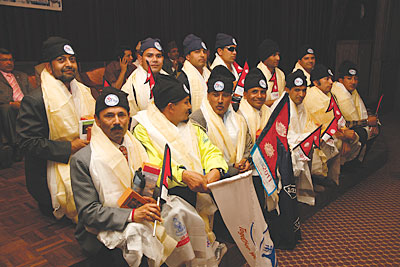
'Into Thin Air' would have brought many amateur climbers and would-be Everest summiteers back down to earth: for a while the idea faltered that anyone could 'conquer' the highest mountain on the planet, courtesy a little training, a lot of cash, and an experienced support crew. But clearly the lesson has not been learnt closer at home. When 15 civil servants (pictured above) announced their plans to scale Everest as part of Nepal Tourism Year 2011, I laughed at their audacity, until I realised this exercise was to cost the state exchequer Rs 30 million. When former foreign minister and octogenarian Shailendra Nath Upadhyay threw his glove into the ring for title of oldest Everest summiteer, I shook my head in disbelief.
Upadhyay perished on the mountain in early May. This would have sent shivers deep into the paunches of our brave civil servants who, unlike the ill-fated Upadhyay, had not ventured beyond the altitude of 5,500 metres prior to this expedition. But as Republica reported without a trace of irony, they were 'dead set about scaling the mountain.' Thankfully, another tragedy was avoided; though six turned back, the remainder reached the summit of Everest Wednesday morning.