Political culture is the problem

Political culture is more important than the model of governance for democrats, says political scientist Krishna Khanal

Himal Khabarpatrika: The committee on system of governance failed to present an 'ideal' governance system. Weren't the models floated in the committee any good?
Krishna Khanal:
The committee failed to propose a single model even after voting on the main proposal and those of the dissenters. There are clearly three models for a governance system. The Maoists' model of the presidential system got 18 votes but failed to garner a majority. The UML/NC proposal for an executive prime minister elected through parliament got 14 votes, while TMLP's proposal for an elected president through parliament got three votes.

For those who truly believe in democracy, the governance model is not as important as the principles involved. First, there should be an elected government. The biggest party should lead the government. Second, the government should be accountable and capable of governing and delivering services to the public. They should not be in power forever once they get elected. There should be periodic elections: usually 3-6 years in democratic countries.?

The executive president as proposed by the Maoists would also be elected through periodic elections. We can make a provision to ensure such a president would only be eligible to serve two terms. The reformed model proposed by UML and NC is the Westminster model of parliament, which is a popular model. An added provision in this model is that a no-confidence motion shall not be tabled twice in the same parliamentary session. The 1990 constitution also had this provision but it did not work, as parties resorted to special sessions of parliament to table such motions.

Although TLMP's proposed model is similar to the Westminster model, it has an executive president instead of a prime minister, as is the case in certain African countries, where parliament elects the president.

Therefore, all these models are democratic models. An elected government through periodic elections and an accountable and capable government to ensure good governance is what people want.

Why isn't there a consensus if all models are in line with democratic norms? A lack of expert advice?
Lack of inter-party dialogue and rigid party stances prevented a consensus. The discussion on the proposals was not sufficient and the other democratic models were not even discussed..

There was expert advice but the political leaders didn't make use of it. For instance, why did UML suddenly abandon its official proposal and support the NC proposal? TMLP did not support a directly elected executive, as that would not benefit small parties. Since the Maoists won the last election, they opted for a directly elected executive.

owever, we have to look at this proposal in its totality. It is important to know what kind of legislative, judiciary and executive they have proposed. One can see that the Maoists' proposal leaves open the possibility of a totalitarian leadership. For instance, they have proposed a unicameral parliament while they advocate a federal system. Their system lacks checks and balances for legislative bodies. Besides, they have also demanded supremacy of parliament. They have even recommended control via a parliamentary special committee of other organs of the state. The Panchayat regime had this structure. The Maoists' model on the form of state governance is questionable for this reason.

Which of these models is most suitable for us?
All three models proposed are based on a first past the post system. The Maoists and TMLP have different opinions on the election of an executive president. NC and UML are parliamentarians traditionally. Although the parliamentary system is unstable, the government is more accountable to the public. The executive presidential system is stable but not as accountable.The British saw the monarchy as a symbol of continuity and they chose the parliamentary system to make government more accountable. The Americans wanted stability and opted for a presidential model, as there was nothing that could bring them all together.

The monarch is now gone. Though we never took him as a symbol of unity, we do need stability. That is why the president should represent diversity, not continuity, and we should have a directly elected executive prime minister. In the past, we never got a stable government even if a party got majority. Given the nature of our parties, a directly elected PM could mean more stability.

Why do you think the Westminster model didn't work in Nepal?
Because we lacked the necessary political culture. This model is characterised by government and opposition in parliament. The party in majority leads the government and other parties make up the opposition, also called the government in anticipation. They wait until the people vote them into power, whether that takes 10, 20 or 50 years. In 15 years of parliamentary practice, our political parties did not exhibit the necessary patience to play the opposition. NC, which supported this system, didn't even stay out of government for six months at a time. The opposition has the right to criticise the works of the government. In parliamentary culture, they play a productive role outside of government, and there needn't be requests for a national unity government. We need to revise the form of state governance in light of our political culture. This is the job of political parties and intellectuals.

Could a directly elected prime minister fulfill our needs?
A directly elected executive prime minister might be new to many of us. The checks and balances system will be weak in the presidential system but in a directly elected prime ministerial system there will be a set of control mechanisms. There are two reasons for Nepal to go for such a prime ministerial system. First, the country's diversity should be reflected at the highest government levels. For that, federal and provincial parliaments can elect the president, who can exercise limited power. Second, if the popularly elected prime minister exceeds his authority, the president can correct him.

What form of state governance would you recommend?
A directly elected executive PM is not a bad option. As the country has become a federal republic, it is realistic to have an executive elected directly by the people. It does not matter which system: prime ministerial or presidential, but the executive should be directly elected by the people. However, the presidential system should be different from the Maoist proposal, which doesn't maintain an appropriate balance of powers. The conventional parliamentary system won't work now. Therefore, a directly elected executive prime minister and a president elected by the federal and provincial parliaments will be the most appropriate model.

READ ALSO:
Constitution 2010, Nepali Times coverage of issues related to writing the new constitution

Published on

Share:

Comments (Archive)

  • Arthur

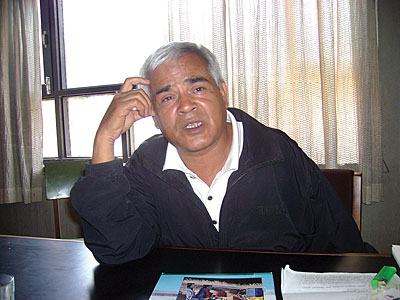
    "One can see that the Maoists' proposal leaves open the possibility of a totalitarian leadership. For instance, they have proposed a unicameral parliament while they advocate a federal system. Their system lacks checks and balances for legislative bodies. Besides, they have also demanded supremacy of parliament. They have even recommended control via a parliamentary special committee of other organs of the state. The Panchayat regime had this structure. The Maoists' model on the form of state governance is questionable for this reason." So the Westminster system of legislative supremacy as practised in Britain is "totalitarian leadership"?! Organs of state like the Army and judiciary being answerable only to themselves and not answerable to representatives of the people is far more satisfactory to this "political scientist". No wonder the photo shows him looking distressed. How did such a mentality survive into the 21st century?

  • Gangalal

    Re: Maoists' state "capture": They (meaning the anti-Maoists) have cried wolf so many times that it's lost its urgency. The disadvantage though is that by portraying the Maoists as dictatorial, the elites have basically asked the people to chose between the dictators and the democrats. Common people don't care much about modes of governance or isms as long as they can imagine a better future. If it takes a dictatorship to improve our lives, then be it so. That seems to be the prevailing sentiment.

  • Arthur

    Gangalal, this tactic of constantly "crying wolf" about "state capture" seems very odd. My guess is that its the only tactic all the anti-Maoist parties can agree on, so each of them has to stress it in the hope that one day they could unite despite the fact that each of them is fighting for their own share of looting via the state.

  • Gangalal

    Arthur, Yes. It's odd and it's very stupid. It's an strategic error on the non-Maoists' part to cry state capture because it rather than weakening the Maoists, it strengthens them in the long run. Although, we should not forget that the scare tactic is used with the complicity of the media, including Himal/Nepali Times et al. You should check out their lead articles around the coup d'etat 9 months ago. It is said that Nepali people are sick and tired of dictatorships. But they forget that we aren't tired of ALL dictatorships. Just the Shah/Rana ones. That dictatorship was a family/clan dictatorship legitimized by an offensive nationalism. The Maoist dictatorship, if it arrives at all, will be an ideological one (so they claim) based on class and ethnic liberation, with the added carrot of modernization. It's foolish to think that this distinction is lost on the masses. It ain't. There's a qualitative difference and the people know it. And it scares the hell out of the so called democrats. The only thing that unites the opposition is the opposition to the Maoists. It's perverse. And despite the rhetoric, the rest of them don't care all that much about democratic principles, as we saw with the "soft" coup d'etat 9 months ago. In politics, losing the moral ground is the first, fateful step out of power. It's only a matter of time before the Maoists are back in Singh Durbar. The new party can perhaps take lessons from international experiences. The old parties will try to prevent losing power for at least a medium-term (Thus the worry about presidential system being dictatorial). They will increasingly cite Venezuela, that's a path that ought to be avoided. They have stopped talking about Peru. It is no more a possibility. But what happened in Chile on 9/11, 1973 will most likely be repeated in Nepal in some farcical manner. That drama is also coming.

  • Arthur

    Thanks for serious discussion Gangalal! As a foreigner I naturally cannot be well informed about is going on, however I have some different impressions. I assume you are right that most of the masses, and therefore also many of the Maoists, care mainly about improving their lives and don't care much about the form of government. Of course it goes without saying that the anti-Maoist parties don't care much about democratic principles, are generally rather stupid and keep doing things that only strengthen the Maoists (who are exceptionally good at ensuring this result by rapidly shifting tactical position when necessary). However I think the Maoist leadership have good reasons of their own to attach much more importance to multi-party democracy than their mass base does. This is precisely because they have long term aims (communism) that go far beyond immediate improvement in peoples lives. As well as requiring such immediate improvements, those aims also require radically changing the people themselves so that they are really able to govern and manage all aspects of social and economic life. Such change in mentality requires ongoing political conflict. There is no other way to learn politics and economics. It cannot be "taught". Historical experience of other communist parties that successfully led modernizing revolutions that improved peoples lives shows that they all ended up turning into corrupt capitalist parties themselves. I think the Maoists need multi-party political competition, not because the kangresis, UMLs etc have anything useful to contribute, but to make it harder for their own party to degenerate in the way that other communist parties have degenerated and easier for the masses to learn how to actually govern. Also I think the Maoist leadership at least understands this. The desperate clinging to the old army certainly indicates the anti-Maoists still hope for a "solution" like Chile. But as you say, it would have to be in "some farcical manner". They are stupid enough to try, but they also know that they could not win last time they tried military rule and they have been growing weaker while the Maoists have grown stronger. So I would say such "drama" is still possible, but not certain. (They can't even smuggle munitions from India to Kathmandu without getting caught, so how well would they do in another People's War?) The other possibility is still that the parties will again confront each other in free elections. But this time with the landlord led Madheshi parties that joined in the present coalition having lost a lot of the hopes placed in them from their supporters seeing how they actually performed and joined with the UMLs and Congress in just looting while achieving nothing. In the local constituencies the anti-Maoist parties are no longer strong enough to hope to win through intimidation or "tradition" (unless under military rule). So if they dont resort to military rule they would need to form an alliance that could still win some seats by not fighting each other, and hope to later gain strength when the Maoists start facing difficulties and making mistakes as a government. So I am still guessing they are not just being stupid when they emphasize the only point they can all agree on - that they dont want the Maoists to "capture the state". What I find bizarre is the childishness of the arguments they use in presenting this common position. eg The Nepal Army would become Maoist controlled if the COAS was replaced by his deputy!! Or this article complaining that legislative supremacy over other organs of the state could be "totalitarian leadership"!!!

  • Nilabh

    What a disgrace Arthur and Gangalal. You congratulate each other over a bogus analysis built on a phantasm. But in the process you betray your real intentions. Reading your post it seems that you are not interested in democracy, you are not interested in establishing the rule of law and have no regard for traditions and for culture. I have a very strong feeling that this is an objective that you share with the Maoist party. Their only interest is in establishing a dictatorship with the sole purpose of destroying our culture, our religion, our history, our ideas -our entire inheritance. Their entire discourse is directed towards this project. I believe I understand how you - the Maoist - intend to do this. You will distort our history and, through your collaborators, spread discord among the people of this nation. Arthur, I have repeatedly noticed that you build your arguments through conjecture, depending on the idea that people would be so outraged by it that they would not know how to respond. Thankfully, you are mistaken. You say that these parties are not truly democratic, may be you are right, but at least they practice their politics peacefully. You say that politics and economics cannot be learned without political conflict. That is not a sensible comment, it betrays you as a mediocre university student. You repeatedly assert that the political parties are foolish and stupid, and that they cling to this or that, again you betray your lack of respect for others and a total lack of civility. I will let you on to something. I hope that your desire is fulfilled and there actually is this dictatorship where all expressions of opinion must confirm to the party line or it would be the gallows. Every aspect of life would be controlled by the party - social, economic and cultural - based on an ideology completely discredited by so many historical experiences. Then at least the fight would be clear. You communists are great at rhetoric - I want a fight in the real world of real ideas for real people who have a real life, culture, history and family. And, I really hope you both respond to this because I have also noticed that whenever anybody mounts a challenge you simply move away. Apparently you have a lot of time at your hand taking so much interest this little country. Go ahead talk to me.

  • Arthur

    Nilabh, your comment is slightly less of a disconnected ramble than previously from "Anonymous" but it still consists of abstract generalities without any substantive reference to either anything in the article we are discussing or in the comments made about it. The only point of responding to such comments would be to take up some random phrases in them that happens to be relevant. If you want actual argument you have to engage with what others are actually saying rather than starting up a conversation of your own and complaining that it ends up being a conversation with yourself. Meanwhile I will pick out a couple of such random phrases. 1. "You say that politics and economics cannot be learned without political conflict. That is not a sensible comment, it betrays you as a mediocre university student." If you actually engaged in political conflict you would learn how to argue and learn something about politics in the course of arguing against other views. By simply repeating your own views or simply denouncing other views and those holding them you are not actually engaged in political conflict and will learn nothing. This is well illustrated in the above sentence. 2. "You say that these parties are not truly democratic, may be you are right, but at least they practice their politics peacefully." I pointed out that the "political scientist" who wrote the article says that legislative supremacy over other organs of the state would be "totalitarian". That is the central issue in the current political deadlock. The anti-democratic parties currently in office seek to maintain Nepal's traditional politics (common also in other least developed countries) in which the Army is not subordinate to the civilian authorities chosen by the people but can impose its will by armed force. They have refused to democratize the feudal army so they may indeed be described as "not truly democratic" but can hardly be described as practicing their politics peacefully. 3. "You repeatedly assert that the political parties are foolish and stupid, and that they cling to this or that, again you betray your lack of respect for others and a total lack of civility." There seems to be a near unanimous consensus in Nepal that the parties now governing are foolish and stupid and cling to this or that. Of course the royalists who are noisiest about that in the comments here say it for different reasons from the articles saying it and very different reasons from Maoists saying it, but it really is "common ground" rather than lack of civility. Nobody familiar with them pretends otherwise (and they all say the same about each other and about other factions of their own parties). My point about that was not mere repetition of the prevailing view but to suggest that nevertheless there is some point to their apparantly foolish endless repetition about the Maoists "capturing state power". Namely that this is the only point of unity they have.

  • Nilabh

    Thank you for coming back to expose yourself as a propaganda machine mate. Your arguments can be summed up in this: If you can't dazzle them with brilliance, baffle them with bullshit. Forget the political parties, it is not about them - they would reach a pact with the devil to get into power, your rant against them is meaningless, everybody knows they are hollow and care for no principle. It is your meaningless, mind-bogglingly silly rants that I am interested in. You are wrong and over time we will establish that, because you always use the same arguments, no matter what the topic is. Anonymous did not. Even your reply, which is full of rage, you expose the hollowness of your ideology.

  • Nilabh

    Just because you don't have the capacity to answer, don't insult. "If you actually engaged in political conflict you would learn how to argue and learn something about politics in the course of arguing against other views. By simply repeating your own views or simply denouncing other views and those holding them you are not actually engaged in political conflict and will learn nothing. This is well illustrated in the above sentence." No, you learn about politics and economics by understanding the methods and principles underlining these subjects. Argument comes after that, this way you actually add value to the conversation, otherwise you look for someone who already agrees with you and congratulate them for "a serious discussion". If you wanted a real one you would have argued with Anonymous because he stayed exactly to the point. "I pointed out that the "political scientist" who wrote the article says that legislative supremacy over other organs of the state would be "totalitarian". That is the central issue in the current political deadlock. The anti-democratic parties currently in office seek to maintain Nepal's traditional politics (common also in other least developed countries) in which the Army is not subordinate to the civilian authorities chosen by the people but can impose its will by armed force. They have refused to democratize the feudal army so they may indeed be described as "not truly democratic" but can hardly be described as practicing their politics peacefully." This is an interview, he was answering a question. No matter, this indeed is the central issue for the political deadlock. That is because as you, and many other communists, have clearly and repeatedly suggested, you do indeed seek to establish a totalitarian regime. What is more, you seek to follow economic and cultural policy that is wrong headed. Refer to the earlier part of my comment and next time don't try to divert attention by changing the subject. It is your actual intention that is up for debate, answer that question. Regards your comment about the army and the judiciary, they do indeed need to be independent - most notably the judiciary. Otherwise, the executive would have too much power over it and would repeatedly create obstacles in the path of justice. On the Army, you have absolutely no clue evidently that in virtually all democratic nations, with very few exceptions, the command over military is clearly separated from the legislative arm of the government. This arm is devoted to making laws that govern the army, not exercising control over it. The point is that this guy is just answering a question about a debate, the pros and cons have to be debated, that is what makes a democracy. I don't understand your argument about violence by parties when it is only the Maoist who have established a monopoly over violence. "not mere repetition of the prevailing view but to suggest that nevertheless there is some point to their apparently foolish endless repetition about the Maoists "capturing state power"." The only thing I can surmise from the response that you have given is that you are another unimaginative communist who simply can't think beyond his brief and are incapable of appreciating others views. Communist propaganda always has this pattern so try something more intelligent next time. For example actually making a point - like Anonymous. I know I am replying too late, but then its never too late to stop a communist.