
 He stands alone, seemingly neglected at first glance, if you notice him at all. The traffic and people bustle past, the small shops conduct their business as usual. A small, crude, tiled concrete arch gives him some protection from the elements and human encroachment. The knee-high Buddha has stood there for 2,000 years.
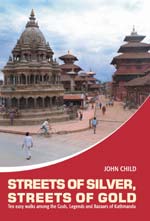
'There' is now the Bangemudha Square, just in from the lively Asan Tol. Who quarried the stone, who carved him, who put him there, what has he witnessed?' These are not questions we normally stop to consider as we rush about our daily lives. But it is exactly the kind of pause John Child encourages in his new book, Streets of Silver, Streets of Gold: Ten Easy Walks among the Gods, Legends and Bazaars of Kathmandu, published by Himal Books.
The book's title might more appropriately have been 'of Kathmandu Valley', since the author takes you on walks that range from Swoyambhunath to Bhaktapur, in addition to the bylanes of Kathmandu itself. This excellent guide is written by a person who clearly loves the Valley and knows a lot about its history, its people, and its places. His passion is infectious.
The walks are not long gruelling treks, but strolls through the past alive in the present, through the spiritual manifest in the everyday. Child alternates between the minutiae in front of you and more thorough informational digressions. It is a good balance. He does not overburden the reader with information, but does a commendable job of giving the average person an initial taste, or perhaps a reminder, of the political and cultural history of the Valley and of the different but intertwined religious practices.
But the walks are not just tours of the curious and the notable, though there is plenty of that-an exquisite Shiva and Parvati in the sensual Uma Maheshwar posture is next to Newa Chen. The largest lingam in the country is on the banks of the Bagmati. The first house in the Valley other than the palaces to have glass windows is near Kel Tol, and there is a 6th century stele granting tax relief to local villagers behind the Jaisidewal temple.
After a few outings, you begin to get a sense of the larger mosaic that is the Valley. The contours of the previous eras emerge through the concrete, asphalt, and exhaust. It is not an endless sweep of houses and shops in front of you, but open land. You can imagine the space that actually existed between places that now seem to differ only in name. The author untangles the layers of history from modern sprawl and brings your attention to the faint outlines of the old Rana estates, the original settlements, or the intermediate kingdoms. This history puts the present political and social turbulence in a different perspective-intrigue, greed, and ego are not new among the leaders of Nepal.