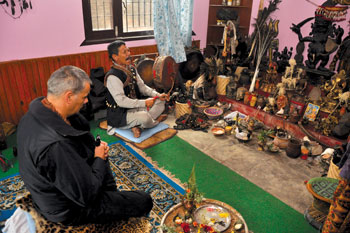
THE POWER OF FAITH: Mohan Rai teaches faith healing at the Shamanistic Studies and Research Centre in Kathmandu, showing that traditional healing is not just practiced in remote parts of Nepal, but also in the capital. The fact that many of Rai’s students are from the West also indicates a disenchantment with the limitations of modern medicine.
You step into the doctor’s office. You have an unknown illness that needs diagnosing. The doctor lights incense, beats a drum and starts trembling all over to diagnose which spirit is the cause of the ailment.
One would expect the spread of modern medical care in Nepal in the last 60 years to eliminate the people’s belief in traditional medicine. However, dhami jhankris are still in business, and not just in rural areas.
“Jhankris know the psychology of their patients, they don’t just treat them medically but also mentally,” says Dinesh Lamsal at the Civil Service Hospital in Kathmandu. “People still visit them because they are part of their community, they trust them and they are cheaper than clinics.”
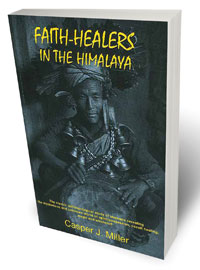
Casper Miller, who published Faith Healers in the Himalaya in 1978 after research in Dolakha, describes jhankris using controlled shaking, chants and drum-beating to show patients that they are in close contact with the spiritual forces causing illness.
Doctors, too, shake a pill bottle of placebos to make patients feel better. Educated Nepalis are skeptical about healers who perform a dance around the fireplace to cure patients, and despite the cost, have more faith in modern medicine.
In 1990 researchers estimated there are 100 faith healers in Nepal for every health worker, and today the 15,000 medical doctors are primarily in the capital or abroad.
This does not meet the demand for medical treatment Health experts say the staying power of faith healers should be incorporated into the national health system. Modern medicine now teaches students that it’s all in the mind, and the patient’s faith in treatment is almost as important as the medication itself.
Robin Basnet, a surgeon at Bir Hospital, says traditional healers also benefit from the body’s ability to heal itself. “The best doctors can keep patients alive until nature heals itself,” he says, “it just takes time, and they take advantage of that.”
Many families in rural Nepal still trust local shamans, even when there is a hospital nearby. Basnet recalls that he would see four to five patients a day while working in SoluKhumbu, while the traditional healer would have 50.
Whether there really is a bad spirit causing pain or illness is not as important as the relief exorcising it can provide. Traditional healers’ dominion over both the physical body and the mind of the patient, as well as their ties to the community means they occupy the space between physical wellbeing and religious beliefs.
American researcher Steven Folmar, who is studying the relationship between mental health and traditional sacred beliefs in Lamjung district, says that with increasing societal stress, this emotional and mental space will become more important, not less.
Traditional healers should be retained as a valuable resource to address mental health because of the trust they command in the community.
Source: Ed van der Kooy
Mental health carries stigma in Nepali culture, and it is still not mentioned in the Ministry of Health’s updated actions for Essential Health Care Services.