
Day 1
 NEPALI KUKUR |
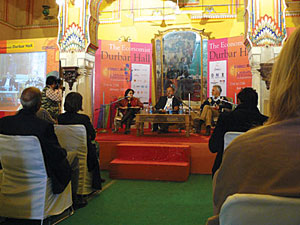
Jaipur seems bigger and more anonymous every time I return. The Jaipur Literature Festival, too, is growing by the year, with over 100 sessions spread over four venues and five days in the sprawling grounds of the Diggi Palace Hotel. But if crowd crush is an inconvenience at sessions with marquee authors such as Orhan Pamuk, Vikram Seth, Martin Amis, Kiran Desai and Junot Diaz – with tens of thousands swarming the fest on the weekend – the essence of such a gathering remains, to quote opening
speaker Karan Singh:
"Prose is written to be read
Poetry is written to be heard"
The passion for both forms is what ties the diverse Jaipur audiences together. Shabdabrahma awaits you, quoth Singh, and we were ready to be beguiled by the divine word.
An early highlight was Orhan Pamuk, expounding on the themes of cultural change in the context of Turkey. His accented, rather mechanical sounding English belied an acid, self-deprecating humour, and a very clear sense of his mission as an author. But the patience one would imagine necessary to recreating the milieu of medieval Ottoman miniaturists, as in 'My name is red', wasn't much in evidence come question time.
"I really like your—"
"Yes, yes. Next question!"
Day 2
'Strangers in the Mist', a discussion on the Indian Northeast's gloomier prospects, triggered reflections on the pitfalls inherent in a state's dealings with ethnic communities. With 220 ethnic groups making up a population of 40 million – "an anthropologist's delight, and an administrator's nightmare" – according to panelist Sanjoy Hazarika, the Northeast is an example of how not to 'do' federal Nepal. The tragedy here is not only in the truth of massacres, rapes and disappearances, but also in the fact the young novelists like Assam's Aruni Kashyap can only write about violence, because they have "never known what it is like not to live under the shadow of a gun". The success of Indian democracy, he concluded, "is that it has managed to create apathy amongst urban populations towards the plight of those in rural areas."
Day 3
JM Coetzee's reading was probably the most anticipated event of the festival. A spare, upright, white haired man of 70, he could not have seemed more different from last year's Nobel Laureate, Nigerian author Wole Soyinka. But for forty-five minutes, reading from 'Elizabeth Costello' in his precise, measured tones, the South African achieved the same effect on the Front Lawns of the festival venue. Layers upon layers, in unblinking, limpid prose: you could not ask for more of a novelist.
And what of philosophy, beloved and daunting? Following Coetzee's meditative reading, AC Grayling's 'secular sermon' sought to dispel the fear of seeking answers to 'what is' and 'what matters'. This quest, for Grayling, is a responsibility if we are to live better lives, and make use of the third of the 1000-odd months that are available to us for serious living, learning, and loving. Further, if we are to be able to have "the degree of latitude with which to seek the ethical", we need individual autonomy and freedom of expression. Authoritarians across the world well fear the Graylings of our age, because the sword has no chance against pens wielded with such passionate, articulate intelligence.