
 |
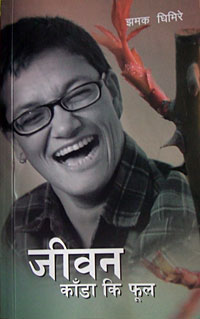
Jeevan Kaanda ki Phool describes a life lived with passion, industry and unyielding determination. In this autobiography Jhamak Ghimire, now a luminary in the world of Nepali poetry and prose, chronicles her struggle for freedom and self-expression while battling cerebral palsy in an intolerant social environment. Born with a congenital illness that left her unable to use her limbs or speak, Ghimire gives voice to her thoughts by writing with her foot, and this book gives readers access to the memories in which her proclivities for independent thought, rebellion and ingenuity are clearly manifest.
By far the most intriguing passages in Jeevan Kaanda ki Phool are the ones in which Ghimire traces the roots of her desire and efforts to read and write freely. From anecdotes of her rudimentary attempts to write on rocks and mud with her feet, to the acquisition of her first pen and paper, to her surreptitious searches for others' books, she keeps the reader hanging on to her every word. Of writing she speaks with fervour, with defiance, and a passionate caress that makes the reader fully cognisant of the importance of expression in her life.
Of her family and society, on the other hand, Ghimire speaks with biting sarcasm. She describes in brutal and painstaking detail the extent to which her community tried to suppress the talent burgeoning within her. From constant mental and physical abuse to wishes of a speedy death, Ghimire writes of how she was forced to bear witness to ridicule and deprecation from an extremely tender age. She also describes the neglect and scorn she endured at the hands of her parents, both of whom she credits with very little for her success. In Jeevan Kaanda ki Phool she reprimands them for remaining woefully oblivious to the degree to which their words and actions affected her then-impressionable heart and mind.