
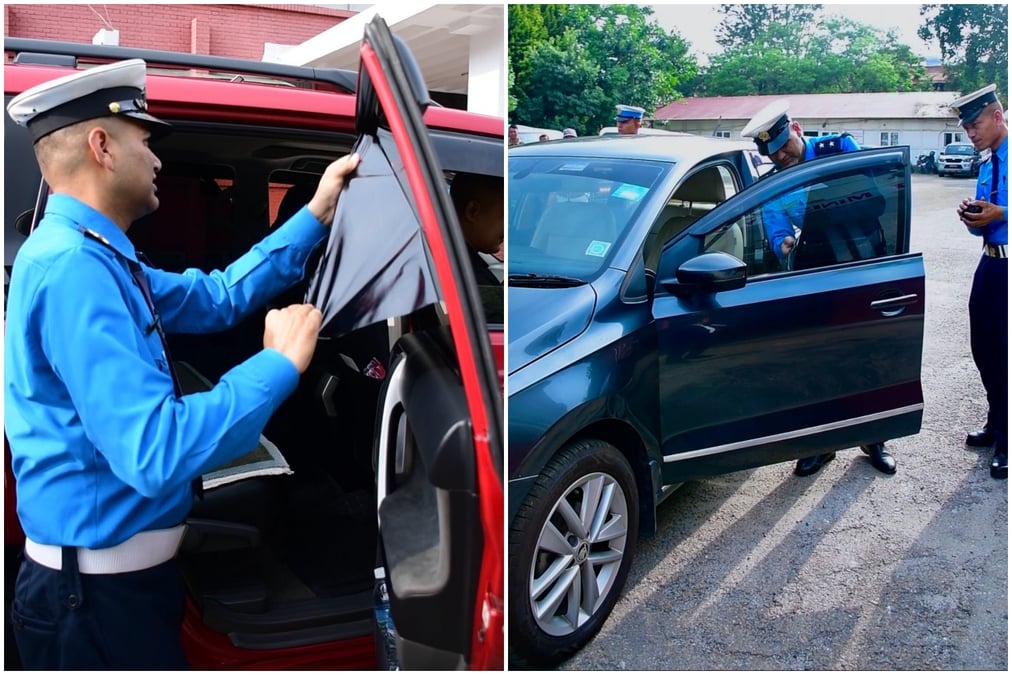
Nepal’s leaders want to be reincarnations of Lee Kuan Yew, and like to say that they want to turn Nepal into Singapore. It may take several decades to attain the income levels of the city state, but Kathmandu may already be like Singapore in one aspect: new fines for traffic violations.
Nepal’s cybersphere is rife with debate about the government’s decision to slap exorbitant fines on traffic violators. Cars with shaded windows will henceforth have to fork out a whopping Rs100,000. Jaywalkers pay Rs500, speeding tickets have tapering fines depending on velocity of the infraction.
Social media is filled with videos of motorists pulling out their aftermarket plastic window tints saying they would rather lose some plastic than pay one lakh to the police.
In the last couple of months, Nepal has seen an alarming increase in road traffic accidents, a subject which we discussed in my last column in this space. Nepal Police launched stricter enforcement of road rules in a bid to improve safety.
But what seems to have eluded the Police as well as the designers of the new pecuniary penalties is the wisdom of the age-old saying: prevention is better than cure.
With an average of seven daily deaths on our roads, a new Bill that will increase fines ranging from Rs 500 to as high as Rs 100,000 for violations to deter dangerous driving has been drafted by the Ministry of Infrastructure Development. It is currently being vetted by the Ministry of Law, Justice and Parliamentary Affairs.
According to this new law, motorists caught driving under the influence will face fines of Rs25,000 for two wheelers, Rs35,000 for light vehicles and Rs50,000 for heavy vehicles. What is baffling is that tinted windows are penalised more than DUI.
Trying to set an early example, Home Minister Sudan Gurung, went public removing his own vehicle’s tinted window citing security reasons. And while this may have been true in older more tumultuous times, vehicle windows are a meticulously developed component today.
Many modern car manufacturers offer factory tinted windows where the molten glass mixture is baked with metal oxides creating different shades. They come in colours such as charcoal grey, light green or blue. Premium vehicles sold in Nepal even offer double glazed glass for better insulation from heat and noise. This ultimately results in a cooler cabin, less noise and comfort for passengers while pushing less load on the AC and thereby improving mileage and range, and, in effect, saving energy.
Globally, countries regulate vehicle window tint through Visible Light Transmission (VLT) standards. Countries like South Korea, Canada, France and Italy all allow different VLT figures. For example, in India the law requires 70% Visible Light Transmission on the front and rear windshield but allows 50% VLT on side windows.
Nepal’s outright ban in this day and age in the name of ‘better security’ and visibility sounds like a regressive slap for automotive technology.
The new Bill also prosecutes overspeeding progressively, but also fines amounts between Rs 3,000 and Rs 5,000 for driving too slow when slower drivers on Nepali roads could be those cautious of the chaotic traffic, or still beginners. There are also a certain number of older vehicles that struggle to pick up speed.
Noteworthy are fully loaded Safa tempos that run routes climbing uphills — they simply do not have the torque. Not to mention, a three-wheeler carrying 10-14 passengers has no business going at the 50kmph speed limit on the Ring Road either.
And then there is always the underlying question about whether citizens can afford such steep fines when the country still has a GDP per capita of less than $1,500 and the fines are several times the monthly salary of most people.
The new fines also overlook the poor condition of roads that need to be fixed first. An MP quipped in Parliament that it is the government that should be fined Rs100,000 if a pothole on the road is not patched up.
There needs to be better road safety education for sure, but for that the roads also need to be better. The old figure 8 driving trial system needs a substantive update.
Current driving tests evaluate basic vehicle control, but does little to prepare motorists for the realities of our chaotic roads. Practical on-road exams should test not only maneuvres like parallel parking, multi-point turns, and blind-spot awareness, but also everyday driving habits such as lane discipline, proper indicator usage and speed compliance.
Safe driving is learned through real-world experience, and those habits should be drilled before obtaining a license – not through steep punitive measures afterwards.
So while higher fines may make headlines, they will not on their own make Nepal’s roads safer. This Bill appears to treat road safety as a problem that can be solved with bigger penalties, when the real challenge lies in decades of inadequate driver education, inconsistent enforcement, and poor road infrastructure.
Discipline on the road cannot simply be legislated into existence, it must be learned, reinforced, and practiced over time.
Arnav Upadhyay is a content creator who reviews automobiles and promotes road safety for his Nepali Times column, Drive Line. He is also on Youtube, Tiktok and IG under the handle Casually Annoyed Driver.