
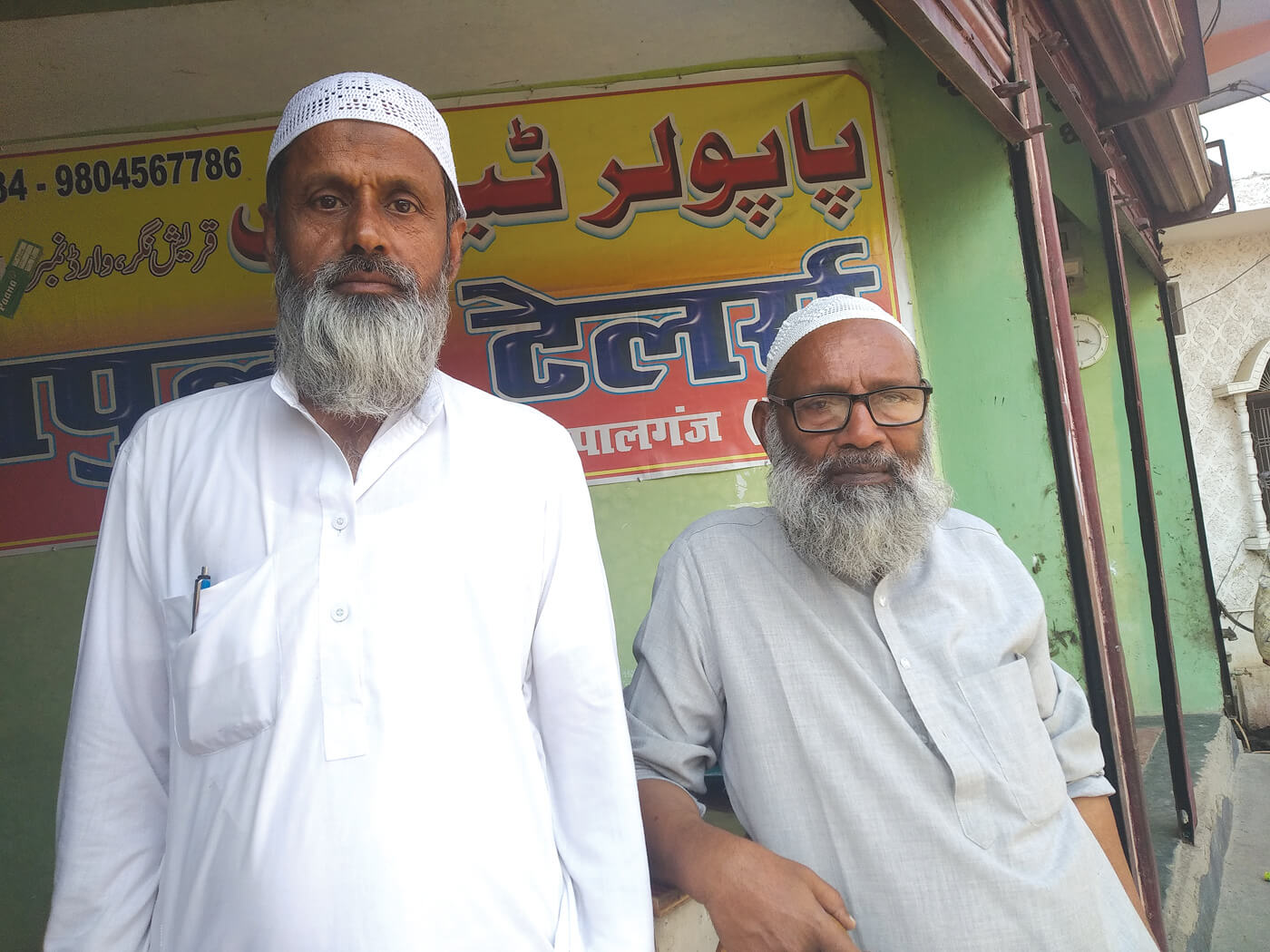
Wearing a white salwar kameez that matches his short white beard, Mustafa Ahasan (at left, above) calmly sews clothes at his tailoring shop near Tribhuvan Chok, the old Muslim quarter of Nepalganj.
But the 51-year-old is no ordinary tailor — behind him on the wall hangs a certificate vouching for his credential as a noted poet of Urdu ghazal and shayari, forms much admired but little understood in Nepal.
Ahasan and his fellow ghazal enthusiasts keep the proper forms of Urdu poetry alive in Nepalganj through a group called Gulzar-e-adab. With 18% of its population Muslim, the influence of Islamic culture is evident everywhere in this western Tarai city bordering India.
The narrow street called Eklaini has swirling Islamic curlicues over doors and terraces, even on modern concrete buildings, and the sidewalks are packed with colourful chura-pote shops selling bangles and glass beads.
Read also:
Moving to the mainstream, Chandra Kishore
Nepali Muslims on the margins, Prakriti Kandel
Mustafa Ahasan was educated in a Nepalganj madrasa and went on to get a degree in literature from Aligarh University in India, where he also learnt Arabic, Persian and poetic metres called beher used in these languages.
“There are only a handful of people in Nepal today who write Urdu poetry in beher, and half of us are here in Nepalganj,” says Ahasan. “We keep up the tradition of Motiram Bhatta, who introduced ghazal in Nepal and who was proficient in these metres.”
Gulzar-e-Adab has been holding regular monthly ghazal events for the past 40 years, says 81-year-old poet Abdul Lateef Shauk (at right, above): “Our events are not just for Urdu poets; we also have recitals in Nepali, Hindi and Awadhi. They are a vibrant hub for cross-cultural exchange.”
Once in a while, the group also holds all-night Mushayra events, inviting poets from across Nepal and India. But Shauk and Ahasan say they are swimming against the tide, as the interest in traditional Urdu poetry is dwindling.
Ghazal scholar Ghanashyam Nyaupane is among a handful of poets writing in beher in Nepal, and agrees that these forms are not very well understood in Nepal. “There are three strands of ghazal writing in Nepal: one group creates its own metres and purists do not like it. The second group has no knowledge of metre at all and just rhyme. The third writes in classical Urdu metre, but this group is very small and getting smaller.”
Sewa Bhattarai
Read also:
Written locally, read globally, Sewa Bhattarai