
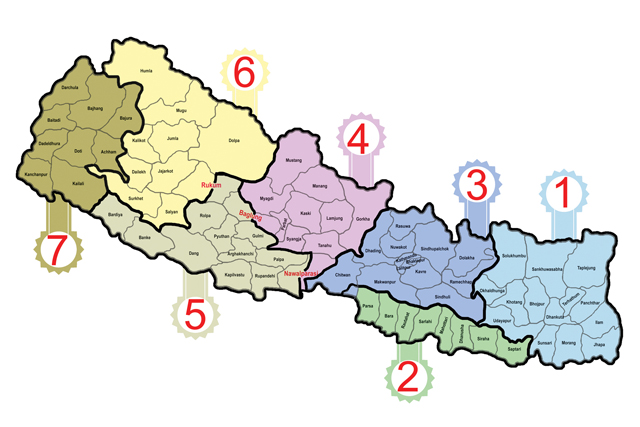
Story so far: the four main political parties made up of the ruling NC and UML with the opposition UCPN(Maoists) and MJF(D)signed an agreement on 8 June to speed up the constitution draft with a provision for eight provinces, but leave the demarcation of provincial boundaries to a future Federal Commission and their names to state legislatures.
After protests erupted, the parties said “oops” and went back to the drawing board, demarcating boundaries not for eight but six provinces. How that number was picked out of a hat, we don’t know. But it set off a maelstrom of protests by various groups which felt left out.
The people of the Province #6 in the west were for and against and went on a weeklong arson spree. The folks in Baglung and Rukum found their districts cut cleanly in half and were unhappy. The Tharus wanted their own homeland in the western Tarai and were on warpath. And the Madhesis were suddenly not satisfied with just the plains in Province #2 and also wanted a piece of the Pahad.
So the constitution framers went back to the maps and decided on seven provinces by dividing Province#6 into two: the trans-Karnali and the Mid-West. This put out the flames in Surkhet and Jumla, but angered the Tharus who felt their demands had been ignored. It got serious enough for the Tharu chief of the MJF(D), Bijay Gachhadar, to disassociate himself from the four-party grouping and join other Madhesi and Janajati parties at the barricades. And now things have gone out of control with the violence in Tikapur of Kailali where Tharu protesters fought pitched battles with police that left at least seven protesters and policemen dead.
Already the Tharuhat Struggle Committee and Madhesi activists had shut down Nepal’s plains for the past week or more, essentially blockading the hill and mountains. Thousands of trucks are stuck on the Indian side of the border, hundreds of thousands of people are stranded, and there is a danger of the unrest spreading after the Tikapur clashes.
So, as the number of proposed provinces goes from the original 14 to 8 to 6 then 7, the number of parties in the constitution alliance goes from 4 to 3. Senior ministers from the NC, UML and UCPN(M) tell us informally that they are doing the best they can, but there can’t be a formula that will satisfy everyone. They are determined to take the process forward with an amendment bill, clause-by-clause debate and voting in the coming week so that the constitution will be ready. They say even if everyone is not fully on board, there will be a provision to turn the Constitution Commission into a Constitution Appeals Commission to address the demands of those who feel left out.