
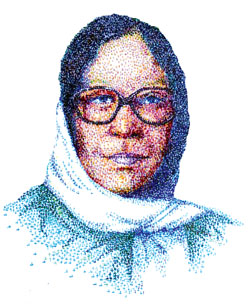
 Parijat's memoirs flow with the poetic current that characterises the best of her writings. No one tells her story as compellingly as she does herself. Regular readers such as I could bypass all the self-appointed authorities and pick up her Atmasamsmaran instead.
Parijat, born Bishnu Kumari Waiba, grew up in Darjeeling under the shade of a hardheaded, militantly atheist father. "[H]e has read Marx, read Engels, read Gandhi, read lots more, but reading alone does nothing to a person. He has read, read he has, that's all!" writes Parijat in the first part of Atmasamsmaran which is dedicated to the memory of her father.
A sickly child with an indomitable spirit, she realised early on that she resembled no one. "A world has formed inside me but I am silent." She wanted to be sociable and vivacious like Sukanya, her younger sister, but admits "[u]nnecessary pride and tenacity takes hold of me.For some reason, I can't be happy." What stirred Parijat was her surroundings. "River, looks like a blue serpent...I want to wrap the whole river round my neck." She felt an urge to write the smell of a flower. "I tell my friend I want to write this. What? She looks confused."
Unlike her friends whose love letters she wrote, Parijat experienced love only as pain. "At night I grow full of love for him, by dawn love sheds its petals one by one, like a withering flower, and I'm done for, empty! In daytime, I have nothing left to offer him except platitudes." It's as though her overpowering sense of aloneness ruled out the possibility of romantic happiness. Such happiness grew ever more elusive when, at the age of 26, Parijat was bedridden with rheumatoid arthritis. In her memoirs, she describes the realm of illness with wrenching clarity.