
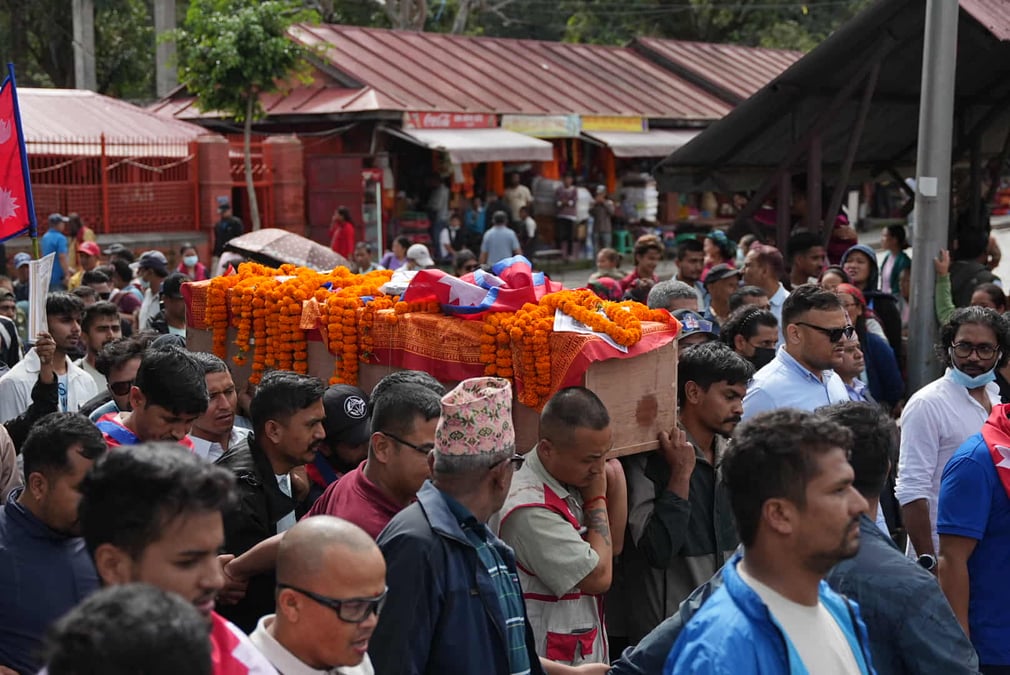
As the youth protest turned violent in Baneswar last week, healthcare workers across the city watched shocked, horrified, and overwhelmed, as the injured were carried in with bullets to the head, chest, torso, and limbs.
The death toll from last week’s youth protests against corruption and malgovernance has now reached 74. A majority of the dead and injured are young Nepalis who had marched on 8 and 9 September in hopes that the movement would see the dawn of a new Nepal.
Meanwhile, more than 1,700 people across the country were injured. Many young Nepalis had joined the rally in their uniforms, believing that it would protect them from any violence that might occur during the day, as international law protects students from use of force.
But the security forces fired live ammunition into the crowd. First responders and healthcare workers say that police have used extreme and inhumane force on student protestors, with some needing multiple surgeries to treat bullet wounds.
Read also: Remember their names, Nishi Rungta
Twenty-year-old student Kishore Dhakal is one among hundreds of protesters who was shot during the protest. He now lies recovering at Bir Hospital, unable to speak due to the injuries and stitches on his face. Videos of him being shot have been widely circulated on social media.
“He just completed grade 12 and was planning to go abroad for his further studies,” says Dhakal’s father, who is by his son’s bedside. “Once he is out of danger and gets better, we plan to go back to our village.”
Netra Bikram Thapa, 30, was at the protest in Baneswar chanting anti-corruption slogans when the security forces began firing water cannons and tear gas towards demonstrators. As they were asking to be able to move forward, police started firing live rounds, and a bullet struck Thapa.
“I joined the movement because I wanted corruption to end and good governance to prevail,” says Thapa, who is currently recovering at Bir Hospital. “We are not from the land of Gandhi, this is the land of Bhimsen Thapa — we refused to keep mum, and began counterattacking with stones.”
The protest degenerated into arson and mayhem on the second day as protestors vandalised political party offices and private residences of leaders. Demonstrators reportedly found millions stashed in the houses of political leaders, burning the money along with everything else.
Arson and looting escalated that afternoon after erstwhile Prime Minister Oli resigned, as agitators set fire to the three branches of government, numerous bureaucratic and government institutions , 12 Bhatbhateni outlets, the Hilton Hotel, Ullens school, Kantipur Media Group, and several automobile dealerships.