
Is the human brain hardwired for violence? Why does another war start after one ends? How does one suppress the reptilian side of the mind to foster peace and compassion?
Sages through the ages have grappled with this question. Binod Shrestha seeks answers through his art. He says: “The history of humanity is violent. It is embedded within us. Nepal’s history and politics are also replete with violence.”
Shrestha’s project Silent Bone is exhibiting in galleries across Kathmandu in June and July, and will invite viewers to think about violence and the residue it leaves behind in identity and memory.
Shrestha landed in the US just after 9/11 and was immediately interested in how that act of terrosim shaped the country's trajectory since.
Silen Bone will be taking place simultaneously at Dalai La Art Space, Siddhartha Art Gallery, Mandala Theatre, Nepal Academy of Fine Arts and Taragaon Next. Shrestha is also involving 28 students and recent graduates from Kathmandu University, Tribhuvan University, and Lalitkala Academy.
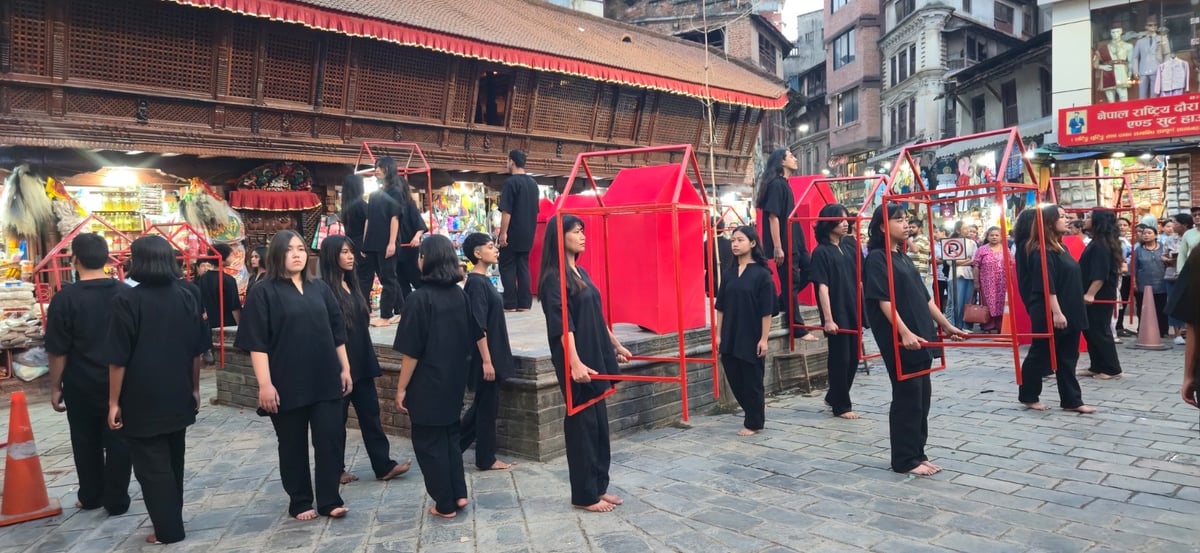
This unique exhibition combines performance, street theatre, sculpture and included one at Annapurna Temple in Asan, featured art students in black walking silently in slow formation on a platform, holding structures made of red steel rods shaped like homes, but meant to represent bones.
Shrestha monitored the performance from nearby, and explained: “The idea is to show homes as bones and vice versa. I’m not interested in depicting violent imagery. I want viewers to think about it.”
The skit drew a curious but confused crowd on a recent afternoon, the silence and calm of the sombre performers stood in stark contrast to the hustle and bustle of Asan. The red hue of vermilion or blood pervades much of Shrestha’s work across drawings, prints, photographs, sculptures, and performance art. The strap of his watch is red, too.
“It's a cultural thing, I want to distill red into the purest, abstract form in my art, which makes it more accessible,” says Shrestha, “we are asked that question a lot for some reason what is Nepali about your art? I don’t think of it in that way.”
Shrestha performance art demands a lot of logistics and project management. “When you think of artists, that’s not what you expect them to do, but it is what is needed when you have a big project like this,” he says.
Shrestha has lived outside of Nepal for much of his, exhibiting all over the United States. After leaving Nepal for a Master’s in Fine Arts in Bangalore in 1997, Shrestha did a further MFA degree at the Pennsylvania Academy of the Fine Arts in Philadelphia and a residency at the Skowhegan School of Painting & Sculpture in Maine.
He also teaches studio art at the University of North Texas, and has been back in Nepal only a few brief times, mostly on research trips. IN that span of time, he has seen the Kathmandu art scene change dramatically.
“There used to be just one art school then, and few galleries. Now, there are three art schools that each produce 20 artists a year, and they are making interesting work that people want to see and buy,” says Shrestha.
For aspiring Nepali artists who would like to follow a similar path, Shrestha has advice that is very pragmatic: “Figure out what sustains your practice. Maybe you teach art, work in an office, or drive a taxi.”
Having a side income lets artists follow their own interests and frees them of the need for gallery support. Shrestha himself dislikes confining himself to just one medium or one style, although he did start out as a painter.
“Paintings are one-dimensional,” he says. “Other forms of art are more engaging for the audience.”
Silent Bone
Dalai La Art Space, 9 June - 10 July as ‘Nepali Sublime: Body in Translation’
Siddhartha Art Gallery 12 - 26 June as ‘Of Place, Memory, and Residue’
Nepal Academy of Fine Arts 26 June - 5 July as ‘The Shape of Stillness’
Taragaon Next 28 June - 5 July as ‘Reliquaries for Remembrance’
There will also be an invitation-only performance at Mandala Theatre on 23 June.