
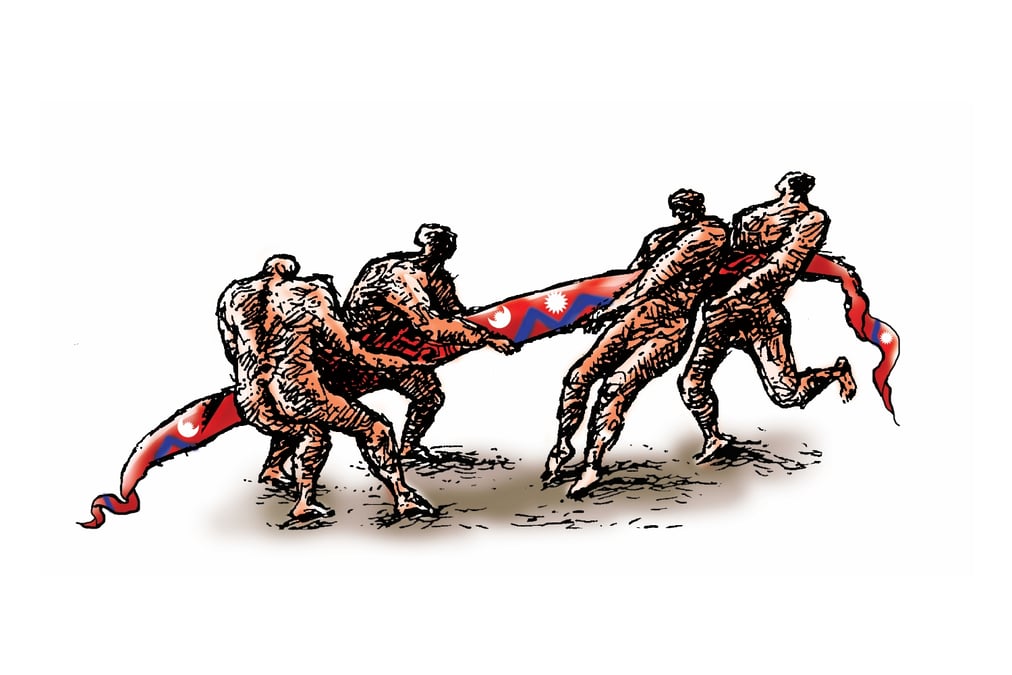
They say you can choose your enemies, but not your neighbours. This rings true especially for small nation states bordering much larger ones.
And that is also what Mao Zedong told King Mahendra in Beijing in 1967, and it is the message successive Chinese leaders have given to Nepal’s rulers ever since: be clever, don’t rock the boat, learn to live with India.
In Beijing in 1988, Deng Xiaoping and Rajiv Gandhi demarcated each other's spheres of influence: south of the Himalaya India calls the shots, and north of it (including Tibet) China does.
Lila Nyaichyai, who did her PhD on Chinese Public Diplomacy in Nepal from Yunnan University, says China’s main concern in Nepal is stability.
“As a country grows to become a global power, its aspirations do too,” she says. “But China hasn’t cared much about whether Nepal is a monarchy, a democracy, or a federal republic as long as it is politically stable for development.”
Nepal’s royal rulers navigated the Cold War between the Soviet Union and the United States successfully, getting both to contribute to the country’s development. But the dramatic rise of India and China as global powers, and the fact that they are rivals in Nepal’s immediate neighbourhood has made the need for balance much more critical now.
A template could be the way Finland survived the Cold War between next door Soviet Union and the West. It did not join the Warsaw Pact, but its reference group was the other Nordics. The country decided to keep Moscow at arms length by appeasing it — a strategy that came to be called ‘Finlandisation’.
“Finlandisation was this attitude of yielding to pressure from a big brother,” Finnish journalist and author Katri Merikallio explained to me during a recent visit to Helsinki. “Finland remained independent, but its sovereignty was narrowed. There was a price to pay. We must acknowledge the risks that such a balancing involves, both for the sovereignty of a nation but also for internal politics.”
It was a survival tactic that saved Finland from being arm-twisted by the Soviet Union, like Hungary in 1956 and Czechoslovakia in 1968. But today with the Russian invasion of Ukraine, ‘Finlandisation’ is not in vogue anymore and Finland has joined NATO.