
Major reforms needed in minor detention centres

Nepal’s Child Reform Homes are supposed to rehabilitate young offenders, but they are incarcerated

Ben ZimmermanNews, Longread

Photos: BEN ZIMMERMAN

Tikka Kafle has six fans and two AC units running in his office, a buffer from the 37-degree heat outside. Perched in a plastic-wrapped rotating chair, his hands are folded atop his stomach.

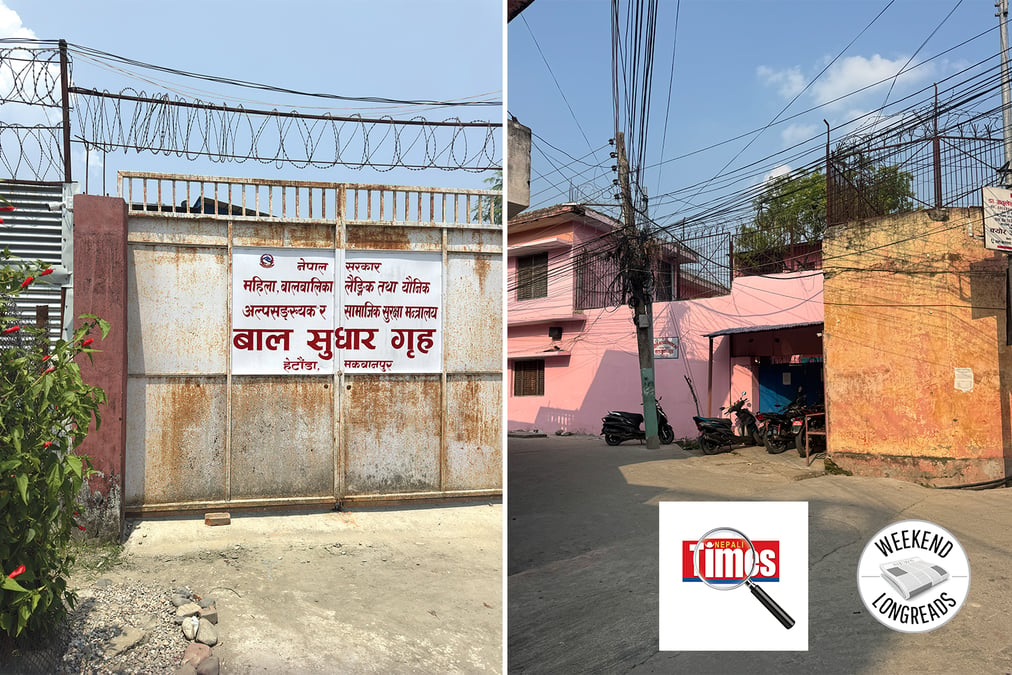
Occasionally, he peers from behind his computer to complain about government underfunding and the neglect of children. Outside the office, walls are painted pink and crowned with barbed wire.

Tikka Kafle is in charge of the Birganj Child Reform Home, one of ten institutions across the country responsible for rehabilitating juvenile offenders. Child Reform Homes are  at the centre of Nepal’s juvenile justice system, but the rehabilitation they promise remains unrealised.

The courtyard outside is too small for anyone to play in the midday sun. They remain indoors, 15 or 16 to a room where working fans are scarce. Intended for 50 residents, the facility houses 110.

“They’re fine here,” Kafle tells a visitor. “At home they wouldn’t get to eat meat and eggs like they do here — some of them even want to come back after they leave.”

Juvenile justice is grounded in the principle of rehabilitation over punishment, legal action carefully considers the age, maturity, psychology, and other vulnerabilities of underage offenders.

Nepal’s ratification of the UN Convention on the Rights of the Child in 1990 mandated the creation of a juvenile justice system. In 1992 the Act Relating to Children directed the establishment of Child Reform Homes (CRH), but the Maoist conflict delayed implementation and the first one was only established in 2001 in Bhaktapur.

The 2015 Constitution’s recognition of child rights ushered in a period of groundbreaking juvenile legislation. First, the 2018 Act Relating to Children established procedural standards, outlined oversight mechanisms, and directed institutional confinement be used only as a last resort.

Sentencing limits were set at a maximum of one year for children 10–14, half of the corresponding adult sentence for children 14-16, and two-thirds of the corresponding adult sentence for children 16-18 according to the offence.

Subsequent directives included the Supreme Court’s Administration of Child Justice Regulations in 2019 and the Rules Relating to Children in 2021. Together, these documents addressed each stage of child justice, from initial confinement, to investigation, to trial, and finally CRH standards.

UNUSED PRISONS

Unfortunately, writing laws is not the same as implementing them. Extensive guidelines governing a system intended to be child-friendly translate poorly in practice.

Despite bearing the name Child Reform Home, the makeshift facilities housing juveniles operate in unused prisons or repurposed government office buildings, not intended for residential use.

The result is constant overcrowding: the Biratnagar facility houses nearly five times its intended capacity while CRHs nationwide are 63% over capacity. Only one, in Bhaktapur, houses girls.

By law, juvenile offenders must remain in a CRH for the duration of their sentence, even after they turn 18. As of 2025, 53% of all CRH residents were 18 or older. Given the risks associated with housing adults and minors together, regulations require separate housing. But institutions that are constantly overcrowded rarely have the space to do so.

Inevitably, children are exposed to physical and sexual violence propagated by significant age disparities. Birganj, for example, houses both a 23-year-old and children as young as 12.

In Hetauda, certain juveniles will remain at the facility until their release at age 35. In some ways, peer-to-peer abuse is built into the system. Recently, without legislative approval, CRHs adopted the peer-supervision system used in adult prisons.

A three-tier hierarchy of chaukidhar, naike, and sahanaike selects inmates to perform internal management duties in exchange for respective sentence remissions. Child rights advocates have condemned the adoption of this system as a violation of the separation of juvenile justice from adult justice.

Peer-supervision implementation essentially delegates to juveniles the responsibilities of CRH administrators. Each administration is composed of a Chief In-Charge and a variable number of support staff.

Like Tikka Kafle in Birganj, most in-charges are appointed by the CDO or other sectors of government. Previous experience working with children or rehabilitation is not a prerequisite. As government employees, CRH staff are only on site from 9am to 5pm, Monday to Friday.

Outside of these hours, the homes operate without supervision, leaving residents to govern themselves. External security is delegated to police personnel who are required to remain in plainclothes and are prohibited from entering residential areas, except in extreme cases. But enforcement seems inconsistent, with police mingling freely with children at both Hetauda and Birganj.

In CRHs, ‘education’ is almost entirely self-study, and even when children receive formal teaching, many cannot advance because of the CRH’s inability or unwillingness to pay exam fees.

Like education, basic nutrition is not guaranteed. According to the 2020 Prison Rules, the government-allocated daily food allowance consists of 700g of rice and Rs80 rupees for lentils (daal) and vegetables (tarkaari). Meat is provided once every 15 days and two eggs every seven days.

Inside CRHs, it is unclear whether these guidelines mean anything and what happens to government funds. Kafle says that Birgunj juveniles manage and prepare food for themselves, and some older manned a makeshift convenience store where instant noodle packets hang from the ceiling.

Another legislative guarantee that remains unfulfilled is psychological support and counselling. Children dealing with depression, loneliness, and other disorders report a total lack of professional support.

Child psychologist Pratikshya Kafle, who serves on the bench of Nepal’s only child court in Bhaktapur says there is a tendency to simply medicate those who report mental struggles. One child housed at Bhaktapur CRH explained the cause of their ongoing issues: “The law doesn’t understand us and there is nowhere to go from here.”

In August 2023 when Bhaktapur CRH resident Kamal Basnet began to suffer from fever and boils. He was given a standard painkiller and sent him back to his room. Only upon finding Basnet unconscious on the morning did staff take him to hospital where he was declared dead.

A report on the incident and subsequent internal riots, that was blamed on the administration for its negligence and indifference to serious medical concerns. It also noted the home’s lack of adequate medical facilities.

The riots that followed Basnet’s death resulted in mass-escapes. Of those recaptured, 18 were transferred to an already over-capacity Birganj facility, infamous for unliveable conditions and extreme heat. The newcomers began protesting the conditions and were met with violence from existing residents and peer supervisors on the night.

Armed Police arrived on the scene and, unable to enter the facility, fired on the residents with tear gas. Eleven residents and three police personnel were injured.

A month later in Banke, there was a night-time clash between rival groups, composed mostly of residents over 18. One resident, Sulabh KC, was badly hurt and later succumbed to his injuries. Like other CRH incidents, the details are murky, but security forces reported an additional 11 injuries.

Despite resident transfers to a new facility in Naubasta, this deadly dispute spilled over into 2024 when members of KC’s gang took control of the CRH, chasing out staff and security personnel. It took police weeks to regain control of the facility.

In January 2026, Bhaktapur, renowned as one of the best-resourced CRHs, was the site of violence turned arson. Initially sparked by frustration over abuse and bullying,

rioters burned and destroyed facilities resulting in the evacuation of all 164 residents, who were temporarily relocated to District Police offices.

It is clear that tensions arose not just between individuals but larger groups or gangs. This behaviour stems from inbuilt peer-supervision hierarchies, whereby chaukidar assert authoritarian, often abusive, control over other residents.

Internal violence and attempted escapes occur almost exclusively at night, when no staff are on site. Unsupervised and overcrowded, CRHs are ripe for revolt and violence. Ultimately, rehabilitative care is an afterthought when basic health and safety are uncertain.

CHILD JUSTICE

Before children are sent to CRHs, a lengthy investigative and judicial process must take place. Although there is no shortage of legal guidelines governing this process, their enforcement is inconsistent.

First, within 21 days of a child’s initial arrest, a charge sheet must be filed. During this period children are to be held in special juvenile units, interrogated in a non-intimidating manner, and provided legal aid.

Parents or guardians must be present and informed, and psychosocial support provided to the child. In reality, detainment is often less hospitable. Between 2019 and 2026, Advocacy Forum Nepal documented 46 cases of torture or ill-treatment against juveniles.

“The way police beat them, it’s just like in the movies,” says lawyer Kumar Thapaliya. The judicial progress, while slow, offers cause for optimism. Eight years ago, legislation directed the creation of separate child courts for the administration of juvenile justice.

Only one, the Bhaktapur Child Court, was opened last year. The three-person bench is comprised of a judge, child psychologist, and social worker, who work together to consider familial and psychosocial factors such that the needs of the victim and the rehabilitation of the accused are addressed.

Pratiskhya Kafle and Devi Shiwakoti Pathak serve as the court’s inaugural psychologist and social worker, respectively. Kafle has a background in child-friendly city planning and counselling support for children on trial, while Pathak has worked at the Kathmandu and Dolakha district courts providing social evaluations of juvenile defendants.

Both say the judge allows them meaningful contribution in case decisions. Upon opening, the court inherited jurisdiction of all new and pending cases from Kathmandu, Bhaktapur, Lalitpur, and Kavre.

The court has been efficient, handing down 377 verdicts in the first five months of operation. Continuing at a pace of 8 to 16 cases per day, tentative plans are in place to complete all over-due cases by mid-August.

“It’s much better than before.” Says Pratiskhya Kafle, “children can even see their name on the building.”

Hearings are conducted at a roundtable rather than a conventional courtroom setting, are governed by a set of guidelines requiring the use of child-friendly language and prohibiting aggressive or intimidating actions from prosecutors.

Still, judicial willpower only goes so far. Administrative ineffectiveness means cases are processed slowly, and institutional issues are not raised with the appropriate government bodies in a timely manner. Budgetary restrictions forced Kafle and Pathak to work without salary for extended periods.

Governmental ineffectiveness is nothing new to Pathak. She compares the Ministry of Women, Children, Gender and Sexual Minorities, and Social Security, responsible for overseeing child justice and rehabilitation at the national level, to kitchari hodgepodge.

“Instead of daal bhat tarkari, they’ve mixed everything together into one,” she says. The Ministry’s name might be the giveaway.

Thapaliya also takes issue with the Ministry’s approach, criticising frequent turnover of deputy secretaries, who are responsible for overseeing CRHs. He says:  “If they stay for just one year, they won’t even begin to understand how Child Reform Homes work”.

Under the new RSP leadership, the Ministry says it is turning renewed attention towards child justice.

“These kids have the most potential,” says Nirman Rai at the Ministry. “Look at us, before we even kill a fly, we take a moment to think about it — these kids have killed a person. It’s about taking that potential and turning that from negative to positive.”

At a conference in June, Ministry officials outlined new policies to an audience of CRH administrators and other stakeholders. First, proposed legal amendments would reduce the maximum juvenile sentence length to seven years, while significantly reducing sentences for less serious offenses, such as theft. Sentence remission opportunities would also become more available.

Two additional CRHs would be established, bringing the national total to 12. Together, these initiatives would reduce the CRH resident population by half from the current 1,400. Steps are to be taken to relocate residents over 18, and they may be transferred to adult prisons if they engage in violence, abuse, or other forms of misbehavior at CRHs.

Rai says rehabilitation of the children will be addressed through a plan to establish schools in all 10 CRHs. These provisions will be included in a draft bill sent first to the Ministry of Law, then to the Cabinet, and finally to the House of Representatives for legal enactment.

Some CRH administrators express cautious optimism towards these commitments. Others are less diplomatic.

“For the past five years I have been hearing that changes will be made but nothing has happened,” says Kafle, the loudest and most frequent contributor in the room. “Sometimes we call the Ministry three times a day and they don’t pick up or call us back”.

The Ministry official suggests, “Keep calling, maybe they will get so sick of you calling and finally pick up”. It’s not clear if this is a joke.