
The #9 of 'The Worker' , the Maoist party bulletin in English carries a review of recent books on the Maoist insurgency in Nepal titled 'Proverbial Blind Men's Portrayal of an Elephant' written by a certain 'Laldhoj'. Excerpts from the review:
The year 2003 marked a watershed in the publication of numerous books and
research papers on the revolutionary movement in Nepal, both within the country
and outside. This is definitely a sign of universal acknowledgement of the
revolutionary movement as a serious political force by both friends and foes
alike. The books and publications under review, however, can be taken as
important samples representing the viewpoints of major power centers in Nepal
and abroad, particularly India and the USA.
Despite their varying strategic and political interests, all the
publications seem to have one thing in common: their empiricist method of
enquiry and presentation. As a result, they miss the 'forest' and harp about
individual 'trees' in their own narrow perspectives. This is not surprising
given their bourgeois, or at the most, revisionist or neo-Marxist outlooks.
Consequently, most of the time their assessment of the epoch-making
revolutionary movement in Nepal is a crude reminder of the proverbial blind
men's description of an elephant.
There are factual errors galore on
crucial historical events, personalities and policy decisions, some of which may
be condoned, however, for lack of access to authentic sources in an underground
revolutionary movement.
The People's War in Nepal: Left Perspectives,
edited by Karki and Seddon, is a collection of documents, articles and
interviews from the revolutionary camp, as well as from other 'left' and
revisionist groups. Relatively, the book provides a fairly objective account of
the movement, except for some nakedly motivated vituperation from such known
opportunists like Mohan Bikram Singh and Pradip Nepal. The introductory piece by
the editors is quite objective, except for some factual errors and limitations
of their own social democratic outlooks.
One of the factual errors, or
willful distortions, repeated in this book as well is the claim that the then
United People's Front, Nepal (UPFN), led by Com Baburam Bhattarai, was forced to
boycott the parliamentary elections in 1994 because of the withdrawal of
recognition to the Front by the Election Commission.
Among the other
'left' contributors to the volume, whereas Govind Neupane makes serious efforts
to construct a class analysis of the rebellion, Mohan Bikram Singh, Pradip Nepal
and Sujata Sakya thoroughly expose their own Right revisionist bias against the
revolutionary movement through lowly slander and wild canards.
Understanding the Maoist Movement of Nepal, edited by Deepak Thapa, also
provides a collection of articles mostly from a non-left perspective, but it
lacks rigor and analytical coherence, except perhaps those by A Andrew Nickson
and Kanak Mani Dixit, and of course, within their own ideological limitations.
The inclusion of a fictitious piece by some imaginary 'Maoist activist' in 'The
Maoist View' section has definitely reduced the credibility of the book.
Moreover, malicious propaganda such as 'The one factor that is
uncontested is that India is the staging ground for the Maoists of Nepal'
(p252), that too, from the pen of editor Deepak Thapa himself, seriously
challenges the objectivity of the entire exercise.
A Kingdom Under Siege
seems to be a mere extension of Understandings, though this one is a single
composite project by Deepak Thapa with Bandita Sijapati. The presentation is too
descriptive and lacks analytical depth. However, some poignant scenes like that
of 11-year-old Dilli Biswakarma feeding his two siblings, both whose parents
were killed by the police, deeply touch the sensibilities of any reader.
Maoist Insurgency in Nepal by S D Muni, who is a known hand on Nepal and
is believed to enjoy some access with the South Block, provides a fairly
accurate account of the events, except for some factual errors, and is
surprisingly not very biased against the revolutionary movement. Originally
prepared as a research paper for Observer Research Foundation in Delhi the book
should provide useful fodder for policy makers in India who seem to be pulling
in different directions at the same time.Muni's plainspeak:
'India's
image in Nepal today is that it is an ally and supporter of monarchy. India
needs to bring the Maoists and the political parties together, which, in the
process will also moderate the Maoists' extremist stance and use of violent
methods. It is this combination of the main-stream political parties and the
Maoists which can contain monarchy's powers, help India emerge as a
people-friendly neighbour and reduce the excessive influence and strategic
presence of the Western powers.' (p 66-67) Only time will tell whether it will
have any impact in the corridors of power in Delhi.
It is, however,
quite unbelievable that a research scholar of Muni's caliber should repeat such
unsubstantiated claims about the so-called 'Compact Revolutionary Zone' (CRZ)
supposedly planned by the Coordination Committee
of Maoist Parties and
Organisations of South Asia (CCOMPOSA) to link Nepal with Bihar and Andhra
Pradesh. This is just a figment of imagination by some journalists (or
intelligence agencies?), who seem to have floated the idea to instigate the
Indian state for a military intervention in Nepal. A similar insinuation was
made by Deepak Thapa in his Himal South Asia (April, 2002) article (reproduced
in Understanding the Maoist Movement of Nepal), which has since then spread like
wild fire in the pro-establishment publications of Nepal and India. The real
truth is that CCOMPOSA is a mere ideological-political platform of Maoist
parties and organisations of South Asia and has never formulated any plan or
resolution on the so-called CRZ.
Insurgency in Nepal by Thomas A Marks,
a former US government officer, well-known strategic expert and author of Maoist
insurgency since Vietnam (London, 1996), provides a glimpse of the current
thinking of the US ruling class on Nepal. Marks is unabashedly unapologetic
about his militarist thinking and his public support to the hated monarchy and
it's mercenary Royal Army. On his latest visit to Nepal in January 2004, he is
reported to have openly advocated a military solution to the so-called 'Maoist
problem' as against the near-unanimous view of other foreign powers for a
'political solution'. It is, therefore, not at all surprising that he advocates
for more military aid to the royal regime at the end of his monograph thus:
'Lest Nepal prove similar (to Colombia and southern Philippines), it is
imperative that Washington proceed with an adroit mixture of reasoned advice and
adequate material aid and training. Given the nature of the foe, the existing US
military role seems destined to increase in prominence.' (p 31-32). One is just
tempted to remind the learned author that further military involvement of the US
in Nepal may be 'destined' to repeat the ignominy of Vietnam in the 21st
century.
While going to press a new book has been received, which does
not seem to be much different from the books just reviewed.
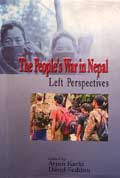 The People's War in Nepal: Left Perspectives
Arjun Karki and David Seddon (eds)
Adroit Publishers, Delhi, 2003
IRs 600
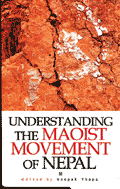 Understanding the Maoist Movement of Nepal
Deepak Thapa (ed)
Martin Chautari, Kathmandu, 2003
NRs 475
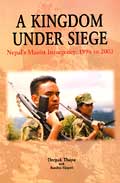 A Kingdom Under Siege: Nepal's Maoist Insurgency 1996 to
2003
A Kingdom Under Siege: Nepal's Maoist Insurgency 1996 to
2003
Deepak Thapa with Bandita Sijapati
the printhouse
Kathmandu, 2003 (price not stated)
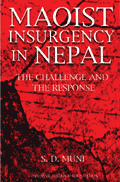 Maoist Insurgency in Nepal: The Challenge and the
Response
Maoist Insurgency in Nepal: The Challenge and the
Response
SD Muni
Rupa & Co, New Delhi, 2003
IRs 195
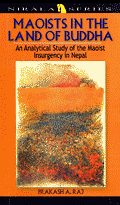 Maoist in the Land of the Buddha: An Analytical Study of the
Maoist Insurgency in Nepal
Maoist in the Land of the Buddha: An Analytical Study of the
Maoist Insurgency in Nepal
Prakash A Raj
Nirala Publications,
New Delhi, 2004 IRs 395
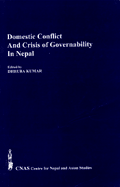
Domestic Conflict and Crisis of Governability in Nepal
Dhruba Kumar (ed)
CNAS, Tribhuvan University, 2000
Rs 525