
 NHUCHHE MAN DANGOL |
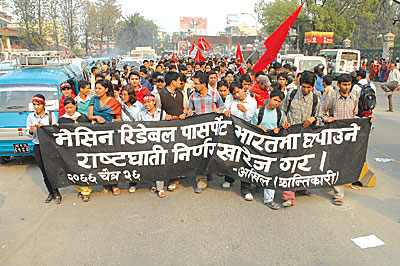
The government took the MRP decision without following rules. It defended it tooth and nail when faced with questions. Then internal pressure from UML, a parliamentary directive, a court order, and fear of Maoist protests forced it to retract.
In the process, it ended up backing out of a state-to-state deal with our most important neighbour, coming across as an utterly unreliable international partner. It was also further discredited within Nepal, and faced accusations ranging from corruption and impropriety to 'selling the country's security'.
In any other country, after such a fiasco, the government would have resigned. But that would be too much to expect from a bunch of losers with little accountability, and no moral fibre.
But the real story here is about Indian diplomacy. It is an open secret that Lainchaur helped put this government together. The embassy strengthened the Nepal-Oli combine in UML, split the MJF when Upendra Yadav began flirting with the Maoists, encouraged the NC, and pressurised TMDP to join the government instead of backing it from outside.
Since then, even as the domestic base for this government has got steadily weaker, India's backing for it has become stronger.
There is internal dissent in NC and UML. TMDP knows the longer it stays in government, the more credibility it loses in the Tarai. And even the smaller parties have become dissatisfied. But no one is quite willing to pull the rug from under the government's feet, for they fear it would antagonise Delhi. And who would want to be in India's bad books?
India decided its interests were at stake. It had the influence to determine who would control the state apparatus, and exercised it to shape the process and outcome. This is perfectly justified in statecraft.
But despite such leverage, with a government of its choosing in Nepal, why is it that India cannot even retain a government contract that it feels is important for its security?
Regimes that do not have a strong domestic popular base are perpetually insecure. They are defensive, indecisive, and constantly on the look-out to ensure that no decision they take is construed as 'anti-national'. This is especially true when that regime has, or is seen to have, strong external backing.