Climbing Mount Everest is no longer the domain of seasoned climbers. Affluent, inexperienced climbers have been seeking to ‘conquer’ the world’s highest mountain, and with the appeal of recent Hollywood movies it is likely that more novices will continue to attempt to scale Everest.
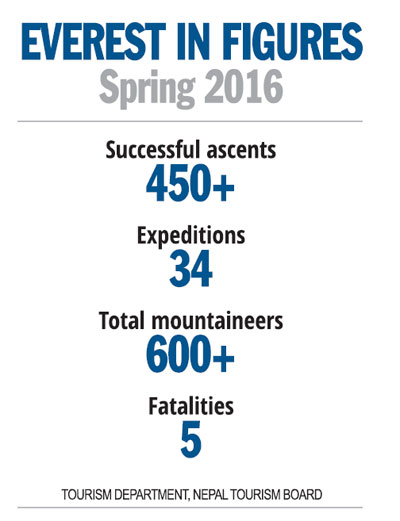
This spring’s climbing season that ended two weeks ago was the first time there were expeditions on the mountain after the deadly avalanche and earthquake in 2014 and 2015. Over 400 climbers reached the summit, and there were six fatalities that could have been avoided.
There are several lessons we must learn from this year’s expeditions:
A strong mountaineer with good technical skills in the Alps — where the highest mountain is less than 5,000 m — may not fare well on Everest (8,848 m). Climbers must note that the acclimatisation of the human body to high altitudes is not completely dependent on just gradual ascent. The physiological make-up of the individual, which is essentially genetic, also plays an important role. Over-representation of HIF (Hypoxia Inducible Factor) protein, which may be crucial ‘messengers’ in adaptation, in people of Tibetan origin like the Sherpas may be an important reason why they are such strong, agile high-altitude climbers.
A novice alpinist attempting Mt Everest should therefore scale one of the many trekking peaks of 6,000 m to gauge individual physiology at an extreme altitude. This would be time well spent before attempting to go up the world’s highest peak, and may not only help the individual climber but also boost Nepal’s mountain tourism as climbers turn their attention to other peaks in the Himalaya.
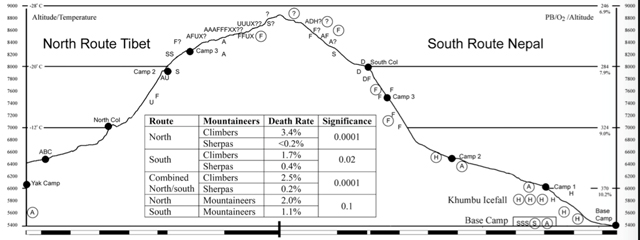
Some mountaineers died this year because they did not reach the summit of Everest early enough in the day. As statistics from the British Medical Journal of climbs from 1982 to 2006 reveal, most deaths of Western climbers occurred during descent on both the North and South routes. Many climbers who reach the top very late in the day are extremely exhausted and may be suffering from high-altitude cerebral edema (HACE), a deadly form of mountain sickness. To avoid a late ascent of the mountain, astute climbers have followed a ‘turnaround time’ of 2 pm while climbing Mt Everest. Climbers consistently underestimate the arduous task of descent, hence the fatalities. The figure also shows that many of the Sherpas who succumbed to falls or avalanches while carrying loads to higher camps did so while ascending in the Icefall area.