
|
|
Director Ashutosh Gowariker keeps great interest in history but has no qualms about flouting historical accuracy. The wiles of his filmmaking were already evident in the charming Lagaan (2001), relating rural India's espousal of cricket as a patriot's wet dream. With Jodhaa Akbar, however, mired in controversy even before the release, he is finally learning the grim responsibility of historical representation.
Rajasthan was witness to protests against the film last week, claiming that Jodhaa is the wife not of Akbar but his son Jahangir. But let us not fuss - like the modern day progenies of the virile Rajputs and their VHP cohorts - about who Queen Jodhaa really was. Gowariker's researchers may not care that the misnomer comes mainly from the spurious source of the 1960 film Mughal-e-Azam, but suffice it to say that Akbar had a Hindu queen, daughter of Rajput, Raja Bharmal, who we will temporarily call Jodhaa.
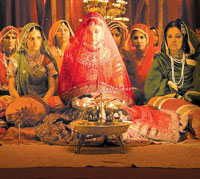
Gowariker depicts this strategic marriage as an epic love story, perhaps to evoke the distant amiability of Hindus and Muslims in India. To find a 'good Muslim', acceptable to Hindus, it is as if the film had to hark back all the way to the Mughal Akbar (played by hunky Hrithik Roshan), whose good-heartedness is to be evinced by his love for Hindu Jodhaa (Aishwarya Rai). Akbar defies Islamic mores and the baddie Imams of his court to accommodate Jodhaa, even marrying her Hindu-style. The queen, who was in reality rechristened Mariam-uz-Zamani, does not even give up her name in the film. The only concession she makes to Islam is to write Akbar's name in Urdu, which neither of them can enunciate - Akbar because he is illiterate and Jodhaa because Hindu wives are not allowed to utter their husbands names.