
Nepali Times spoke to Director General Kamal Ram Joshi of Department of Hydrology and Meteorology (DHM) about weather extremes and changing rainfall patterns. Excerpts:
Nepali Times: Is the risk of glacial lakes bursting as serious as it is made out to be?
Kamal Ram Joshi: Analysing meteorological data of the past 30 years we see that average temperatures in Nepal are rising at o.o56 Celsius per year. That may not seem like a lot, but it adds up over the decades. More worryingly, the rise in average temperature is much higher: 0.086 Celsius a year. The Himalaya is therefore more at risk from global warming.
This means 24% of our glaciers retreated between 1977 to 2010, and in many of them glacial lakes are expanding. Of total 47 glacial lakes categorised as potentially dangerous for Nepal, 21 are in Nepal, 25 in China and one in India. Since many of our rivers start in China, the impact of glacial lake outburst floods (GLOFs) is transboundary.
In the past 60 years 27 major GLOFs have been recorded in Nepal. Of them, 15 were from lakes in Nepal and 12 originated from Tibet. Lately, we have seen that even smaller unnoticed supra-glacial lakes have turned out to be a serious threat downstream – for example, recent floods in Thame of Khumbu, Namkha of Humla and Bhote Kosi in Rasuwa.
So, what can be done to reduce the risk from GLOFs?
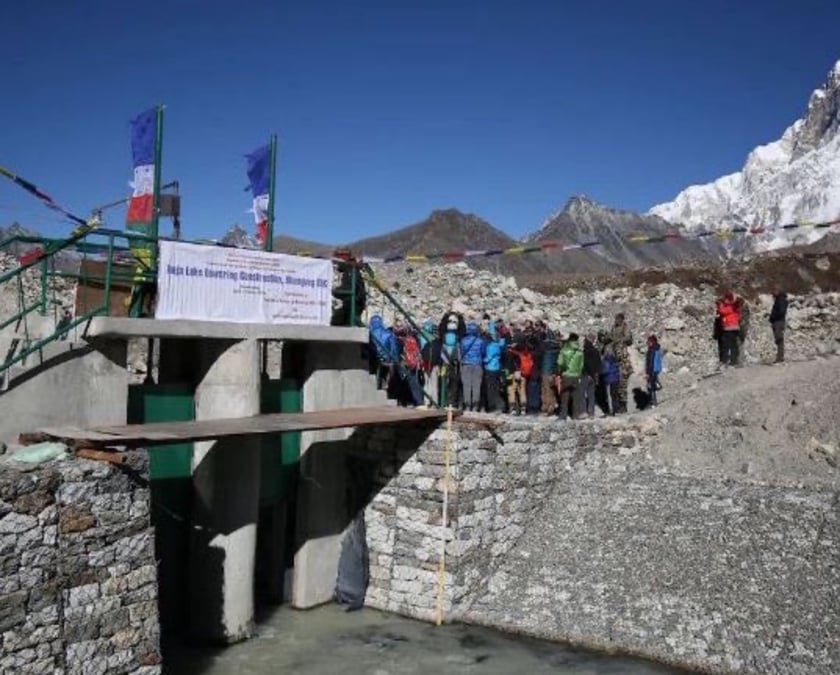
In 2000, with the support of The Netherlands the DHM lowered the level of Tso Rolpa glacial lake by 3.4m. Sixteen years later, we lowered the water level of Imja glacial lake in the Everest region. We have installed automated early warning systems in downstream areas based on precipitation data.
Based on the experience with Imja and Tso Rolpa, we proposed to the Green Climate Fund to reduce the risk of four other dangerous glacial lakes: Thulagi, Hongu 2, Lower Barun and Lumding Tso. It will cost of $50.44, GCF has approved $36.1 million with the UNDP and Nepal government co-financing it.
How easy was it to secure GCF funds?
The Imja lake lowering was with support from the Green Environment Fund, and this experience allowed us to get the GCF on board to lower the water level of four more glacial lakes. We have also prepared a national adaptation plan based on which we can approach other donors and the international community.
Does Nepal graduating from a least developed country affect access to more funds for climate adaptation?
Despite being a climate vulnerable country, Nepal has made good progress especially in the mitigating glacial lake outburst floods. India, Bhutan and China have not lowered their glacial lakes yet. Nepal has a lot of experience that it can share, for example 20 years ago we started an SMS early warning service to save lives from floods. Others can also follow our model. Lowering glacial lakes in Nepal means less risk for downstream countries.