
After months of delay, the Nepal government has appointed 13 new ambassadors to various countries from where envoys had been recalled after last year’s GenZ protest led to regime change.
Although politicians selected them, most appointees are non-political personalities with experience and education in the countries to which they have been appointed. The selection has been received positively across the political spectrum, and is a significant departure from how previous governments chose political favourites with little qualification for their posting.
The long-delayed nominations came just before Prime Minister Balendra Shah’s departure for New York to address the United Nations General Assembly on 23 September, a month after the catastrophic Bhote Kosi-Trisuli flood.
This is the first time in Nepal’s history that ambassadors have been selected from applicants who responded to the government’s vacancy appointment, in keeping with the RSP government's commitment that envoys would be chosen on merit.
The government says the delay was because there were nearly 4,500 applicants, which were narrowed down to 2,700 from which the 13 were chosen. However, insiders in government said the announcement process was hampered by attempts to reconcile lists favoured by the Prime Minister’s Office and the Ministry of Foreign Affairs.
Interestingly, none of those named on Friday are career diplomats from the Ministry of Foreign Affairs, although eight more nominations remain for vacant missions abroad. Sources said they will be announced after Foreign Minister Shishir Khanal returns from New York in two weeks.
Until last year, Nepal had 34 embassies and 10 consulates around the world. After the GenZ protest led to the formation of the interim government headed by former Chief Justice Sushila Karki, 12 ambassadors were recalled. When Prime Minister Shah assumed office after the March election six more ambassadors were asked to return.
Nepal is also closing down its embassies in Denmark, Brazil and South Africa, as well as the consulates in San Francisco and Chengdu. As many as 17 Nepali missions abroad had been without ambassadors for the past year. This void was felt most acutely after the new government came to power, especially following the 26 August flood disaster as Nepal pushed the climate justice agenda.
Prime Minister Shah’s address to the General Assembly is expected to make a strong case for international assistance to Nepal to deal with emergency needs for the estimated 30,000 people directly affected by the disaster, as well as longterm rehabilitation, relocation and reconstruction needs.
Nearly 1,400 bodies have so far been found, but over 6,100 people are still missing. Nepal estimates the economic cost of the disaster at $4.8 billion, with the largest portion being the destruction of 13 hydroelectric plants along the Trisuli basin.
Although the Cabinet announced the ambassadorial nominations, the appointees will still have to sit through a special hearing of a Parliamentary Committee before the Minister of Foreign Affairs sends the nominations to the various countries. However, those two processes are expected to be formalities.
GENDER BALANCE
Of the 13 ambassadors named, most are academics, professionals and experts in their fields. Care seems to have been taken to match their university education and expertise with the countries they will serve in. There also appears to have been some attempt at gender balance with four of the 13 envoys being women.
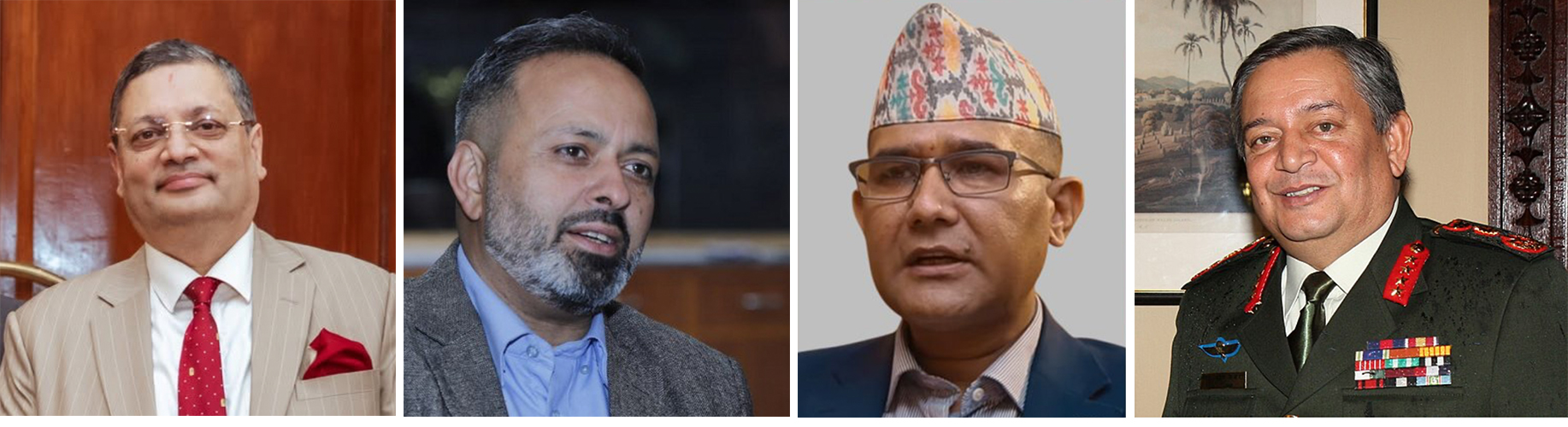
For example, Nischal Nath Pandey, the ambassador designate for India is an international relations expert serving in foreign policy think tanks, and is the son of Ramesh Nath Pandey who served as foreign minister during King Gyanendra’s rule till 2006.
The nominee for China, Kalyan Raj Sharma did his PhD from Fudan University and speaks Mandarin. Chiran Jung Thapa, selected as ambassador to the United States did his masters in international relations at Columbia University in New York and also completed a security course at Harvard’s Kennedy School.
Gaurav SJB Rana, chosen for the UK, attended the Sandhurst military academy and was the Nepali Army chief during the peace process after 2006. He has attended the Royal Military Academy Sandhurst, the US Army Command and General Staff College at Fort Leavenworth, and has also served in UN peacekeeping operations in Lebanon.
Other nominations include: Jigyan Kumar Thapa (Tokyo, studied in Japan), Suresh Kumar Karna (Israel), Manchala Jha (Sri Lanka), Prapti Sherchan (Spain), Padmakshi Rana (Oman), Giri Bahadur Sunar (Saudi Arabia), Sargam Shrestha (South Korea), and Chudamani Kharel (Malaysia).
Many of the appointees have international experience serving in development organisations or the private sector. From their social media posts, some candidates appear to have strong ties with the RSP and actively campaigned for the party in the March election.