

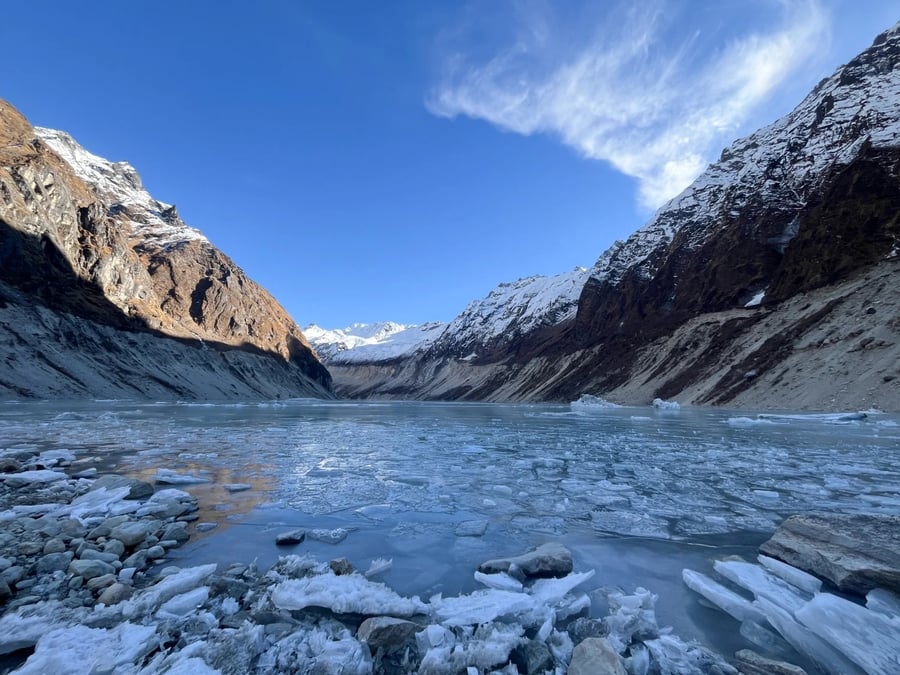
The 26 August climate-induced ice-rock avalanche in the Himalaya triggered a catastrophic debris flood along the Trisuli Corridor, killing thousands and destroying critical infrastructure. It shocked Nepal and stunned the world.
It also propelled Nepal to take the climate crisis and climate justice far more seriously, both domestically and internationally. Prime Minister Balendra Shah devoted his address to the UN General Assembly exclusively to climate justice.
Also at the UN, Foreign Minister Shisir Khanal hosted the Sagarmatha to the Sea: A Call to Action for a Climate-Resilient Future, and highlighted climate justice at the ministerial meetings of the Least Developed Countries, Landlocked Developing Countries, the Non-Aligned Movement, and the Group of 77 and China. He also raised the issue at the pre-COP 31 leaders’ event in Fiji and Tuvalu.
Finance Minister Swarnim Waglé is leading efforts to mobilise international solidarity and support for post-disaster recovery that is estimated to cost $5 billion.
Nepal is calling for international solidarity with all climate-vulnerable developing countries that contribute little to greenhouse gas emissions but suffer disproportionately from their effects. It is well placed to assume a leadership role on behalf of the world’s high-mountain regions, small islands, and coastal states.
Regrettably, despite mounting scientific evidence and disasters the current international climate is not conducive to action. Political leaders in many wealthy and powerful countries that have contributed substantially to global warming continue to deny the climate crisis or resist the measures needed to address it. Their support for long-term climate finance has been woefully inadequate.
Many wealthy and powerful countries are reducing overseas development assistance and increasing military spending. It is therefore difficult to expect a dramatic breakthrough in climate finance in the next few years.
The climate crisis, however, will not go away, it is likely to intensify and pose an existential threat to communities and countries around the world.
I recommend this 10-year strategy to strengthen Nepal’s leadership, build partnerships and establish Nepal as a serious and influential player in international climate negotiations.
1. Domestic Action
To be credible in its global advocacy, Nepal must demonstrate that it is doing everything within its capacity to respond to the climate crisis. Nepal already has an impressive community forestry program, promotion of electric vehicles, greater use of renewable energy and a range of mitigation and adaptation measures.
Its National Adaptation Plan for 2021–2050 and its Nationally Determined Contributions set out ambitious targets in agriculture, water resources, energy, forestry, biodiversity, and human health. Nepal is committed to achieving net-zero carbon emissions by 2045.
Nepal should assemble a strong official delegation for the forthcoming COP31 and other fora, drawing on highly qualified experts not only from government but also academia and civil society. Members of the Nepali team should agree on a common set of national messages and speak with one voice in international forums.
Nepal should also strengthen domestic disaster-risk financing with more robust insurance schemes to protect private property and public assets, including hydroelectric plants. Urban, regional, and spatial development need reforms to counter rapid but poorly planned settlement growth and infrastructure development along snowed rivers. Some settlements will need to be relocated to safer areas, this could be costly and potentially controversial.
Nepal should aim to build a more disaster-resilient nation with holistic resettlement plans, ensuring access to jobs, schools, health care, transport, and other essential services.
2. Regional Action
As Prime Minister Shah observed in his UNGA address, rivers do not stop at borders, glaciers do not carry passports and floods do not need visas.
Nepal is advocating for a Himalayan Climate Resilience Mechanism to strengthen joint early-warning systems, share scientific and satellite data, exchange technical expertise, monitor dangerous glacial lakes, and coordinate cross-border assistance. The mechanism could initially bring together China, India, and Nepal, then include all countries of the Hindu Kush Himalaya and High Mountain Asia. The Kathmandu-based International Centre for Integrated Mountain Development (ICIMOD) could help convene and institutionalise such a mechanism.
3. Global Advocacy
Greenhouse gas emissions and wildfires affect sea levels, rainfall patterns, extreme weather, permafrost thaw and the melting of icecaps across the world. The crisis demands concerted global action guided by the principle of common but differentiated responsibilities and respective capabilities. Those that have historically contributed most to the problem and those with the greatest capacity to respond must do more.
Nepal should collaborate with leading universities specialising in climate science and policy, as well as research networks such as the Asian Mountain Academic Alliance to sharpen its negotiating positions.
Given uncertain prospects for substantial increases in the Loss and Damage Fund and other climate-finance mechanisms, including the Green Climate Fund and the Global Environment Facility, Nepal should work with least developed, landlocked and small island states to promote debt swaps for climate action.
4. Nepal in the COP Process
Nepal has had a prominent voice in recent climate summits, championing the Mountain Agenda and drawing attention to the effects of rapid glacier melt and extreme weather on Himalayan communities. It chaired the LDC negotiating group at COP18 in Doha and, in more recent COPs, has advocated for climate finance, Loss and Damage, direct access to climate funds, adaptation resources, and support for vulnerable, low-emitting mountain countries.
Nepal was particularly active at COP26 in Glasgow in 2021, where it presented updated NDC targets, emphasised its commitment to carbon neutrality by 2045, and called for direct climate finance for mountain regions vulnerable to glacial melt and extreme weather. At COP28 in Dubai in 2023, Nepal strongly supported operationalising the Loss and Damage Fund, highlighted climate-induced disasters in the Himalaya, and presented its $47 billion NAP roadmap.
Nepal is preparing to engage actively at COP31 in Antalya, Türkiye, next month. At a Pre-COP Leaders’ event in Fiji in October 2026, Nepal proposed a new international climate partnership linking the Himalaya with vulnerable Pacific Island states. The aim is to build a common front among mountain and ocean countries.
Nepal’s Minister of Agriculture, Forests and Environment, Gita Chaudhary, is attending the UN Biodiversity Conference in Yerevan before COP31. Armenia and Kyrgyzstan could therefore be natural partners with Nepal at COP31 and beyond in highlighting the particular needs of landlocked, mountainous developing countries.
Nepal should also seek a strong partnership with the Alliance of Small Island States, the main negotiating bloc representing 39 small island and low-lying coastal developing states. It should support AOSIS priorities at COP31, including pressing major greenhouse-gas emitters to accelerate emissions cuts to keep global warming to 1.5°C, securing rapid, direct-access funding through the Loss and Damage financing mechanism for vulnerable island communities, and accelerating the shift from fossil fuels to renewable energy. In return, Nepal should seek explicit recognition of vulnerable mountain communities alongside island communities in relevant funding and policy priorities.
Nepal should mobilise its embassies in relevant countries to explain its priorities and advocate for them with governments and other influential stakeholders. Because Nepal does not have diplomatic missions in many small island states, its missions to the UN in New York and Geneva should take a lead in building partnerships with those countries.
5. Preparing for COP31 and Beyond
Nepal should advocate for a much better-resourced Loss and Damage Fund so that vulnerable countries can obtain more adequate support when future disasters strike, as they inevitably will.
Nepal should also propose a dedicated window for the rapid allocation and disbursement of funds when sudden, catastrophic events hit high-mountain countries. Such countries are particularly exposed to glacial outbursts and ice-rock avalanches that can cause extensive loss and damage downstream.
6. Hosting COP38 in 2033
The next possible opportunity for an Asia-Pacific country to host a climate summit would be COP33 in 2028. Several countries in the region have already expressed interest. A two-year preparation period would be unrealistic for Nepal. However, COP38 in 2033 would be a feasible and potentially transformative goal, allowing seven years to prepare before the Asia-Pacific region’s next expected turn.
The year 2033 would be especially meaningful because it marks the 80th anniversary of the first successful ascent of Mount Everest by Nepal’s Tenzing Norgay and New Zealand’s Edmund Hillary in 1953. Nepal could designate 2033 as ‘The Year of the Himalaya’ and present it as a ‘The Himalayan COP’. The outcome of COP38 could be framed as ‘The Himalayan Compact for Climate Justice’.
Nepal should announce its ambition and begin lobbying at COP31 in Antalya where a decision on the Asia-Pacific host for COP33 is likely to be made, and competition may be intense. Nepal could use its support for a COP33 host candidate as an opportunity to seek reciprocal support for Nepal’s COP38 bid. Beginning diplomatic outreach early would improve Nepal’s prospects and give it time to build support before any competing bids emerge.
The main reservation about selecting Nepal to host COP38 will likely be its current logistical and organisational capacity, including whether it can provide adequate facilities within the required timeframe. Nepal’s response should be to transform Kathmandu, Pokhara, Lumbini, and the Mount Everest region, into world-class international conference destinations in the next seven years.
The UNFCCC Secretariat’s formal COP preparation process typically takes about 18–24 months. It includes fact-finding and technical missions, followed by detailed planning for venues, transport, accommodation, security, and other arrangements. This process assumes that the host country already has - or can quickly develop - the necessary underlying capacity.
Once member states have reached agreement in principle on Nepal’s proposal to host COP38, Nepal should ask the UNFCCC Secretariat to begin its fact-finding and technical assessment well in advance. Rather than building a vast temporary ‘COP City’, Nepal should use COP38 as the target date for a seven-year national modernisation program demonstrating climate resilience and low-carbon design. The hosting arrangements themselves should become an example of enlightened climate action.
The country most vulnerable to Himalayan climate change would not merely be asking the world to talk about climate resilience. Nepal is demonstrating it.
7. A Road Map
2026–2027: Diplomatic groundwork to secure the right to host COP38
Establish a national COP38 task force
Consult Asia-Pacific countries and begin a diplomatic advocacy campaign
Develop a preliminary master plan for potential venues in Kathmandu, Pokhara, the Everest region, and possibly Lumbini
Engage the UNFCCC Secretariat on early fact-finding, technical missions, and venue assessments, and work toward a Host Country Agreement at the appropriate stage
2028–2029: Infrastructure planning
Select sites for conference facilities.
Expand convention capacity.
Ensure adequate hotel and other accommodation capacity.
Plan airport improvements.
Develop an integrated transport master plan.
Strengthen digital infrastructure.
Prepare comprehensive security plans.
2030–2031: Construction and implementation
Build or upgrade the main convention complex.
Develop temporary and permanent exhibition facilities.
Expand accommodation capacity.
Improve public transport, roads, and utilities.
Upgrade waste-management infrastructure.
Expand renewable-energy systems.
2032: Full-scale testing
Nepal should proactively host several major international events as dress rehearsals, including:
A Sagarmatha Sambaad
Climate-related preparatory conferences for mountain countries, LDCs, LLDCs, and other partners
Major Asia-Pacific conferences organised
Large tourism and convention events
2033: Everest 80 + COP38
By 2033 Nepal should have spent several years building an international coalition of mountain countries, LDCs, LLDCs, SIDS, and other climate-vulnerable developing countries facing Loss and Damage. Nepal would be better placed to present a coherent and compelling case for climate justice.
The Himalaya provide water and sustenance to nearly two billion people across more than a dozen Asian countries. Climate impacts therefore connect mountain systems to downstream populations and the world’s oceans. The coalition’s geographic narrative would be powerful and easy to communicate: Mountains → Rivers → Plains → Oceans.
Nepal’s climate diplomacy should have a multi-year legacy agenda rather than making COP38 a one-off event. The summit could become a milestone in Nepal’s journey toward climate resilience and recognition as a global leader championing climate justice for vulnerable countries.
8. Potential Constraints
Nepal will face significant challenges in realising this ambitious vision:
Sustaining political commitment
Maintaining continuity in leadership and management
Ensuring effective coordination
Securing adequate funding
Engaging young professionals, climate scientists, and civil society
If Nepal can summon the political will to address these challenges, it can aspire to lead a concerted national and global effort for climate justice. A carefully prepared bid to host COP38 in 2033 would turn Nepal’s acute climate vulnerability into a source of international leadership. The goal should be not simply to host a major conference, but to help secure lasting progress toward climate resilience and climate justice for Nepal and for vulnerable communities around the world.