
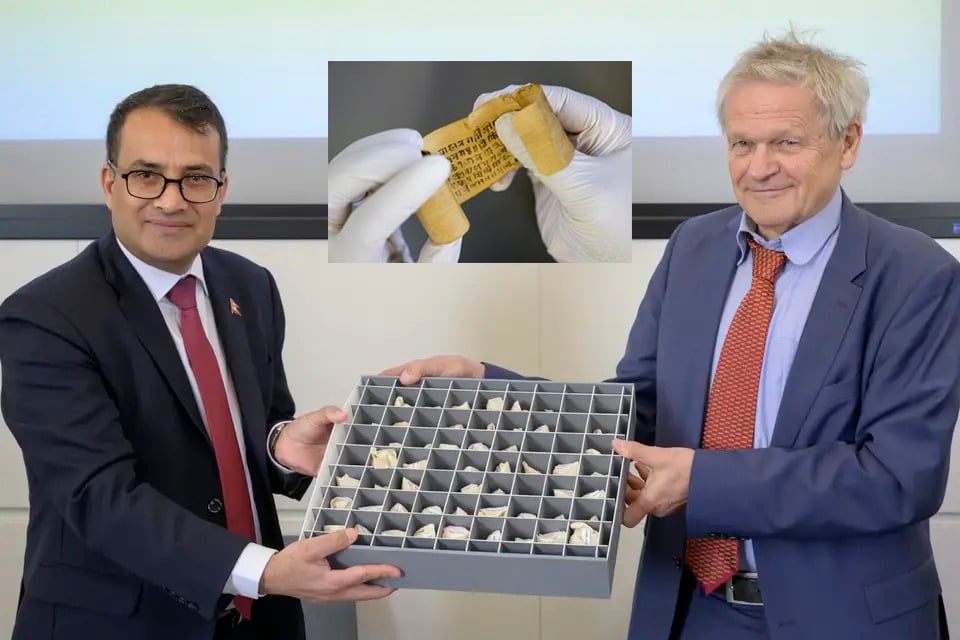
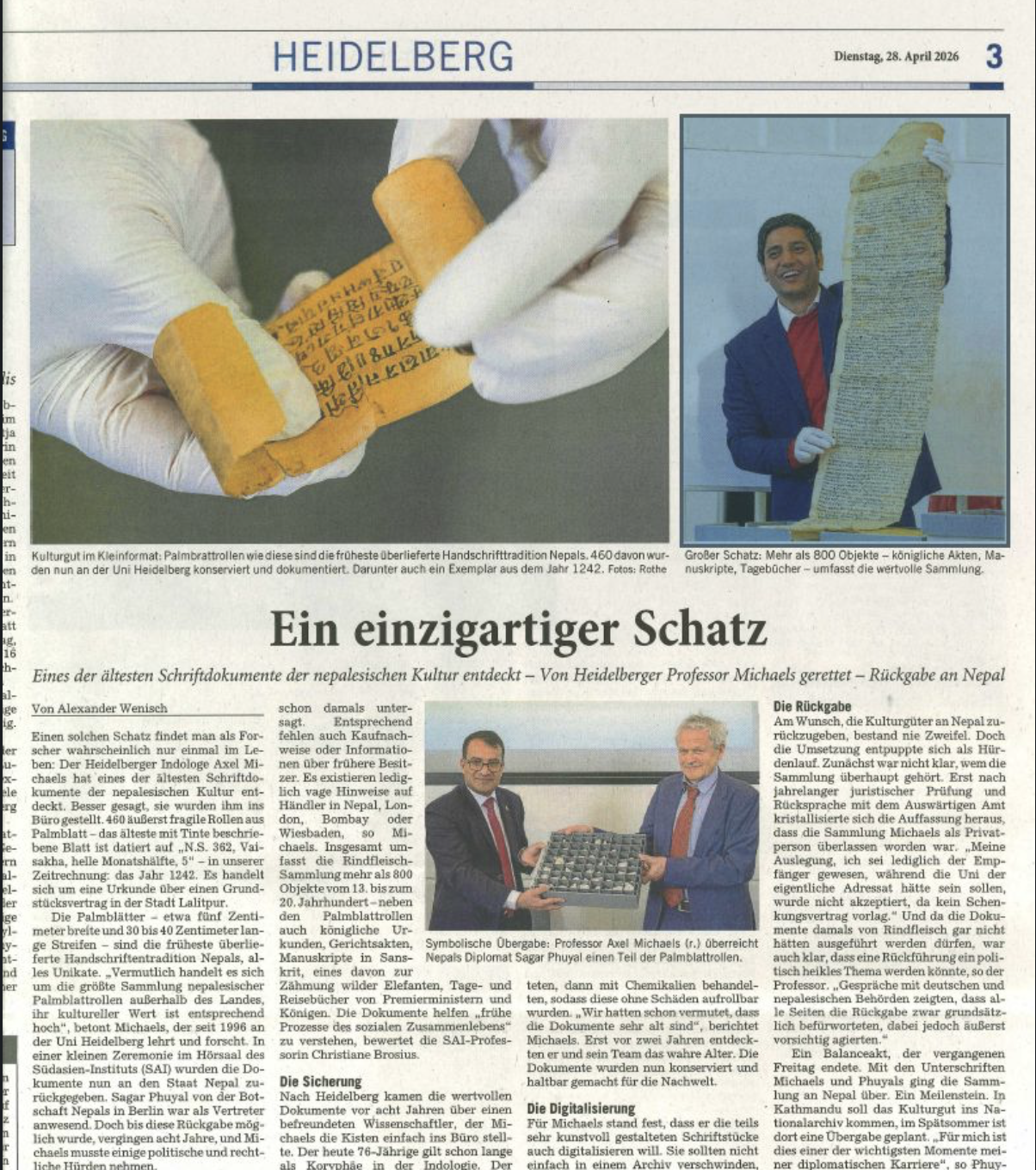
German academics handed back to Nepali officials the first of 800 rare archival documents during a ceremony in Heidelberg this week.
The trove of ancient manuscripts from Kathmandu were in the collection of Bavarian collector Josef Peter Walter Rindfleisch who had acquired them between 1980-2000, and had been previously entrusted to the Indologist Axel Michaels of Heidelberg University with the explicit aim of eventual repatriation.
Scholars say the holdings which include 465 Newari palm-leaf scrolls, most of them bearing clay seals and dating to the Malla period in Kathmandu 1200-1779 CE, are one of the largest collections of Nepali palmleaf rolls outside Nepal.
“This collection offers a unique window into Nepal’s political, legal, and religious history across several centuries,” said Alex Michaels, who heads the Documents on the History of Religion and Law of Pre-modern Nepal project at the Heidelberg Academy of Sciences and Humanities.
The archive also includes royal decrees, court records, Sanskrit manuscripts, and a wide range of historical materials from legal documents and ritual texts to photographs, maps, and personal writings. The collection includes 15 bound volumes that record palace life, state expeditions, and official correspondence from the 19th and early 20th centuries.
When the manuscripts first arrived in Heidelberg, their provenance was only partially documented, and many items were in poor condition. Mould, insect damage, and earlier repair attempts had left visible traces. Conservation specialists restored the items by humidifying the fragile palm-leaf scrolls, carefully opened, cleaned, repaired, and digitised before being rolled again and placed in acid-free archival storage.
The project was supported by the Transforming Cultural Heritage initiative, enabling systematic cataloguing and digitisation and is now accessible online via Heidelberg University Library and integrated into the Documenta Nepalica research database. An open access catalogue of metadata of the collection will soon be released from Heidelberg University Publishing.
Manik Bajracharya and Rajan Khatiwoda, scholars of the project were at the handover ceremony on 24 April, as well as Prof Christiane Brosius, a researcher at the Heidelberg Center for Transcultural Studies which systematically records endangered cultural assets in Nepal—such as temples, monasteries, palaces, and inscriptions—and makes them digitally accessible.
Marc-Philippe Weller, Vice-Rector for International Affairs and Diversity, and Prof Hans Harder, Director of the South Asia Institute also spoke. With the handover, a substantial body of Nepal’s written heritage will be returned home – preserved for future generations, yet accessible to researchers around the world.
For Alex Michaels, the dual approach of digital access and physical return was essential. “Making the materials available worldwide is one goal,” he said. “But returning them to Nepal is equally important. It acknowledges their cultural significance and our responsibility toward their history.”
In Nepal itself there was generally positive reaction to the news, as it follows a series of returns of Nepal’s stolen religious artefacts from the United States and Europe in recent years. However, there were some voices saying the rare scrolls may be safer if Germany kept them.