
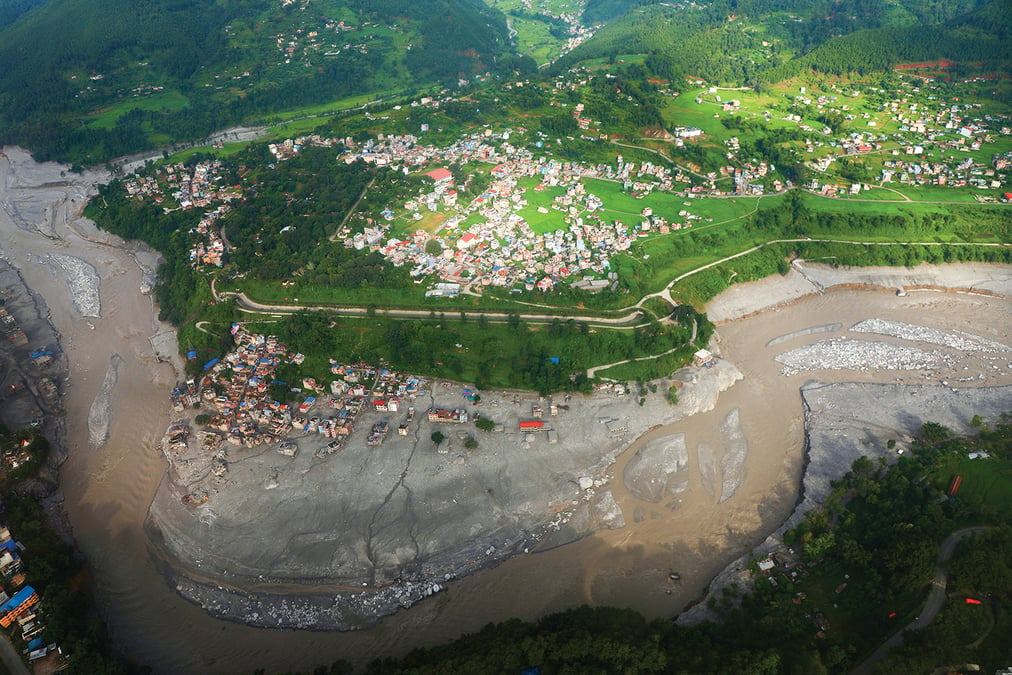
This Saturday it is exactly one month since the catastrophe on the Bhote Kosi-Trisuli. The death toll in Nepal and China is exceeding 8,000.
One month on, only 110 of the 1,450 recovered bodies have been positively identified and handed over to families.
On Friday morning, Prime Minister Balendra Shah delivered his address to the UN General Assembly where he reminded the world of what befell his nation.
Secretary-General António Guterres mentioned the Nepal disaster in his speech in the context of climate breakdown. But international memory is short, and easily distracted by wars and calamities elsewhere.
The geopolitical climate is not quite right for climate justice. We can raise concerns, but not have unrealistic expectations that rich nations will suddenly develop pangs of guilt about their historical emissions.
It would have been useful for our prime minister after flying all that way to stay longer for the New York Climate Week, and highlight how despite being in the least-developed category, Nepal has done its bit to expand carbon sinks, ensure 100% renewable energy and promote electric transport.
The prime minister is to visit India in November to clear the air with New Delhi. Indian investment in current and future river projects in Nepal will loom large.
Three Indian hydropower projects are being built along the Arun River in a cascade. They are exposed to a domino effect similar to one that hit the Trisuli basin last month that swept away 13 plants. The Arun projects will generate up to 3,000MW in the coming years, nearly 80% of it for export to India.
The Indian parastatal investor must have seen how a glacial lake outburst flood in Sikkim in October 2023 breached the Chungthang Dam reservoir, sending a debris wave down the Teesta River.
A dam that generated 1,200MW and took six years to build at a cost of $1 billion was destroyed in seconds. Similarly, two major hydropower plants were destroyed in the Chamoli flood in Uttarakhand in 2021.
The Arun River originates in China and has the highest mountain in the world in its catchment. It is fed by glacial lakes that are rapidly expanding. A megaquake in southern Tibet could cause these lakes to burst simultaneously, unleashing a catastrophic flood downstream.
RESETTLE, RELOCATE
Here in Nepal, the most urgent need is to care for the 30,000 people who have lost relatives, homes and livelihoods. Many have now spent a month in shelters. The government has identified locations in Rasuwa, Nuwakot and Dhading for survivors.
Families do not just need resettlement, they need safer places, a community and jobs to go back to. People from three villages in Rasuwa that were destroyed in the 2015 earthquake were resettled along the banks of the Trisuli. Many of the 1,400 who survived the earthquake were swept away by last month’s flood.
Nearly 500 children have lost one or both parents, they need counselling, homes and schools. Getting them back to classrooms is the quickest way to restore their routine.
Nearly 14,000 people were rescued through prompt action by the security forces, including from hydropower tunnels which has been the biggest challenge. The Prime Minister’s Relief Fund has received Rs15.06 billion so far, and need-based cash handouts could be the fastest way to get families back on their feet. This is an urgent need, and should not be mired in bureaucracy.
Despite delays and hiccups, the RSP government has been more diligent than previous ones in immediate response. We would have liked to see less grandstanding on social media by some officials, but such stunts come with the territory.
Nepal has not had a break from calamities, political and otherwise, since 1990. We have always bounced back, but that is not the same as having learnt from them. Dasain is a month away, and in characteristic Nepali fashion we could fall back on our legendary apathy and fatalism.
How wisely the RSP government responds to this catastrophe will define its legacy more than anything else.