
There is heightened expectation in New Delhi that the government of Prime Minister Sher Bahadur Deuba will heed its concerns about consensus-building on the Constitution and addressing the grievances of the marginalised, especially the Madhesis.
India backed the power-sharing pact and used subtle diplomacy to persuade Deuba’s predecessor, Pushpa Kamal Dahal, to stick to his agreement to step down in nine months and not break with the NC to seek UML support.
This is being interpreted here as the “right move” on the part of the Maoist chief, who until recently did not enjoy the best of relations with New Delhi. He visited India twice during his tenure and assured the Indian leadership of his commitment to push for a constitutional amendment, an issue which had disrupted bilateral ties and led to the Blockade of 2015-16. The Indian establishment will seek from Deuba a similar assurance on the amendment.
Deuba’s immediate challenge, as perceived here, is to keep the coalition intact and subsequently conduct local, provincial and national level elections by January 2018. But there is concern that the rift within the NC rank and file could derail the transition process.
“Deuba is in an unique position to address the issues confronting the Madhes and hold elections by bringing everyone together even if that means postponing the second phase. Otherwise, there will be deepening conflict in the Tarai, even the rise of secessionism,” one academic here said.
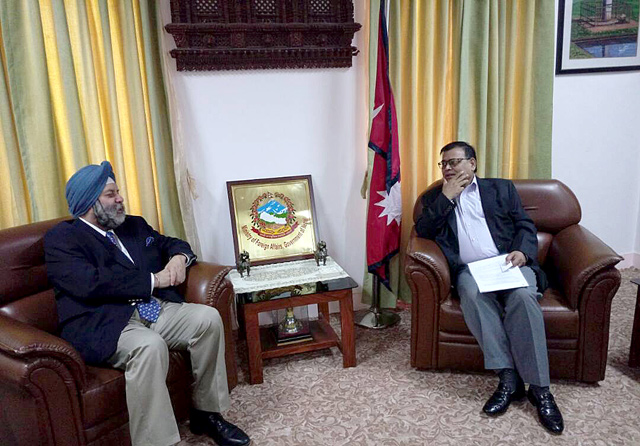
Deuba underlined three priorities after taking office last week: implement the Constitution, accommodate Madhesi groups and push development. Since then, his government has had four bilateral dialogues with the Indian side: Indian Prime Minister Modi called to congratulate him immediately after he took over, External Affairs Minister Sushma Swaraj spoke with her counterpart, and the Indian Ambassador in Kathmandu, Manjeev Singh Puri met Deuba and his Maoist Foreign Minister Krishna Bahadur Mahara this week (pictured).
Sources here say that they were given “credible assurances” the Madhes-based parties can be persuaded to take part in elections since the Maoists and NC together can muster support in Parliament to push for amendments. India will also urge Deuba to implement the three-point agreement between the SLMM and other parties signed in August 2016, just before Dahal took office.