
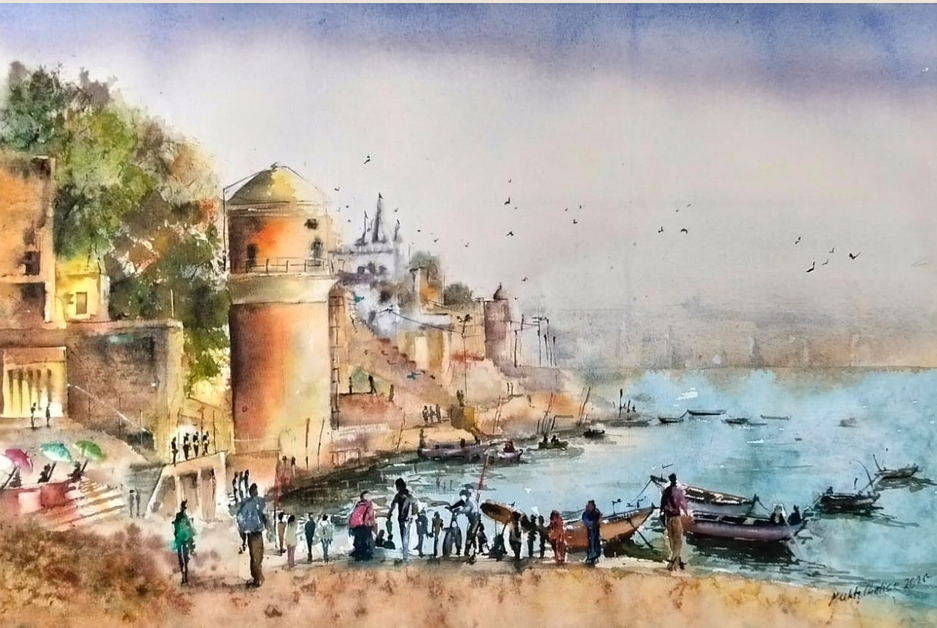
Long before what we know today as Varanasi, the sacred city was called Banaras, a name that has travelled through Sanskrit and Pali into colonial English.
Whatever it is called, this pilgrimage site on the banks of the Ganga is one of the oldest continuously inhabited cities in the world. Also called Kashi, the ‘city of light’, it has been a holy destination for millennia drawing pilgrims, intellectuals, and philosophers.
The steps leading down to the river have remained a hallowed place of worship, celebration, and cremation — life and death unfolded on the ghat for denturies.
Many Nepali rulers, from Newa kings of Kathmandu Valley to the Shah and Rana rulers made their way to Banaras throughout history, some on pilgrimage and others as political exiles. The city gained a new dimension with the founding of Banaras Hindu University (BHU) in 1916, which became a centre of education, spirituality and politics for many Nepalis as well.
An ongoing exhibition at Kathmandu Art Gallery, Homage to Banaras, brings together two generations of Nepali artists whose lives have been shaped by this city and its history. Nineteen students from Lalitkala Campus exhibit artwork inspired by a visit to Banaras, while alumni of BHU contribute their work.
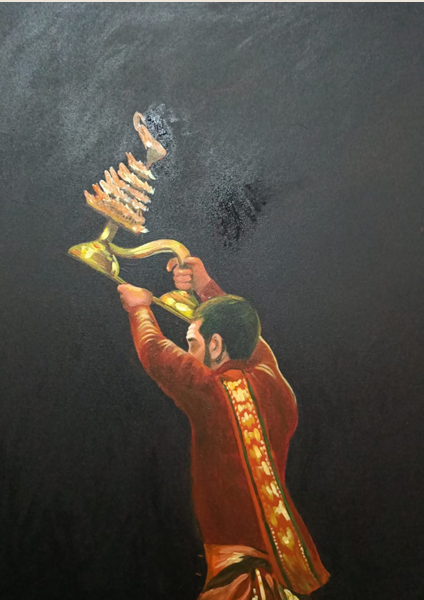
For the student artists, the exhibition is a way of expressing their emotional affinity toward the city, each arriving at it through a different personal experience. Bipin Chhetri, a multi-genre artist, focused on the Ganga Arti ceremony during the trip, capturing its sacred daily evening ceremony on the banks of the Ganga.
The ghat form the foundation of Mukti Chalise's watercolours, a painter absorbed in capturing the effect of light and atmosphere on the river. He uses transparent washes and expressive brushwork to convey the essential character of his subject — the movement of water and boats in constant flux. His mastery of stillness and movement allows him to depict a city for which the river is a venerated vein.
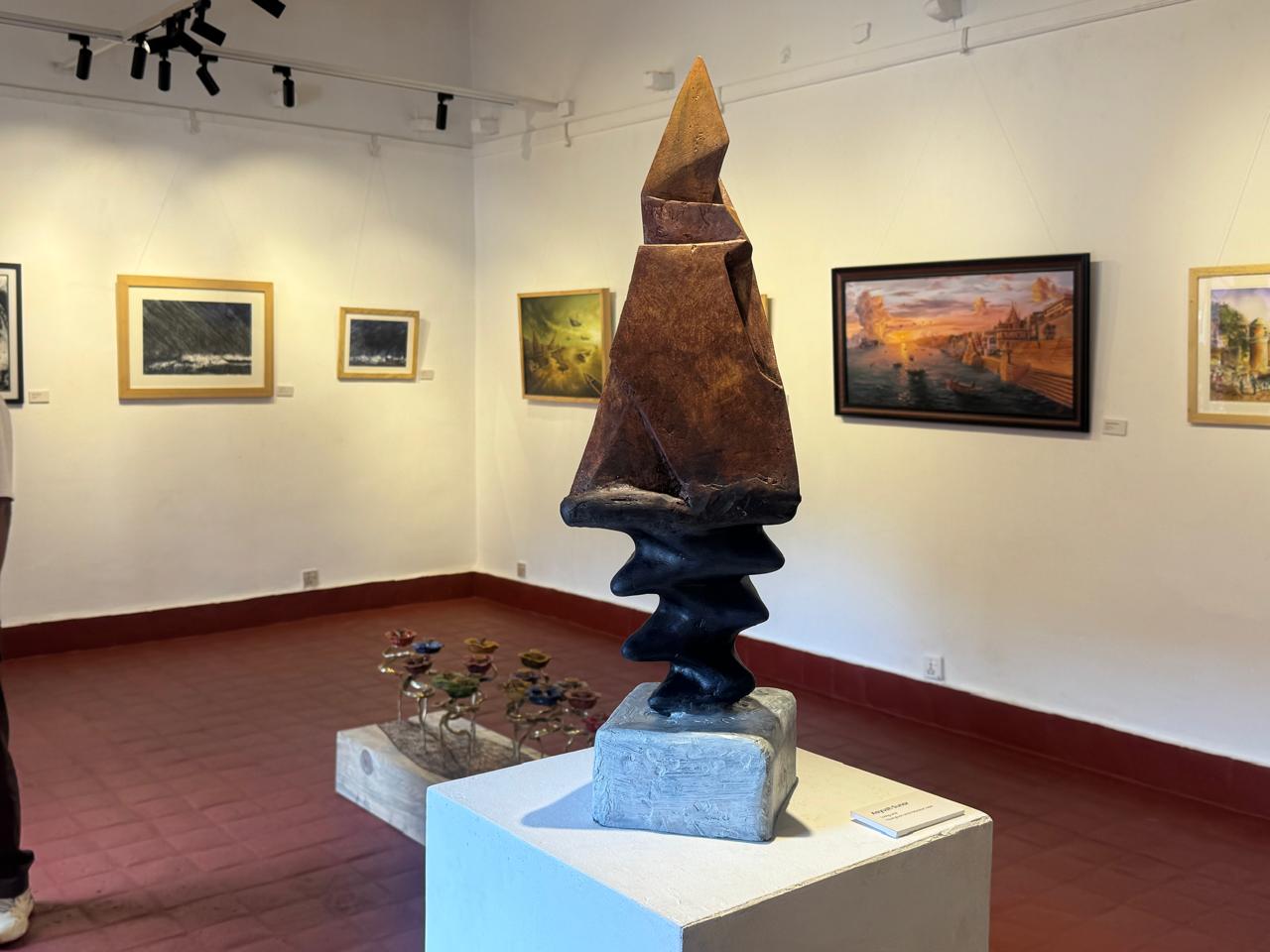
Ayush Sunar also captures the river, but in wood to depict a place where rest is not possible. The result of this sculptural practice is not a single, settled entity, but a question of what remains once the restlessness has ceased.
Pratibha Tiwari paints boats as her central motif, seeing in them witnesses to everything the city has undergone. Each boat becomes an eye-shaped lens floating on the water's surface, carrying centuries of life's celebrations, rituals, sufferings, prayers, and burials. There is no judgment, just the ghats and boats themselves have silently done for centuries.
Aashish Poudel, Arjun Basnet, Dasharath Bhatt, Henjilee Limbu, Kajal Kumari, Manish Shrestha, Parwati Dulal, Pramila Sunuwar, Prashamsa Shrestha, Pratiksha Tiwari, Prativa Khadka, Ranjit Kunwar, Sugam Baralie, Sunil Harijan, and Tshering Tamang also exhibit work under the guidance of professors from Lalitkala Campus, Agam Shrestha and Sangeeta Ghimire.
The second group of works is from a generation returning to Banaras — not for the first time, but, in some cases, as artists recalling a place they never truly left. Many alumni of BHU have shaped the city in their own ways.
The late Karna Narsingh Rana, one of the earliest artists to bring his BHU training back into Kathmandu's developing art scene, and the late Surendra Bhattarai stand at the start of this lineage. Sculptors Pravin Kumar Shrestha, Hridaya Ballav Pandey are also featured.
Kiran Manandhar completed his Master's in Fine Arts in Painting at BHU and became one of the pioneers of expressionism in Nepal — his spontaneous brushwork and rich palette have been influenced not only by Kathmandu but by Varanasi as well.
Uma Shankar Shah completed both his Bachelor's and Master's in Printmaking at BHU, and creates oil paintings and prints centred on temples, deities and ritual. His wife and fellow BHU graduate, Seema Sharma Shah, focuses her work on Banaras, where she was born.
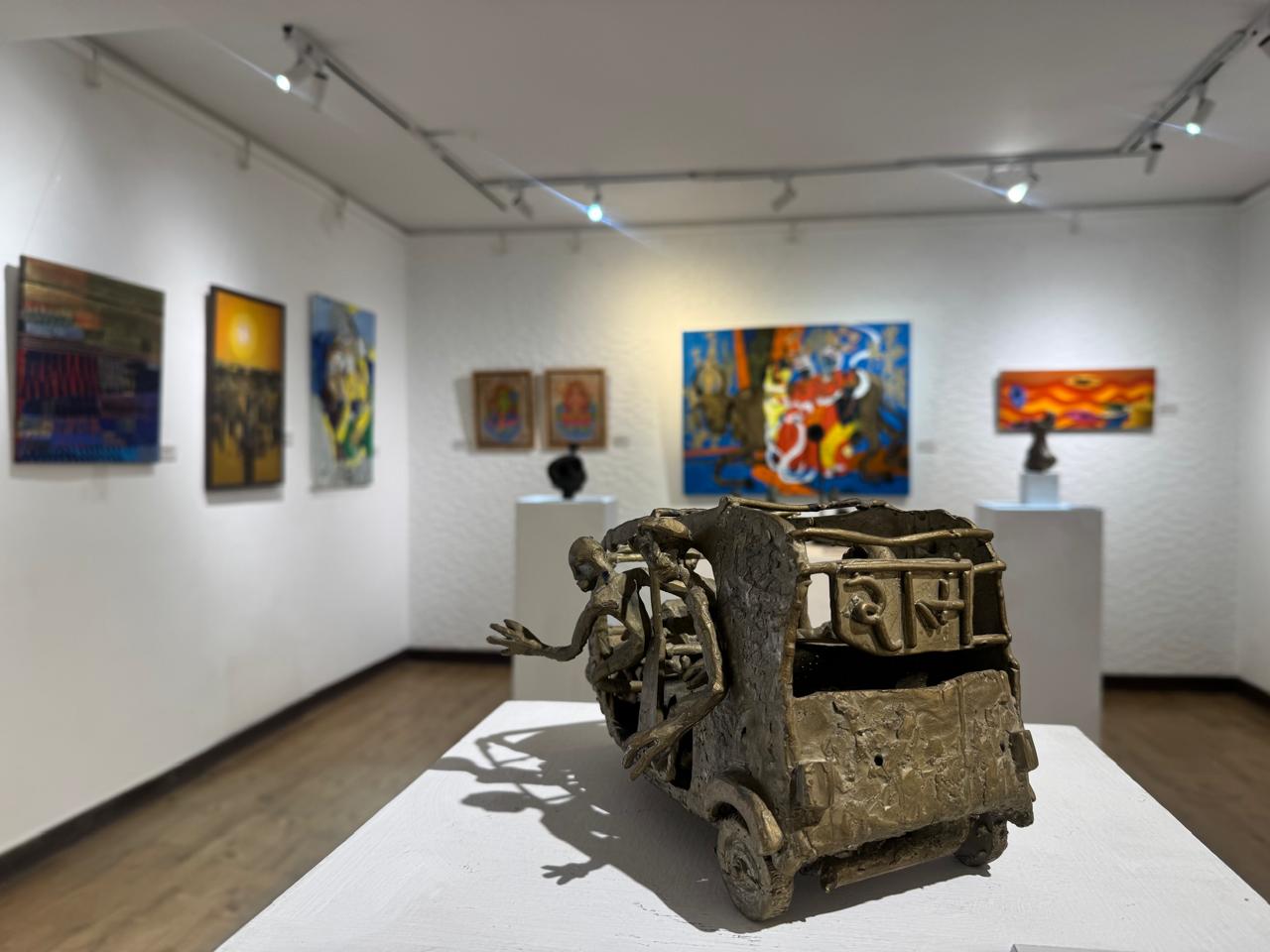
Narayan Prasad Bohaju works in a tradition that unites myth with present-day Kathmandu, a city said to have once been a lake, rising above the traffic of the current city as a parallel to the layering of past and present found in Banaras itself.
Jasmine Rajbhandari and Mukesh Shrestha also pay tribute to their years in the city shaping a practice absorbed slowly rather than glimpsed in passing. Sagar Manandhar, son of artist Kiran Manandhar and holder of two gold medals from BHU for his bachelor's and master's degrees, paints ever-evolving forms of nature, his time on the ghat of Varanasi having shaped his view of the world as a palette of constant change.
Agam Shrestha guided this year's Lalitkala students on their journey to Banaras, and also has a sculptural installation: 25 ceramic diya placed on delicate, flower-like brass stems. Agam's work was inspired by his observation of the votive lamps set afloat on the Ganga by pilgrims — a ritual that continues to this day and serves as inspiration for this new generation of artists.
Kashi is devoted to the worship of Shiva, much like Kathmandu itself. Bhusan Duwal and Shrawan Maharjan, working in bronze and copper, bring the same lineage forward in sculpture, their material choices carrying the weight and permanence of a tradition shaped by years spent in Banaras and Kathmandu.
There are other Banaras alumni not featured: Birendra Pratap Singh of Sirjana Contemporary Art Gallery, Yuvak Tuladhar lives in the US but continues to paint themes of memory and landscape, Pramish Adhikari also in the US is a printmaker, and Sujan Chitrakar of Kathmandu University.
A Nepali artistic homage to Banaras might be understood less as an exhibition about a city than as one about the act of returning to it whether for the first time or many times over.
It asks what it means to carry a place with you after leaving it, and what happens when a new generation arrives to discover a history that existed long before their teachers ever set foot on those ghats.
Homage to Banaras
Kathmandu Art Gallery
Baber Mahal revisited
Till 25 August