
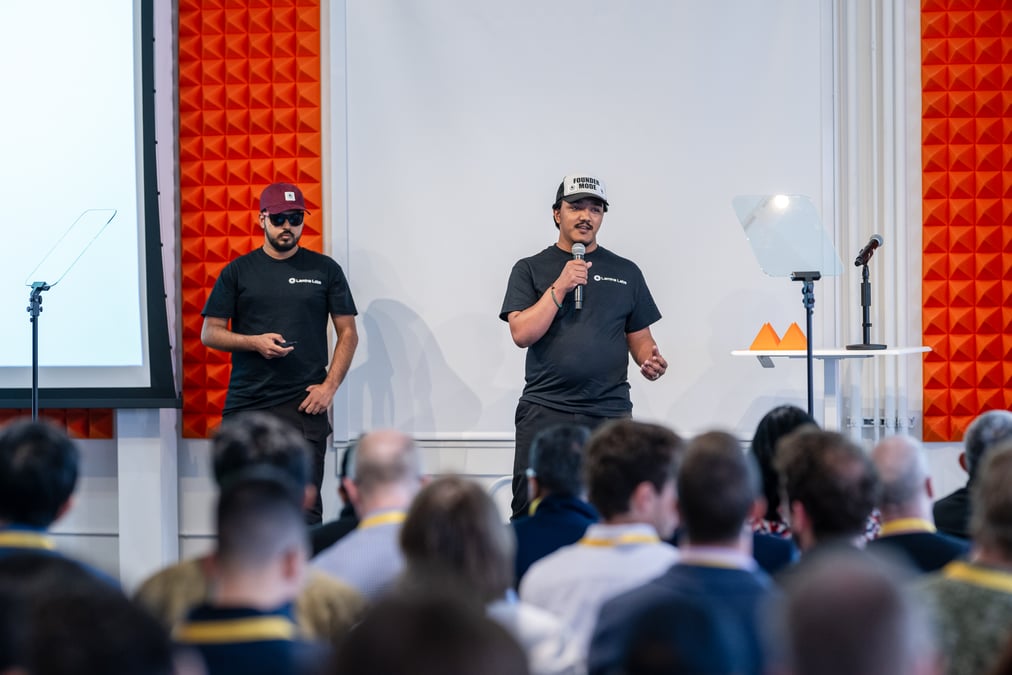
Two young Nepalis have founded an AI company that is on the cusp of takeoff after getting funding from a top accelerator program in the United States.
Sudip Rokaya and Kartikesh Mishra did know each other in Nepal, but met as students at the Massachusetts Institute of Technology (MIT) in Boston. They are now co-founders at Lamina Labs in San Francisco, working on generative video.
Their first product, Simi, generates whiteboard-style explainer videos based on a text prompt, and has received backing from YCombinator (YC), a top startup accelerator and quickly also secured further $3 million funding.
“In high school I did a lot of physics, and I was a visual learner so I really liked educational videos,” says Rokaya, currently on leave from his Math and Computer Science undergrad program at MIT. Rokaya was inspired by YouTuber 3Blue1Brown, known for his use of animation and visuals to explain Math topics.
3Blue1Brown wrote Manim, a custom set of tools in the programming language Python that he uses to create animations. This set of tools, called a library, are available for anybody to use or modify.
Last summer, Rokaya was trying to see if he could automate this library to also create videos but he ran into problems because Manim was designed before the Large Language Model (LLM) era, for users experienced in Python.
“Trying to force it to only do this small library is difficult, it would take millions of dollars to fine tune it to get very accurate,” says Laminal co-founder and Chief Technical Officer Kartikesh Mishra, who studied Electrical Engineering and Computer Science at MIT, and completed a Master’s in Engineering before moving to San Francisco.
Besides, there were other startups already working on the problem that had received funding, so they abandoned that idea. Three months into the semester though, Rokaya was taking a Biology class that was “not one of my favourites”.
“I looked for an AI tool that could help me learn through video. None of what I found had particularly good products, and they didn’t seem to be improving much either,” recalls Rokaya. The problem seemed to be technical and not financial.
At the time, Rokaya was exploring using generative AI and agents to ‘vibe-code’ -- which involves using LLMs to rapidly generate and modify code and software.
‘AI coding agents are the single greatest force multiplier available to founders right now. I’m not exaggerating. The leverage is unreal,’ wrote Rokaya to his 5,000+ LinkedIn audience two months ago.
Sensing an opportunity, Rokaya dove into research in late October, skipping classes and concluded that the process could be sped up 50x, while also generating a better end product. He showed it to Mishra, who had worked for two startups in San Francisco. He was impressed enough to join up.
“One reason I came to the US was to gather knowledge in ways that I did not have access to in Nepal,” Mishra told us. “MIT was about learning, but in San Francisco I wondered if I should work on something the world needs.”
BEATING THE COMPETITION
Their product, Simi, is named for Rokaya’s home village of Simikot in the remote corner of northwestern Nepal. “I needed a cool name, and the investors dig it,” he says.
Simi is free to test for anybody online, and in a test could generate a one-minute explainer video about a concept in economics. The video was structured, with examples, intro, and even tips on how to apply the rule to real life. A talented human animator would have taken many hours to do a similar video.
Users may put in as simple or as complex as a prompt they want to generate the video. For the end product, users can even choose between three aspect ratios, a male or a female voice, 80 different languages including Nepali, and lengths of 1, 2, 3, or 5 minutes.
In the cutthroat world of AI and technology, where solutions get copied instantly, companies need ‘moats’ that elevate their products above competitors. Simi’s impressive moat is that it is faster, cheaper, and generates better videos all at the same time.