
Under Nepal’s reformist new leadership with a Finance Minister committed to jumpstarting the economy, people expected this year’s budget to abandon the status quo and be cleaner, greener and more sustainable.
Finance Minister Swarnim Wagle last week delivered an ambitious Rs2.1 trillion budget that promised sweeping tax reforms, a digital and AI-driven economy, heavy investment in infrastructure, including in the domestic energy sector.
It was not the kind of transformative plan that many had anticipated. But given revenue constraints and the West Asia war impact, it was explicable. However, precisely for those reasons, the budget should have put green energy as an urgent top priority.
If reducing petroleum imports by promoting electric transport and increasing household power consumption was the goal, this budget did just the opposite – introduced a slew of new taxes on EVs, a VAT on electricity consumption, and ignored addressing climate impact.
EVs previously taxed on peak power will now take their CIF price as the measure. This means there is now a flat import rate of 20% on all private EVs, and excise duty has been replaced with a new Clean Infrastructure Tax ranging from 2.5% to 130% depending on vehicle price. VAT and road development taxes will still apply.
This means entry-level EVs below Rs2 million will still be affordable, but the price of high-end EVs will be equivalent to petrol cars of the same capacity. Hybrid cars will fall under the higher tax bracket. A depreciating rupee will further increase the tax burden.
The Finance Ministry says the restructuring was needed to plug the compliance loophole under which importers down-rated EV motor power to cheat on taxes. But under the new system, they can still under-invoice the price of high-end EVs.
Finance Minister Wagle has defended the EV tax overhaul. "The price of EVs below Rs5 million will decrease," he said. "The price of higher end EVs are depleting our foreign reserves. The fact is, if somebody buys a Rs10 million EV, they are owners of luxury vehicles, and we cannot subsidise them."
Last year, Nepal was second only to Norway in EV adoption and the new taxes could prompt many to switch back to petrol cars. Petrol two-wheelers and diesel trucks and buses are still the backbone of Nepal’s transportation, and the budget does not address their transition to renewables.
The budget has removed a 1% customs duty on electric buses with 25+ capacity, but it has gone up to 10% for electric micro-buses with 11-25 seats. Along with the 2.5% Clean Infrastructure Fee that is applicable for all electric public transport, this could hit the popularity of battery-powered vans.
“What affects the economy and the environment most are two-wheelers, buses and trucks where EVs have not been able to penetrate,” explains environmentalist Bhushan Tuladhar. “This is where the government should have provided equitable incentives.”
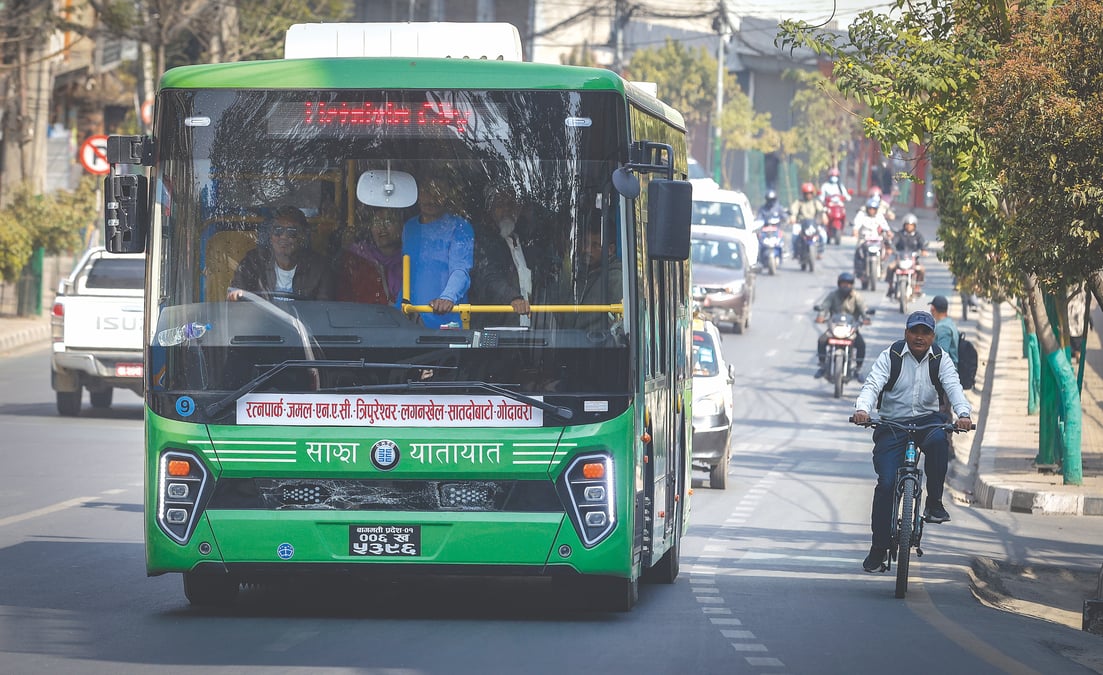
Rs286.48 billion has been allocated for highways and urban infrastructure expansion, while the Clean Infrastructure Tax is planned to fund the smart urban mobility initiative to transition public transport in Kathmandu and Pokhara to electric. And the Vision Kathmandu 2040 also envisions a city of flyovers, underpasses, and electric buses.
“Flyovers and underpasses are necessary in some parts," says Tuladhar, "However, sustainable urban mobility involves a good public transport system, which the budget addresses, but also walkable cities as well as a strong cycling infrastructure.”
But the tax on EVs for clean infrastructure will be deposited in the Federal Consolidated Fund, and could meet the same fate as the Rs 4 billion from the pollution tax on petrol and diesel that has been diverted to meet general budgetary expenditure.
“The question is whether the green tax is another way of raising revenue that will go straight into the government coffers or will that money actually be spent on green initiatives," asks Tuladhar.
TAXING POWER
Although the budget envisages hydropower and 370MW more utility-scale solar energy, there is no mention of cheaper and ecologically less damaging pump storage. Then there is the 5% VAT on households using more than 50 units of electricity which is antithetical to the need to increase domestic power consumption. The VAT charge is even more for businesses, and private charging stations will just pass the cost to consumers.
All this means that households are now less likely to switch from LPG to electric cooking at a time from gas is more expensive and in short supply due to the West Asia war. Finance Minister Wagle justified this, saying the grid could not support so many induction stoves and transformers would “explode”.
This brought an immediate retort from former interim energy minister Kulman Ghising of the Ujyalo Nepal Party: ‘Increasing taxes when electricity consumption should be increased will undermine clean energy promotion and the national electrification campaign.’
The budget has allocated only Rs12 billion for forestry, environment and climate action, down from nearly Rs19 billion last year. This means less money for climate adaptation and to pay for loss and damage. Instead of investing in innovative forestry-based enterprises, ecosystem services, carbon markets and utility scale biogas from urban waste, the budget continues existing programs with modest outcomes.
Climate change financing and adaptation is not linked to disaster management, agriculture production, infrastructure safeguards, tourism, and health. Resilience and risk reduction are not factored into clean energy infrastructure plans.
“The budget does acknowledge climate change as a problem, but the strong framework needed to address it is missing,” says green economy professor Sony Baral at Tribhuvan University. “It should have been more explicit on adaptation priorities, financing arrangements, achievable targets, institutional mandate, and monitoring systems.”
She adds: “A green budget should have included the natural capital of forests, watersheds, biodiversity in planning as contributing to economic growth and national wealth. This is not a green budget, rather an ordinary development budget with some environmental elements.”