
After the youth-led protests last year and the regime change that followed, there was hope that the number of Nepalis leaving for work abroad would come down.
The RSP leadership pledged to create 1.2 million new jobs over the next five years, and the Nepali diaspora enthusiastically supported the party’s election campaign.
But even more Nepalis are leaving than before for greener pastures abroad. And their destination is no more just West Asia or Malaysia, they are travelling further afield to Europe.
Remittance inflow surged to $14.59 billion in the first 11 months of this fiscal year, the highest yet. Nepalis in the Gulf working in dangerous, dirty and difficult jobs are moving on to Europe, many without even returning to Nepal.
The push factors are higher salaries in Europe’s service and manufacturing sectors, the chance of permanent residency, cooler climate, and worries about escalating conflict in the Persian Gulf.
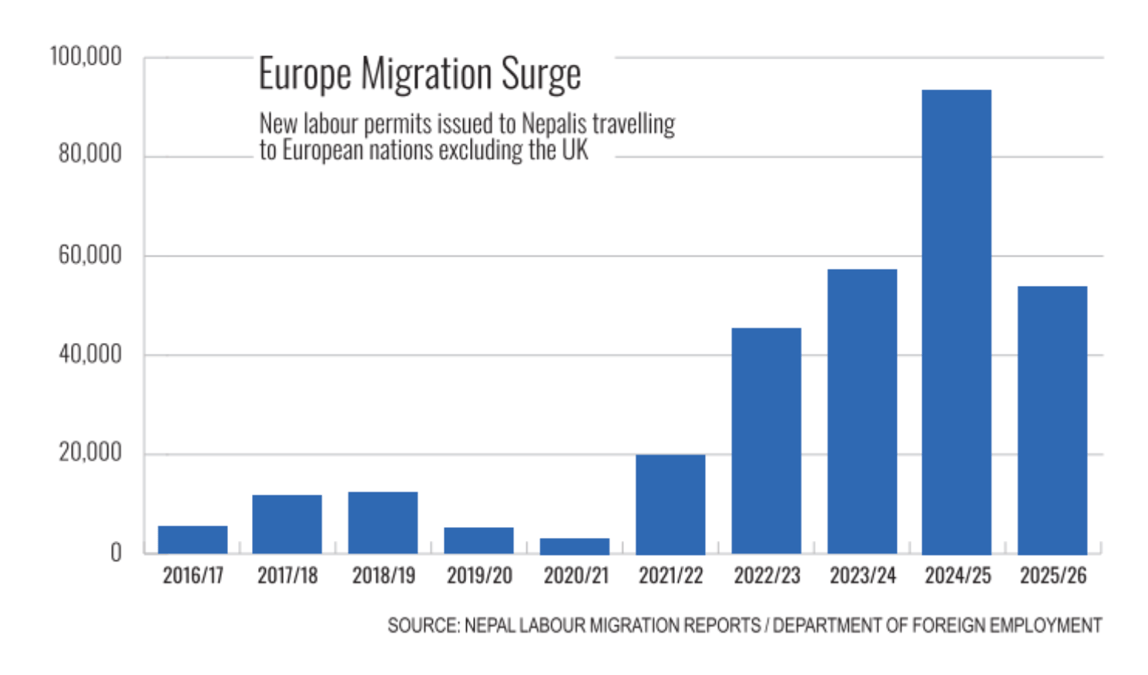
European countries, on the other hand, need cheap labour to make up for shortage, and allow calibrated numbers to work there. Migration to Europe from Nepal has increased 21-fold in the last decade.
Of the 792,187 labour permits issued in fiscal year 2025/2026, 93,508 were to European nations. More than 53,000 of those workers secured new labour permits. Romania is the most preferred destination for Nepalis, serving as a springboard for eventual movement to other Schengen states.
Meanwhile, the share of people migrating to the GCC has fallen from 77% in 2024/25 to 64% last year due to the conflict. These trends are documented and analysed by Nepal Economic Forum (NEF) in an EU-commissioned report on the Nepal-Europe migration corridor.
The methodology involved focus group discussions with Nepalis in eight EU countries, a survey of 400 people intending to migrate to Europe this year, and conversations with 150 households who have a family member in Europe.
The report shows that Nepalis are drawn to Europe because of the prospect of better education and higher wages, legal and social protection, and political stability. Europe’ needs to replenish a dwindling workforce across all skill levels.
Nepali migrants to Europe tend to be better educated: more than 75% have finished high school, half have vocational training. About a quarter are women, twice more than the proportion of female migrants to other countries. The jobs range from construction, caregiving, and agriculture to healthcare, engineering, and IT.
ONE SIZE FITS ALL
Despite the increasing importance of Europe, Nepal’s governance and regulatory frameworks do not reflect this trend, it is still one-size-fits-all.
The impact of this gap in policy means Nepalis seeking migration to Europe pay more in recruitment fees, and skill mismatch forces them to work jobs that do not correspond to their education and qualification. Therefore they cannot use skills and savings earned in Europe to invest back in Nepal on return.
Nepal must now take a more proactive diplomatic initiative to ensure migrants get better opportunities across Europe, and are not cheated by recruiters here. Nepal currently has bilateral labour agreements with only Germany and Romania.
Europe is undergoing a dramatic demographic shift. By 2050, its working-age population will fall by almost 30 million. The NEF report shows that the continent’s structural workforce replacement deficit will shrink by 25%. Nepal’s outbound working population has a window of opportunity to take advantage of this.
The study found that social security and political stability were the two main factors that drove Nepalis to Europe. But as West Asia has shown, Nepal we cannot assume that Europe is always going to be a safe place — especially with anti-immigrant political parties gaining ground.
Nepal’s new leadership cannot suddenly create the 1.2 million domestic jobs, but it can start by ensuring safe and exploitation-free migration and a hassle-free investment climate for those who return. Over half the migrants surveyed by NEF said that they want to eventually return home.
“Reintegration is the stage where we really realise if migration has value, and the Nepal-EU corridor needs rethinking,” says NEF researcher Rojika Maharjan.
She adds: “When migrants come back to their home country they want their skills, their ambitions for enterprise creation, and their economic and social remittances mobilised for their home country and community life.”
Another priority is having a more accurate count of just how many Nepalis are working in Europe. A significant number do not head there from Nepal, but from places where they are already working. Once in Europe, it is difficult to keep track because of the freedom of movement across the Schengen region.
Nepal does not need to start from scratch. Migration, labour, and reintegration policies already exist, they now need to be tailored to the priorities and the resources of Nepali migrants in Europe.
Rojina Tamrakar, Executive Director of the Institute of Foreign Affairs, puts it best: “Migration is no longer simply a labour issue, it is increasingly about foreign policy, economic diplomacy, international cooperation, and human development.”
Shristi Karki