
 MIN RATNA BAJRACHARYA |
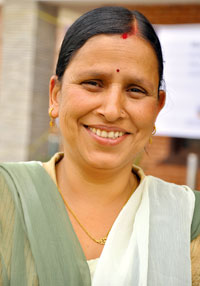
When Yasodha Ojha started working as a nurse in her district in Doti 14 years ago, pregnant women coming to health posts for pre-natal checkups were unheard of. Vaccination centres were empty and hundreds of children were not immunised.
Today, the queues outside Ojha's clinic are so long she can hardly keep up with demand for healthcare in her village of Mahua.
On 12 March Ojha was presented with the Nick Simons Award for her relentless work with pregnant women and children in Doti. For the past four years the Kathmandu-based Nick Simons Institute has honoured healthcare workers in rural Nepal who have overcome financial obstacles and lack of resources to help communities.
But Ojha's journey from a young nurse to successful healthcare professional wasn't easy. She grew up in a remote part of one of Nepal's remotest districts. Mahua lies on a hilltop, 29 km from the district headquarter of Dipayal.
Despite being poor, Ojha's parents made sure to send all their four children to school. And although she was married at 16, she was lucky to have an understanding husband who encouraged her to complete her education and become a nurse.
In 1997 Ojha travelled to Dipayal where she began her ANM (auxiliary nurse midwife) course at Seti Technical School.
However, she was quickly disheartened when she saw women's lack of interest in their own health. Nearly 10 per cent of pregnant women in Doti either fail to complete their term or have unsuccessful deliveries. She went around the village informing prospective mothers about safe delivery practices, pre-natal care, immunisation and persuaded them to visit health posts.
Her perseverance and hard work paid off. Under Ojha's watch, maternal mortality and infant mortality have dropped to nearly zero, and the number of pregnant women seeking healthcare has increased dramatically from 50 per year to 1,500 annually.