Newars are supposed to be Nepal's early settlers, according to one theory even lending their name to the country. They form not a caste, but a complex community--in 1854, the Muluki Ain divided Newars into the equivalent of the four castes, from Brahmins (Rajopadhyaya and Vajracarya), to dalits (Pode and Cyama khalak).
There were only scattered references to Newars in the classic accounts of Nepal (Kirkpatrick in 1811, Hamilton in 1819, Hodegson and Oldfield both in 1880). The first comprehensive piece of research on Newars appeared in 1923, in KP Chattopadhyaya's An Essay on the History of Newar Culture followed, 25 years later by Dilli Raman Regmi's The Antiquity of the Newars of Kathmandu. Western scholars started to focus on Newar communities after Gopal Singh Nepali's full-length book in 1965. One of them was Gerard Toffin.
In the last 30 years, Toffin, now a director of research at France's mammoth National Centre for Scientific Research (CNRS), has written a number of papers exploring different aspects of Newar culture. Most of Toffin's work is in French (bar a two-page preface to the 1993 Nepal: Past and Present, which he edited), and non-speakers have long felt the need for translations. Himal Books' new volume of selected papers by Toffin is good news for academics and laypeople.
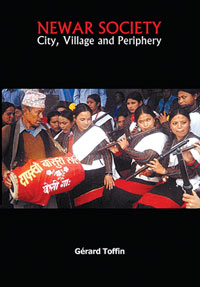
The 13 research papers in Newar Society: City, Village and Periphery are based on extensive fieldwork and personal observation and constitute a significant contribution to the social study of Nepal.
Toffin begins with the Citrakars, Rajopadhyayas, and Maharjans of the city. In his work on the painter Citrakars, he focuses on their two main guthis (si guthi and desla guthi), kinship and marriage patterns and, of course, their art, which sometimes functions as medicine. Toffin describes how they treat Jwanakai, which is thought to be caused by snakes, by painting two lions on the sides of the affected area. The chapter on the Rajopadhyayas mainly deals with the history of the caste and their role as the priests of Hindu Newars. The author argues that, despite substantial changes in their tradition and rituals, the religious identity of the Rajopadhyayas is still largely intact. Toffin's chapter on the social and territorial organisation of the Maharjans of Kathmandu city-their twah or tol system-and their vocal and instrumental music. To readers who equate Maharjans with farmers, this new information is fascinating.
The three papers on the little known Lalitpur Maharjan village of Pyangaon come from Toffin's long periods of fieldwork. He makes a detailed study of Swagumi, who "adopted a Jyapu lifestyle and became Newarised" in one, and in another provides a picture of intercaste relationships, particularly between 'pure' and 'impure' castes, and the position of Swagumi within the Newar caste system. Toffin's third Pyangaon paper is about the socio-religious structures of the Maharjans, this time as villagers. A detailed comparative study of the Maharjans in city and village would have been welcome.