
One of the most moving pieces of reportage to come out of the 25 April earthquake has been from Al Jazeera’s Nepal correspondent Subina Shrestha who broke down on camera mid-report while recounting the devastation of her hometown, Patan Darbar Square, a day after the quake.
“Every morning I hope it was a nightmare, but it’s not,” says Shrestha, her back turned to the camera. “Nepal has no choice but to rebuild, and hopefully I can do it better next time.”
Many of us who grew up in the city, have homes and families here, and were out on field the very next day of the quake have felt the exact same emotions that made Shrestha, an experienced journalist tear up and lose composure on the job. Witnessing destruction is never easy, not even for a journalist, but it becomes terribly hard not to get affected when it involves reporting on a place you have spent your entire life in.
Collapsed temples in Patan, Bhaktapur, and Basantapur didn’t just add up to statistics for us. These were places where we often met friends for tea discussing the future, career goals, relationship troubles. The 8,700 people who lost their lives were not all strangers.
Perhaps this is why reports produced by Nepali journalists have been more sensitive and empathetic in their approach than usual. Unlike foreign reporters who had little idea about the country’s geography, culture and customs, and who couldn’t place Nepal on a map before the quake, we understood the nuances and had more insight.
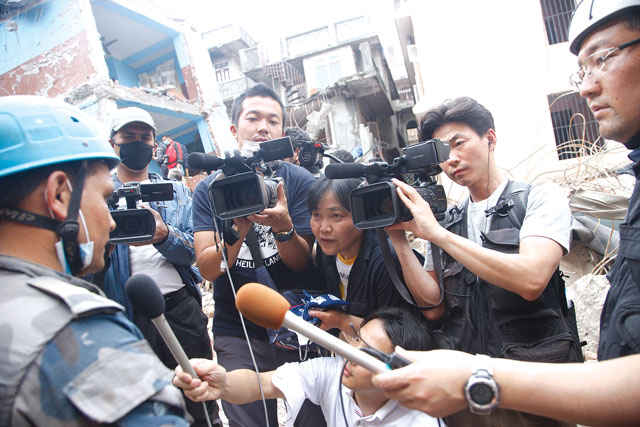
Photo: Bikram Rai
We knew better than to ask a wailing wife who had just found out about her husband’s death “How do you feel?”. Or a grieving person: “Why are you in all-whites and shaving your head?” We had our reservations about taking pictures of mass funerals at Pashupatinath that had become mandatory for many international photojournalists. Even James Natchway couldn’t resist the temptation to make a stop there on his two-day visit.