
|
|
| SCENES FROM A RIOT: Wednesday evening in Janakpur showed how many sides are competing for supremacy in madhes politics. |
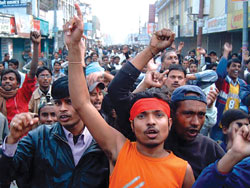
In the wake of this week's Lahan violence, the Madhesi Janadhikar Forum rejected calls by the government to sit down for dialogue. Many other groups however, both madhesi and pahadi, have urged the MJF to talk.
The MJF may or may not talk in the end, depending on how the situation evolves. For now though, it is in the driver's seat and its recent behaviour shows just how strong it has become in the post-Lahan scene. As Nepalganj before it, Lahan signifies the deep resentment in the tarai against a pahadi state structure that has treated madhesis as second-class citizens. The MJF emerged practically out of nowhere to capitalise on this situation.
This new dynamic in the volatile tarai politics is roiling the madhes as much as it is roiling national politics. It is no secret that various madhesi groups today are locked in a struggle to lead the madhes agenda. They are in competition for influence across the tarai with a single-minded purpose: each wants to show that it is the indisputable leader of the madhesi community. This is why December and January have witnessed more bandas and strikes in the tarai than at any other time.
Lahan arrives just at this point and hands the MJF a clear victory. The biggest loser in all this have been the Maoists, the seven mainstream parties, and Nepal's Kathmandu-centric civil society who can think of nothing more original than holding goodwill rallies at the Maitighar Mandala.
If there is one single person has emerged as the biggest loser, it is the Maoists' madhesi leader Matrika Prasad Yadav. It was bad enough that his party disregarded a banda for a genuine madhesi cause by trying to bulldoze through a blockade in Lahan. He then showed extreme stupidity by forcibly body-snatching the dead boy, thus insulting madhesi sensitivities. His pahadi leader, Pushpa Kamal Dahal, made matters even worse by stating: "there should be no talks with the MJF because talks can only be held with political forces, not criminals and gangsters."