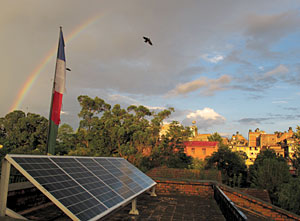
Life in the sunshine

Solar energy promises to take Nepalis out of the dark ages

KUNDA DIXIT
Power cuts will soon hit 18 hours a day. In other words, there will be electricity only six hours a day.

Demand will continue to outstrip supply even if new plants are built in the next three years. Power cuts are here to stay.

Yet, there is one breed of consumer in Nepal who is not worried. It has made the switch to solar and the power cuts don't affect this group at all. Suppliers are rushing to fill the demand for household and office power with more efficient panels, more robust batteries and better relays and switching systems.

For Nepal, solar is the next best thing to hydro. We have plenty of water and plenty of sunshine if hydro is lagging behind, why not harness the sun?

Both are renewable forms of energy and once solar panels are installed they have minimal operating costs and can provide uninterrupted power supply. Nepal falls in a prime solar region, getting two to three times more solar energy than Germany, currently the largest producer of solar electricity in the world. Solar panels are also more efficient in cold climates, like the Nepali winters when there is  power shortage but plenty of sunlight.

Read also:
Here comes the sun

The world's 'Solar King' ,
RIC WASSERMAN in STOCKHOLM
China's Huang Ming wins this year's 'alternative Nobel' for being a solar energy pioneer

Published on

Category:Special
Share:

Comments (Archive)

  • razeep_stha@hotmail.com

    not only solar, i think we have good prospects in wind energy too!!

  • armugam

    Solar panels can be installed in "most" roof tops and the direct current (DC) output generally remains slow and steady. Installing wind mills would not be that simple or practical. Bedsides valley floor, which has the highest concentration of "built space" does not get steady wind.

  • razeep

    i think its not important that we have to install wind mills in built up areas...i think there are lots of areas where we can optain average wind speed..may be we can install in this areas and connect to main grid..

  • armugam

    Wind, no doubt, could be another source of energy - in places with good and steady supply, that is. This story was primarily on Gham and its widespread reach particularly in "urban areas" that are most affected by the over dependence on NEC's supplied electricity.

  • suman

    Thanks for bringing up this issue. Solar is something every nepali can use. it is our best solution for long term energy needs. there is no need for feedtariff. you install where you need it. I hope govt will install solar in office govt buildings which will encourages fella citizens to install too. jai nepal

  • L Wolfe

    Nepalese are suffering too much without sufficient power, and with the cold season upon us, loadshedding adds insult to injury. Solar panels or windmill should be on every roof, but how can individuals afford this? Government can help the people with an alternative energy partial granting program. Or, do you know of an alternative possibility for funding?

  • armugam

    my "dui paise" on solar http://epaper.ekantipur.com/ktpost/showtext.aspx?boxid=45200&parentid=15246&issuedate=112012