
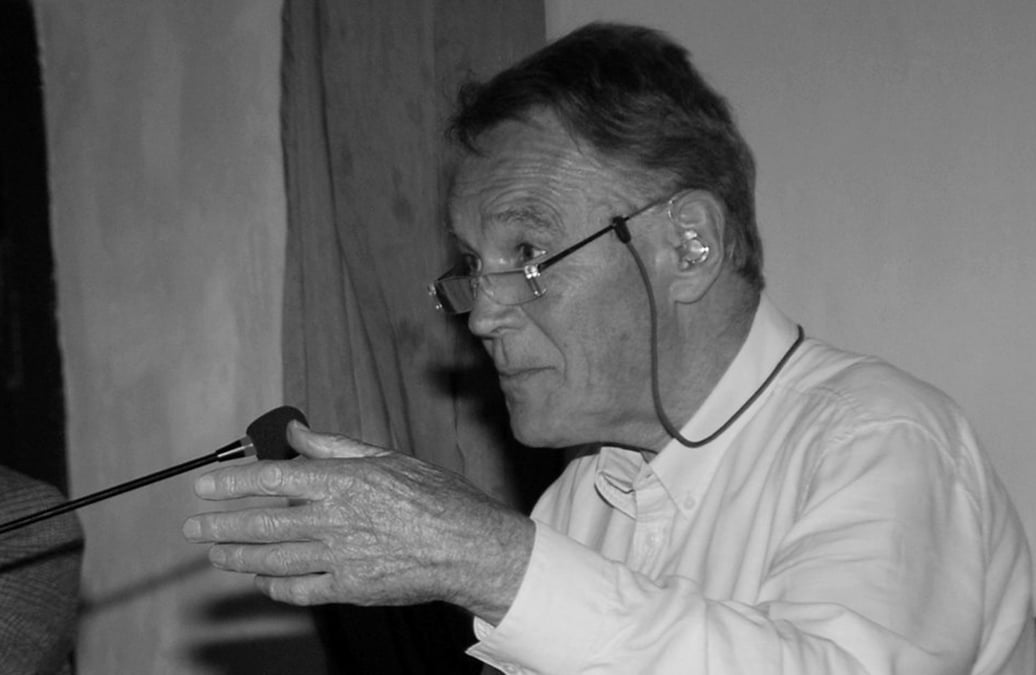
Michael Thompson, who died on 18 March after suffering a stroke a few weeks earlier, was a former Gurkha officer, mountaineer, and founding pillar of Cultural Theory.
His daughter Ursula said it was a peaceful end, Mike himself had asked to be taken off medical support after doctors said they could do no more.
Together with his PhD adviser, the late Mary Douglas and fellow PhD student Steve Rayner of Oxford’s Institute for Science, Innovation and Society, Mike chose to generalise from years of anthropological work—unlike other social anthropologists—to filter out common traits of human behaviour across time and space, and then to apply that to modern society and its conflicts.
Cultural Theory has also been used to explain water and energy conflicts in Nepal and California, seat belt and pension fund battles in Europe, the underlying social dynamics of kibbutz in Israel, and what Mike liked to call “argumentative technology assessment” plus much more.
Unlike other ‘descriptive’ social sciences, Cultural Theory is ‘interpretive' in its orientation, which makes many in the ‘descriptive tradition’ rather uneasy with its ‘uncomfortable knowledge’.
A classic example is the massive almost six-year exercise that resulted in the multi-country, multi-author 4-volume study Human Choice and Climate Change led by Steve Rayner and Elizabeth Malone for the US Department of Energy and the Pacific North-West Lab.
It was, and perhaps still is, the first time that the social sciences looked seriously into climate change. However, its insights and conclusions were uncomfortable enough for it to be ignored, and only Mike Hulme of the Tyndall Center covered it as a chapter in his book Why We Disagree About Climate Change a dozen years later.
During my various lectures around the world, I myself have found younger scholars in China, India, South Asia, South-East Asia, Africa and Latin America much more welcoming and open about Cultural Theory interpretations than in Europe or America.
Mike liked to say that his own work on Cultural Theory was initially conceptualised while he was in Nepal climbing mountains. He was part of the British expeditions on Annapurna’s South Face in 1970 and Everest Southwest Face in 1975.
Even while working on his PhD under Mary Douglas, which was published by Oxford University Press as Rubbish Theory: The Creation and Destruction of Value. Mary Douglas and others having done work on the Cultural Theory of everyday goods and consumption (including drinking), Mike’s Rubbish Theory showed how unwanted trash or scrap eventually became invaluable antique.
Unfortunately, OUP withdrew the book after its eminent economics professor-board member objected to the book showing the limitations of economics in explaining value.
When I asked his wife Anne why Mike was not republishing it, she said it was probably because he is practicing what he preaches, hoping to see if that book can transit from discarded ‘waste’ to achieve ‘antique value’. It did, and was being put up on Amazon for an astronomical sum until Pluto Press republished it.
In line with Cultural Theory, which examines and explains everyday life, Mike’s sociology of mountaineering expeditions was published in Diadem Books’ Mirrors in the Cliffs in 1983 as a hilarious but astute piece titled Sahibs and Sherpas.
I first met Mike in April 1986 at the now famous Mohonk Mountain Conference in upstate New York, the conference with most of the world’s eminent mountain experts which resulted in a major scientific paradigm shift – the debunking of the Theory of Himalayan Degradation.
It resulted in the book Uncertainty on a Himalayan Scale (with Warburton and Hatley), which was republished in 2007 by Himal book with a long updating foreword by Mike and me.
Our collaboration continued across many centres in the US and Europe starting with San Diego’s Western Behaviourial Sciences Institute in 1989/90 where I first met Mary Douglas and Steve Rayner (and became the first person in Nepal to tele-conference via landline phone connected to San Diego’s computer system).
We continued on to Battelle Pacific Northwest National Lab in Washington state that resulted in the monumental 4-volume Human Choice and Climate Change, and involved work with Oxford’s James Martin Institute for Science and Civilization, King’s College London, LOS Center in Bergen, places in Germany and very much at the International Institute for Applied Systems Analysis (IIASA/Laxenburg) since the early 1990s.
During forays to Europe and transits through London, I often stayed with Mike and Anne at their London Highbury-Islington house and later in Bath when he moved there. Incidentally, they had bought the London house rather cheap before its gentrification (their neighbour was a school where Tony Blair’s young children studied).
Between mountaineering and Cultural Theory, Mike worked as a builder, and he single-handedly retrofitted their London home, which he later sold to buy a much bigger and better house in Bath with money to spare as retirement fund.
The idea of what was good versus bad development in the Himalaya from a perspective was further developed as an IIASA/Oxford Science and Society research resulting in our 2017 book Aid, Technology and Development: the Lessons from Nepal.
While he was in Nepal for that research, we did manage to get him to deliver a Social Science Baha lecture on the book’s essence, Cultural Theory and Clumsiness: Some Lessons from Nepal.
Sometimes our collective writings came from discussions in the strangest of ways and places. After a long meeting at the IIASA schloss, we ended up in a pub for beer, and the discussions were around what it would take for a city to be a force for good and not one bad for the environment.
If such a city could be designed, one could plonk it on the middle of a degraded landscape, which theoretically should then heal itself. Someone less inebriated obviously took notes and circulated it, which eventually resulted in the Engineering Sustainability paper On Governance for Re-engineering City Infrastructure.
Another time, I had to give a keynote presentation at an IIED/Sussex STEPs Center dialogue in London’s Goodenough College on re-imagining Development in LDCs. Following that talk, we sat down and produced our Restoring Development Dharma with Toad’s Eye Science.
Just before Covid struck, we (including Bruce Beck and Joanne Linnerooth-Bayer from IIASA) had been working on a Cultural Theory examination of four schools of engineering thought, our last meeting was at Steve Rayner’s Keeble College in Oxford as part of that exercise.
Its earlier efforts were explored in our work on transboundary risk management in the Himalaya at Bergen’s LOS Center and also dealt with in a chapter in EARTHSCAN’s IIASA publication Transboundary Risk Management edited by Joanne and others.
It argued that risk is socially constructed in four distinctly varied ways, where facts and values are entangled, leading to competing technological preferences. Mike desperately wanted to follow up on the Keeble meeting at IIASA, but – given the Covid fears already underway – Anne put her foot down and had him quarantined at home.
Our other on-going effort was, given that IIASA was founded during the Cold War as a place for scientists of the Euro-American West and the Communist East to work together to build confidence for peace, but after the collapse of the Berlin Wall that division (hence raison d’etre) no longer existed – to develop a global North-South axis for IIASA’s work.
We believed that was where the great challenges of tomorrow development debates as well as environmental concerns (including climate change) would play out. Towards that end, he was working with a range of Global South scholars and was very anxious to see if an IIASA-Nepal Social Science Baha/South Asia Institute for History and Philosophy collaboration could be developed.
Mike retained interest in Nepal’s developments up to his very end, even when on hospital bed, asking his daughter to find out from me what was going on with Nepal’s March elections that saw a seismic upheaval which decimated all the old political parties.
When Ursula described the gist to him, I am sure he was inwardly pleased that it vindicated Cultural Theory as Political Science’s contention that moral high ground activist egalitarianism not given proper place at the policy table can strike back at insensitive bureaucratic hierarchism and market individualism’s crony capitalism with swift and lethal vengeance.
Michael Thompson’s physical presence will be greatly missed, but his impact on interpretive social science – and its extremely relevant application to Nepal’s and other LDC’s developmental conflicts – will live on.
Dipak Gyawali is an energy economist with the Nepal Academy of Science and Technology (NAST). He is a former minister of water resources.
To listen to Michael Thomson’s lecture at Social Science Baha in 2011 click here.