
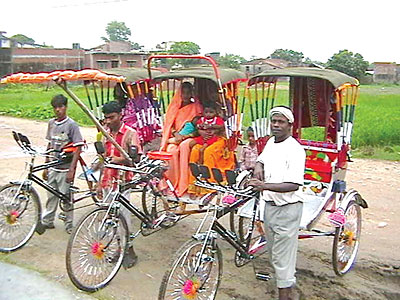
 PROUD OWNERS: Rickshaw pullers from Kalaya, Bara District, who have purchased their rickshaws through social entrepreneur Ranjit Kanswar's organisation. |
Thirty-year-old Ranjit Kanswar runs a unique organisation in Kalaya of Bara district which helps locals purchase their own rickshaws. Instead of paying Rs 60 everyday to rent rickshaws from businessmen, they set aside Rs 25 per day to eventually own it in two years or so.
Kanswar won seed money for his business plan in a competition and began with five families. Now, with the returns, he is trying to work with 10 more families.
The enterprise is an example of an increasingly popular mode of doing business called social entrepreneurship. Traditional private sector or personal philanthropy can exist side-by-side, but many organisations are now adopting a formula that balances economy, ecology and social responsibility.
Contrary to traditional socially-driven organisations, social entrepreneurs use market-driven business models to address critical social and environmental issues. They don't measure returns in terms of shareholder dividend alone but aim for financial independence. Social enterprise is not just another fundraising strategy for non-profits, it is a long-term sustainable business that operates to redirect profits towards social and environmental goals.
The word "sustainability" may have become threadbare with overuse and misuse, but is still very relevant in the Nepal context. Most non-government bodies here are supported by international donors and fold up when funds run out. How can an organisation benefit others if it itself needs help to sustain? Revenue-generating models could be the answer.