
When Nepalis are leaving the country in droves, there are unsung heroes providing selfless services in isolated parts of the country.
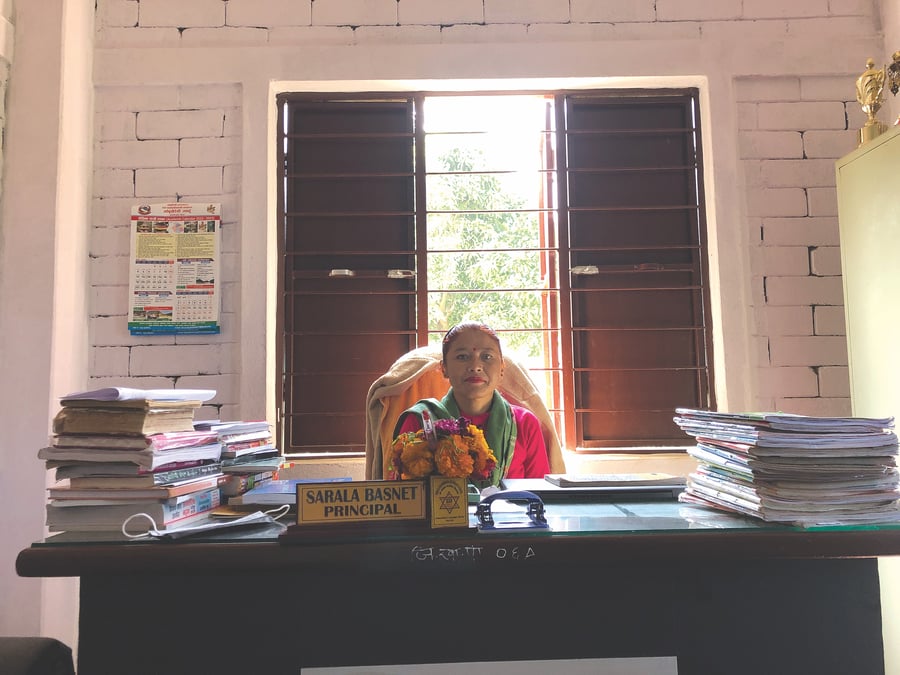
Teachers like Sarala Basnet do not crave wealth or fame but work one day at a time to meet their ideal of bringing up the next generation of motivated and compassionate Nepalis.
Sarala, as her name suggests, values simplicty and is guided by a straightforward attitude towards life: integrity, diligence and decency.
After working her way up from a small village in Baglung, Sarala, at age 35, is the first female principal of Chandrodaya Secondary School in Abu Khaireni of Tanahu district.
Back in Baglung, she was also the first female student to pass SLC from high school two decades ago at a time when very few girls attended school in such far-flung villages.
“The mindset was that if the girl is educated, she will contaminate traditional culture,” recalls Basnet. “But I had my heart set from an early age to being an educator.”
Her father was in the military, and Basnet was the youngest of many siblings. Luckily, the family valued education and sent her to school, unlike many of her childhood mates.
But it was not an easy path. When she raised her young voice against prevailing gender inequality, neighbours scoffed at her. This only made her more determined to be a teacher.
After school, she graduated with a Bachelor of Education from Gorkha Campus, which was an accomplishment on its own at a time when families married off their daughters instead of sending them to colleges.
She traveled to Butwal for an internship as a maths instructor but seeing the need in her own hometown, returned to Baglung and was a teacher for 17 years.
Eight years ago she was transferred to Abu Khaireni and made principal in recognition of her dedication and commitment.
During this time, she got married to musician Krishna Prasad Bhatta, who works as a music teacher in Kathmandu. The couple has two children, 13 and 8.
Abu Khaireni is a small picturesque farming town mostly inhabited by families whose men serve in the British, Indian or Nepali armies. The rest of the young men have migrated for work to the Gulf or Malaysia.