

There is a long-standing economic assumption that work without a wage is not ‘real’ work, yet the deeper issue lies beyond adding monetary value to it.
Can assigning a price to care meaningfully address the structural inequalities that have historically confined women to subordinate social and economic roles? Furthermore, what is being measured—and how?
Is this amount based on replacement cost (what it would cost to hire multiple workers), minimum wage standards, time-use surveys, or merely a judicial estimate for compensation claims? Valuation is not just a technical exercise; it reflects how society understands the role of care.
Care work is not a single, measurable activity. It includes cooking, cleaning, childcare, eldercare, and emotional support—requiring skill, responsibility, and constant availability. A single number cannot capture this complexity.
More importantly, such valuation risks reframing the issue: instead of recognising women’s contribution, it reduces care to the cost of replacing it.
The Indian Supreme Court’s recent recognition of homemakers as ‘nation builders’, alongside a notional valuation of ₹30,000 per month for unpaid care work has sparked debate across South Asia, including in Nepal.
In practice, such valuations apply when a homemaker dies or becomes unable to provide care. This creates a paradox: women’s labour remains invisible in everyday life but becomes measurable when it is lost.
But why must women’s labour require absence, injury, or death before it is acknowledged? Care is not valuable because it is lost. It is valuable because it sustains daily economic and social life.
UNDERVALUED
Unpaid care work cannot be separated from broader gender inequality. The issue is not only that women perform unpaid work, but that work associated with women has historically been undervalued.
Across societies, activities linked to men have been treated as economically productive, while those linked to women have been seen as natural responsibilities. This has resulted in a systematic undervaluation of women’s contributions—within households and in labour markets.
This persistent undervaluation implies that women’s work is inherently inferior. It legitimises economic exclusion, including denial of fair wages, limited access to employment, and weaker labour protections. At its most extreme, this hierarchy of value feeds into broader patterns of violence against women—ranging from structural denial of economic rights to everyday exploitation and physical violence.
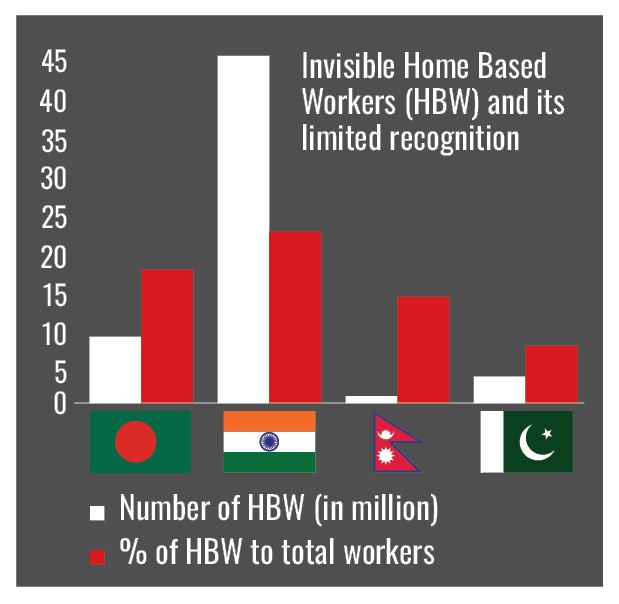
The scale of this invisible labour further underscores the limitation of a compensation-based approach. Home-based workers—most of whom are women—constitute a significant share of total employment across South Asia, yet remain largely unrecognised within formal economic systems.
The chart (pictured right) highlights that in countries such as India and Bangladesh, home-based workers account for a substantial proportion of the workforce, while in Nepal and Pakistan too, they represent an important but largely invisible segment of employment. In absolute terms, this amounts to tens of millions of workers.
A recent study by WIEGO and HomeNet South Asia (2026) estimates that over 57.5 million home-based workers are engaged in production across India, Bangladesh, Nepal, and Pakistan—most of them women working from within their homes and outside formal labour recognition.
Beyond this, unpaid care work is performed by approximately half the population—primarily women—whose labour sustains households, reproduces the workforce, and underpins entire economies. Taken together, the issue is not simply compensating for the loss of women’s care work in isolated cases. It is the vast extent and systemic invisibility of labour that remains outside markets, measurement, and policy frameworks. A notional monetary value applied after loss captures only a fraction of this reality.
Assigning compensation may acknowledge care, but it does not dismantle the social norms, institutions, and power relations that have shaped this inequality.
Women have long been celebrated symbolically as mothers, cultural bearers, and embodiments of strength. Yet symbolic recognition often coexists with material inequality. Societies still restrict their access to property, income, decision-making power, and public life, and hence do not treat them as equal citizens.
Calling women ‘nation builders’ has meaning only if it translates into rights, opportunities, and agency. Nation-building is not sustained by praise alone, it requires recognising women as economic actors, political participants, and equal holders of power.
The question, then, is not whether women are valuable—this has long been acknowledged rhetorically. But why has this recognition not led to substantive equality?
The debate also exposes a deeper flaw in economic thinking: what counts as ‘production’. Gross Domestic Product (GDP) measures market transactions. Work performed within households without monetary exchange remains largely invisible. Yet unpaid care work underpins the entire economy. It raises future workers, sustains the current workforce, and maintains the social fabric.
Care is not outside the economy, it is one of its preconditions. However, assigning a monetary value to care in compensation cases does not automatically integrate it into economic policy, budgeting, or planning. There is a risk that care becomes symbolically recognised but remains structurally excluded.
ECONOMIC JUSTICE
This is why the debate must move beyond compensation toward economic justice. Compensation asks: what is the financial value of lost care? Economic justice asks: how should care be organised, supported, and shared in society?
Compensation responds to inequality after harm occurs. Economic justice seeks to transform the structures that produce inequality in the first place.
A justice-oriented approach would mean recognising care as essential economic infrastructure. It would require sustained investment in childcare, eldercare, healthcare, and social protection systems. It would aim to reduce women’s disproportionate unpaid workload and expand their access to paid work, leadership, and decision-making.
The goal is not simply to pay women to remain within care roles but to transform the conditions that restrict them to those roles.
Nepal has made important commitments to gender equality and women’s empowerment, yet women continue to bear a disproportionate burden of unpaid care. This affects their time, mobility, employment opportunities, and participation in public life.
The question Nepal faces is therefore larger than whether to adopt a monetary valuation of care. Will Nepal recognise women primarily as caregivers, or as full economic citizens whose contributions in care, in paid work, and in public life are equally valued?
The Indian judgment offers an important lesson: recognition is necessary, but it is not transformation. The more difficult—and necessary—task is to move from valuing women only in their absence to recognising their contributions, capabilities, and rights in their everyday lives.
Economic justice requires more than compensation. It demands a transformation of the social, economic, and political structures that have historically produced inequality.
The real question is not how much women’s care work is worth but what kind of economy and society we want to build. One that compensates for inequality after the fact, or one that actively dismantles it?
Bina Pradhan is a feminist economist and founder and board director of the BEES (Business, Enterprise and Employment Services) Network for Women in South Asia.