
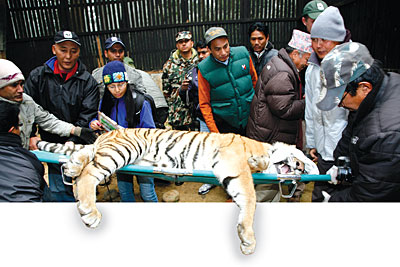
 MIN RATNA BAJRACHARYA PUT TO SLEEP: A tranquilised Namoboudha being trans-located from Chitwan to Bardiya in Feburary. Four months later, poachers had killed him. |
Further on from the resort town of Dhulikhel lies the sacred site of Namobuddha. Though a massive, opulently appointed monastery dominates the hilltop today, pilgrims will be more interested in the caves in which the Sakyamuni Buddha is said to have offered his body to a starving tigress, so she could feed her cubs. Some locals believe that chanting 'Namobuddha' will protect them in the event of their encountering a tiger in the surrounding forests.
Never mind that the chances of bumping into a tiger and enacting an Androclean fantasy are close to zero in Namobuddha these days. Whoever named the first tiger to be collared with a GPS system and translocated from Chitwan to Bardiya National Park 'Namobuddha' must in fact have hoped his spiritual moniker would protect the 28-month old male from humans. But poachers respect nothing but the material. In a self-fulfilling irony, Namobuddha went missing a mere four months after his move in January. Two weeks later, park officials confirmed they had found his charred GPS collar along with a few hairs. Arrests were made, but the damage had been done.
The push to double the number of wild tigers by 2022, decided on at the International Tiger Forum in St. Petersburg last year, is a commendable one. But in the battle to save and boost the population of the 121 breeding tigers that remain in Nepal, every casualty is a significant setback. In a country of politicians who jump on every bandwagon while the going's good, it's useless casting back to the grandstanding of the likes of Madhav Nepal and Deepak Bohara. Rather, we should consider what is actually being done on the ground. In this regard, the GPS collaring project may have stalled in tragedy, but there is much to hope for from the newly created Banke National Park (adjoining Bardiya). We have yet to see what the various committees created to oversee Nepal's efforts to save the tiger will accomplish, and whether anti-poaching patrols can seriously deter the highly profitable trade in tiger parts.