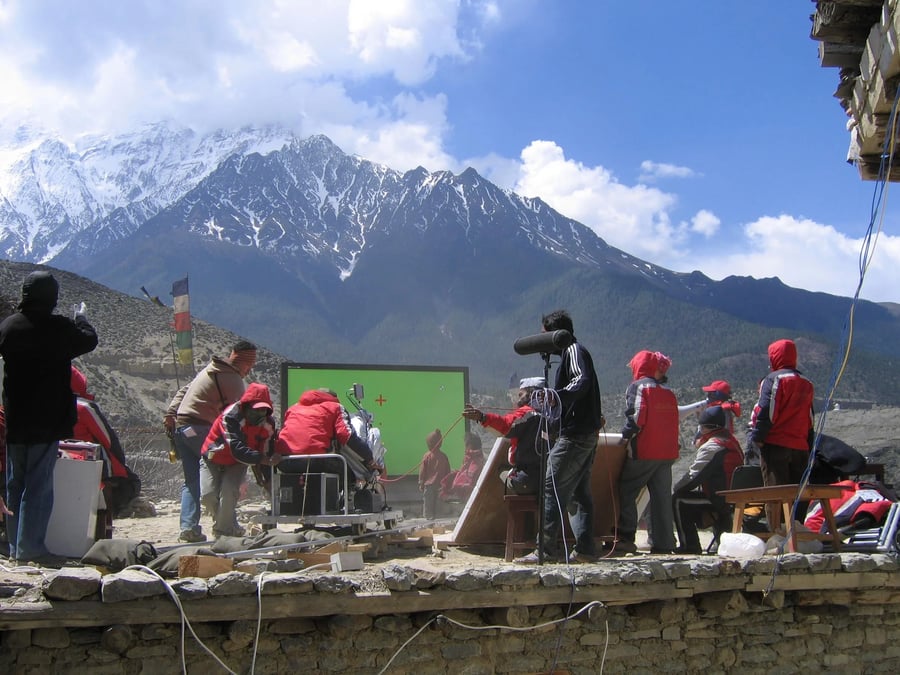
This 108in HD television was the biggest at the time when Panasonic shot its commercial in Mustang below Mt Nilgiri. The screen had to be flown in by helicopter to Jomsom and carried to the set since there were no roads at the time.
When Panasonic wanted to take a 108 inch television to shoot a commercial to Thini in Mustang, there was no road to the village. The screen set had to be lifted by a MI17 cargo helicopter to Jomsom and then hand-carried by the local production team to the set.
The finished Panasonic commercial showed the television against a stunning backdrop of Mt Nilgiri and was a hit. Getting the television set there involved civil aviation, transport companies, permits, production management, casting, local crew and an international creative team. The children in the commercial were local Mustangis.
None of this was particularly visible in the finished film, but without it there would have been no film to watch.
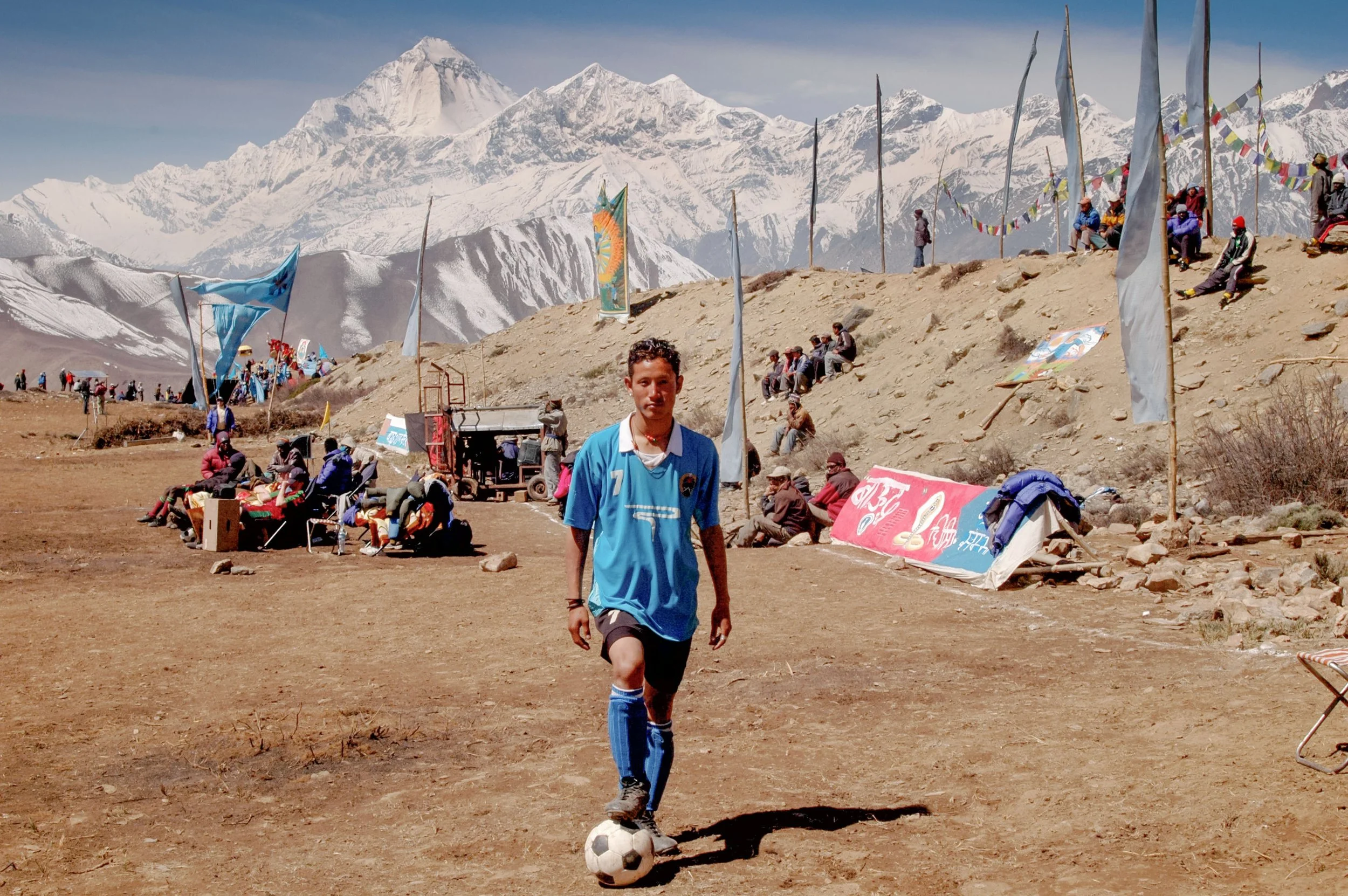
In 2006, a Powerade commercial for Coca-Cola Germany's FIFA World Cup campaign required an international football ground on a remote plateau in Mustang. There were no roads then, you got there either on foot, by helicopter, or hoofed it. Preparing the pitch took 11 days.
There were 54 European footballers and 12 players from the African United team who joined Nepal’s A and B Division footballers, along with around 350 extras. More than 550 people camped at the location for over a week. Snow fell continuously.
The football field and goalposts of the Coca-Cola Germany's Powerade FIFA World Cup commercial in Mustang the day after heavy snowfall. A Nepali footballer cast for the commercial takes a break between filming with Mt Dhaulagiri and Tukuche Peak as backdrop.
Every morning, the camp crew had to dig their tents out of the snow before the day’s shooting could begin. Camera, grip and support equipment travelled by helicopter, while food and other supplies had to keep arriving on mule trains.
Doctors, nurses and paramedics stayed on site around the clock. Oxygen was on standby, with a backup production team in Kathmandu in case anyone became unwell at altitude. Two hundred original match balls were brought in, and even the possibility of one rolling towards the edge of the cliff and down to the Kali Gandaki had to be factored in.
HOLI LAND
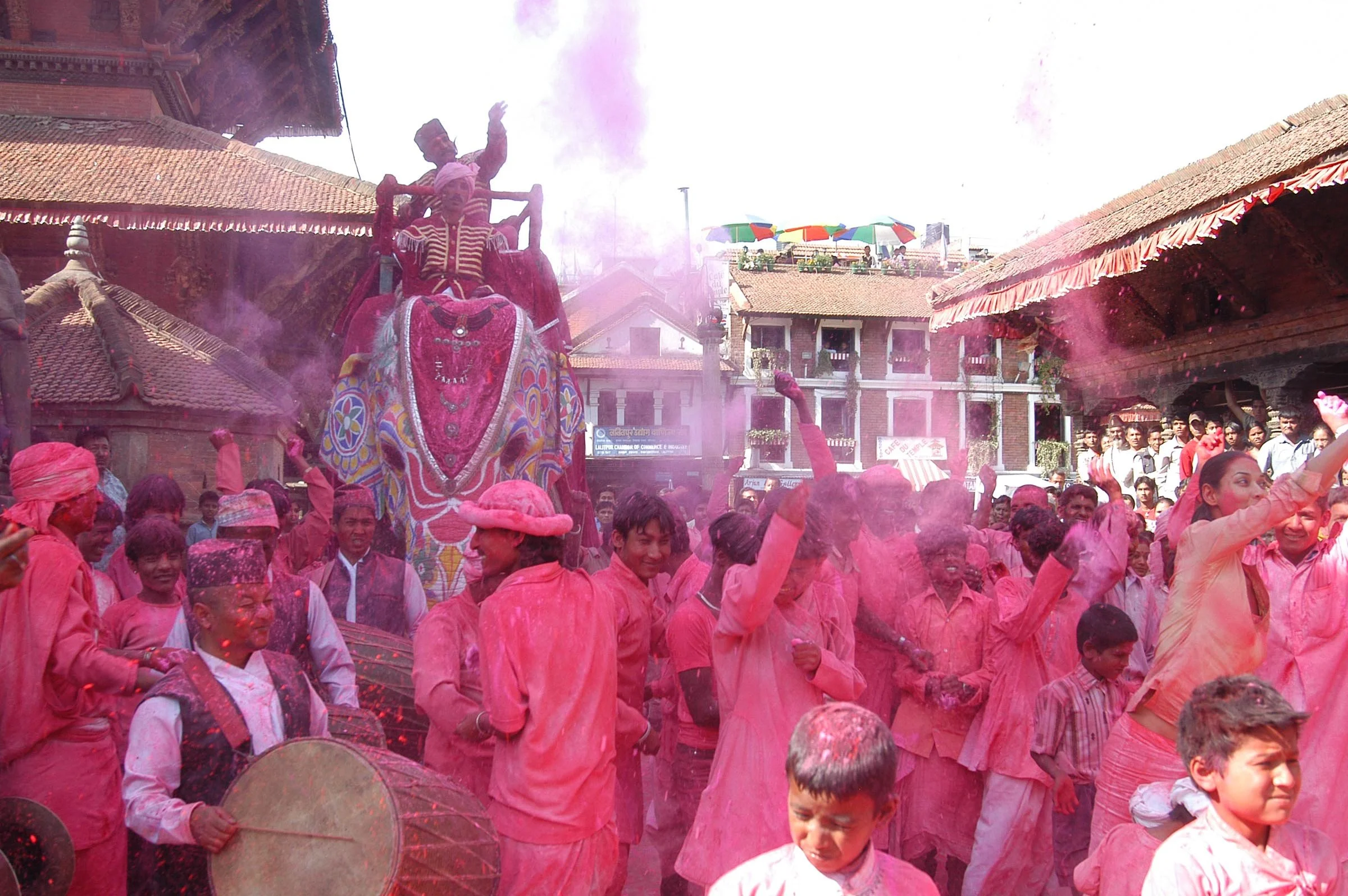
Then there was the Nippon Paint commercial, which involved moving more than 200 crew and around 400 extras between Bhaktapur and Patan Durbar Squares on a single day. Lighting and grip equipment, along with key technical specialists, came from India.
The restoration work at the two heritage locations took more than ten days. These were very different productions, but each depended on a long list of people and services working together. The camera may get the credit on screen, but the work that makes the camera's job possible is spread across an awful lot of people.
A staged Holi Festival scene during the Nippon Paint commercial at Patan Durbar Square, with a decorated elephant and extras set against the historic site. The commercial involved more than 200 crew and 400 extras across Patan and Bhaktapur.
Nepal is an ideal location for film shoots. But that does not a film industry make. A film industry requires a government that knows the potential of this for Nepal’s international publicity and employment. It needs the state machinery to streamline permits and fees so that production companies are not given the run around.
It means having competent crew, facilities, equipment suppliers and production services that make all kinds of shoots possible in Nepal -- feature films, television series, commercials or documentaries. Each needs people who know their job, state of the art equipment and people trained to operate them, services that can deliver and a production system that brings them together.
Take a young lighting technician who wants to become a gaffer. They may know the equipment and have attended a workshop, but they still need time beside an experienced department head. They need to learn how to build a lighting plan, organise the crew, deal with changes on set and take responsibility when something goes wrong.
And who pays them during the weeks of training? Which production is prepared to give them the first opportunity which matters more than we realise because production companies want crew with experience.
International producers have budgets, schedules and delivery deadlines to meet. When they bring in a department head, they look for people with credits, references and experience of working on productions of a similar scale. A talented Nepali cinematographer, production designer or electrician may be well known among local filmmakers and still be an unfamiliar name to a production company arriving from abroad.
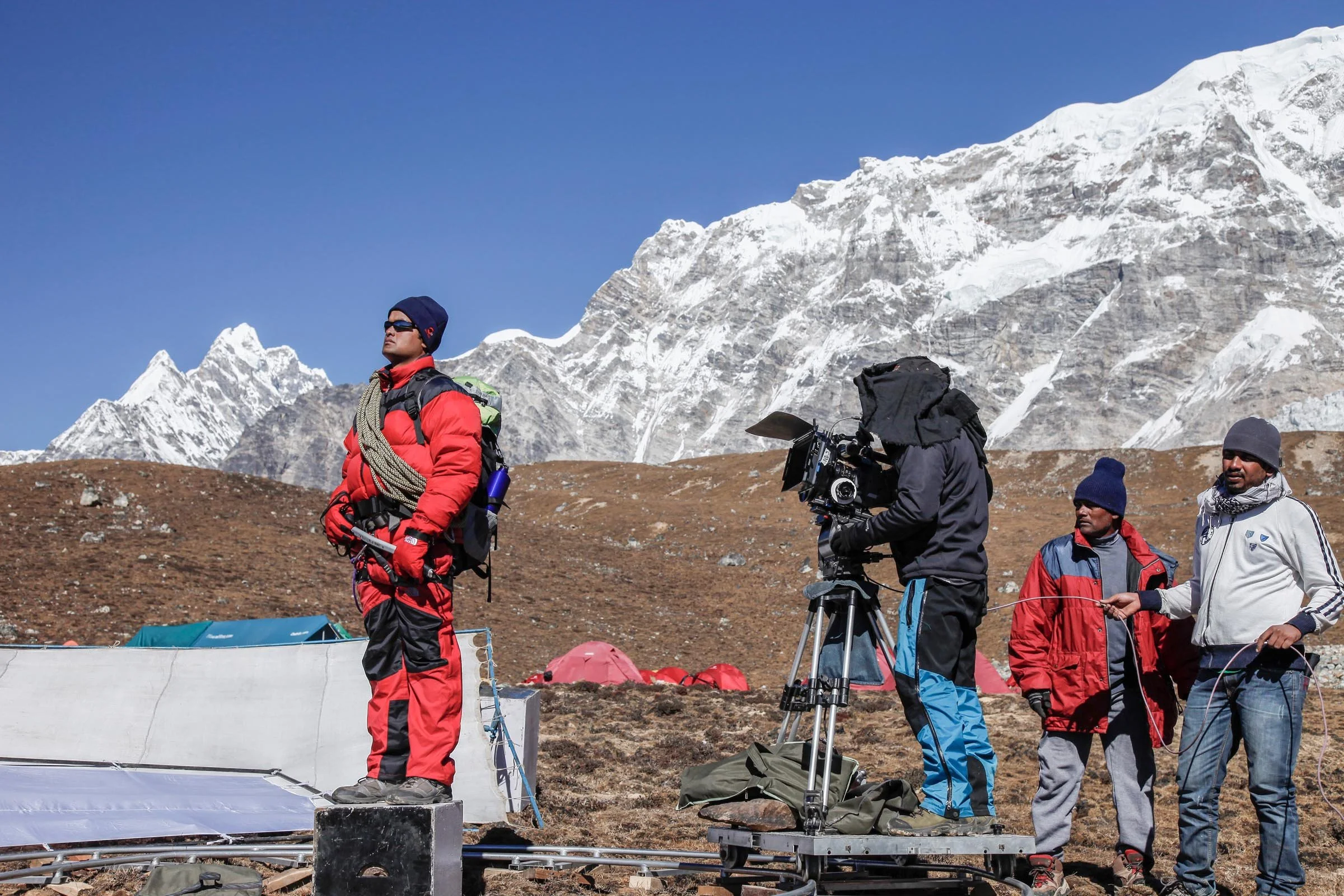
Bangladeshi, Indian and Nepali crew members working at Yala Peak High Camp in the Langtang National Park with a suitcase dolly and full-circle camera track for a commercial production at high altitude.
A foreign producer arrives with crew, locations, equipment and flights to organise. One authority needs the itinerary, another asks for equipment details, and another requires consent for a particular location. The same information can end up travelling from one office to another, sometimes with the producer or local coordinator carrying it personally.
A production coordinator should be arranging the shoot, not making a pilgrimage between government counters. Nepal's Motion Picture Rules already provide for a One Door or Window Committee for foreign filming permissions. They also envisage that permission issued under its policy should remove the need for separate licenses from other institutions for the same shoot.
The provision is there. Now it needs to work as a service. One digital application, one tracking number, internal routing, a published timetable and permits accessible to both the applicant and the field offices would make a considerable difference. Complete routine applications could have a 48 hour target.
Protected sites, restricted areas and aerial work would still need the checks they require, but applicants should know what those checks are and how long they are likely to take before a production is committed.
India's India Cine Hub offers a useful comparison. Its national portal provides a single window for filming facilitation and lists 475 production and support resources across 36 states and union territories. Nepal could put its own resources in one searchable place, from camera packages and key grips to sound mixers, casting services, studios and post production facilities.
Equipment details, availability, credits and references would be far more useful than a company description claiming to be world class. A visiting producer needs to know what is available, who can provide it and whether it will be ready when required. The people listed in such a directory will have acquired their experience somewhere. The next generation needs the same opportunity.
The United Kingdom's ScreenSkills Trainee Finder places paid trainees on film and television productions for 4-20 weeks. The production pays them through its payroll, names a supervisor and agrees on a progression plan. ScreenSkills can contribute up to £325 a week towards wages. Ireland requires productions seeking Section 481 tax certification to prepare a skills development plan and keep track of progress.
These programs put training into the production itself, where people learn by working alongside those who already know the job. Public support has a role here, and the Film Development Board's existing efforts should not be dismissed. Production grants can help films get made.
Workshops, masterclasses and training programs can introduce people to new skills and bring them into contact with experienced professionals. There is something to learn in that time, and a certificate to take home. God bless the certificate. But when the next producer asks who has actually worked on a set, the certificate cannot answer on someone's behalf. Knowing something about the job and having done the job are two rather different things.
Nepal could start an annual Screen Production Exchange with production companies, technical associations, film schools and partners in India, Thailand, South Africa and the UK. Maybe a first group of 12 could work in camera, grip, electrical and lighting, and art departments. They would be paid to work on real productions, have a mentor and be given responsibilities that count towards a verifiable credit.
Sending someone to a set and hoping they pick things up is not quite a training program. A modest trainee allowance, with its own budget alongside production grants, could help cover wages and supervision. There is no need to take money away from a film to do this. Continue supporting productions, but also support the people who will be needed to make the next ones.
A young technician gets paid experience and a credit, the production gets an extra pair of hands. More importantly, the technician has something to show the next production when asking for a job. When the Powerade shoot wrapped, the crew, equipment and all 200 footballs were flown out by helicopter.
The commercial went on television screens across Europe. The production records can tell us what went into Mustang, what had to be brought in by air and what was taken away at the end. They are less likely to tell us which Nepali crew members went on to senior positions, who got another job because of the experience, or who is now training someone else. Those are worth keeping track of, too.
The next time a football ground is built on a Himalayan plateau, it would be good to see a Nepali gaffer running the lights, a local grip team confident with its equipment and a production manager who already knows whom to call. Better still, let someone who joined the previous production as a trainee be the one showing the newcomers around.
How many of the people who made the last production possible will be ready to lead the next one?
Gautam Dhimal is a Kathmandu-based journalist producer for international films and has served on Nepal’s Feature Film Selection Committee for the Academy Awards (Oscars). www.GautamDhimal.com
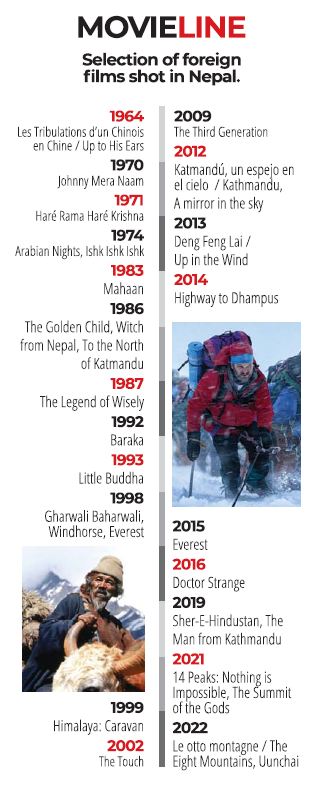
MOVIELINE
Some of the more famous films that have been shot in Nepal. Instagram, Facebook and YouTube videos by travel influencers and content creators now do more to show Nepal to the world. With AI videos, it is not necessary for Holly and Bollywood and other studios to actually shoot on location.
Philippe de Broca’s 1965 adventure-comedy Les Tribulations d'un Chinois en Chine (later retitled Up to His Ears) starring Jean-Paul Belmondo featured 15 minutes of Kathmandu and Himalayan panorama at a time when Nepal was just opening up to the world.
Bollywood made Nepal famous in India by using the country as a location for its many films, starring stars like Dev Anand in Haré Rama Haré Krishna in 1971.
Sequences of Pier Paolo Pasolini’s movie Arabian Nights was shot at Jaisi Deval, Kathmandu Darbar Square, Patan’s Sundari Chowk, Pujari Math and Bhelukhel in Bhaktapur.
The Hollywood martial arts film The Golden Child with Eddie Murphy was shot on location in Asan and Indra Chok with some Nepali extras in 1986. Two more international films were shot in Kathmandu that year: the supernatural Hong Kong film Witch from Nepal and the British cinema To the North of Katmandu.
Bhaktapur Darbar Square was turned into a set for Kapilvastu Palace for Bernardo Bertolucci’s Little Buddha in starring pre-Matrix Keanu Reeves as Siddhartha Gautam. Little Buddha’s production contributed one-tenth of 1992’s tourism revenue in Nepal.
The 1998 IMAX documentary Everest took footage from the disastrous 1996 spring mountaineering season in Nepal.
Éric Valli’s Oscar-nominated 1999 docudrama Himalaya (also titled Caravan), was shot over nine months on location in remote Upper Dolpo.
Michael Palin shot his BBC series Himalaya in Kathmandu, Patan, Bhaktapur and Pokhara in 2004. During a trek in Kaski, he and his film crew were detained briefly by Maoists guerrillas.
Cameron Diaz, hosted a documentary series for MTV called Trippin’ shot at nature sites around the world in 2005 of which the first episode was filmed in Kathmandu and Chitwan, featuring Diaz with actress Eva Mendes, rapper Redman and Mark Hoppus of the hit rock band Blink-182.
In 2015, Benedict Cumberbatch was filmed for Marvel’s Doctor Strange in Thamel, Indra Chok, Swayambhu and Patan. But most of the filming was done in a studio in England.
Only the Base Camp scene of the 2015 movie Everest starring Jason Clarke, Jake Gyllenhaal, Josh Brolin was shot in Nepal. The rest was filmed in Italy and recreated in a studio in the UK. Real-life pilot Vijay Lama played the Nepali Army helicopter rescue pilot, Madan KC.
In 2022, Khumbu became the location for the Bollywood film Uunchai. Supporting actors made Namche Bazar their Base Camp, although the main hero Amitabh Bachchan did most of his scenes in a studio in Mumbai.
In 2026, the biopic of Tenzing Norgay, TENZING, was filmed at the British embassy residence in Kathmandu, in Khumbu and Mustang.