
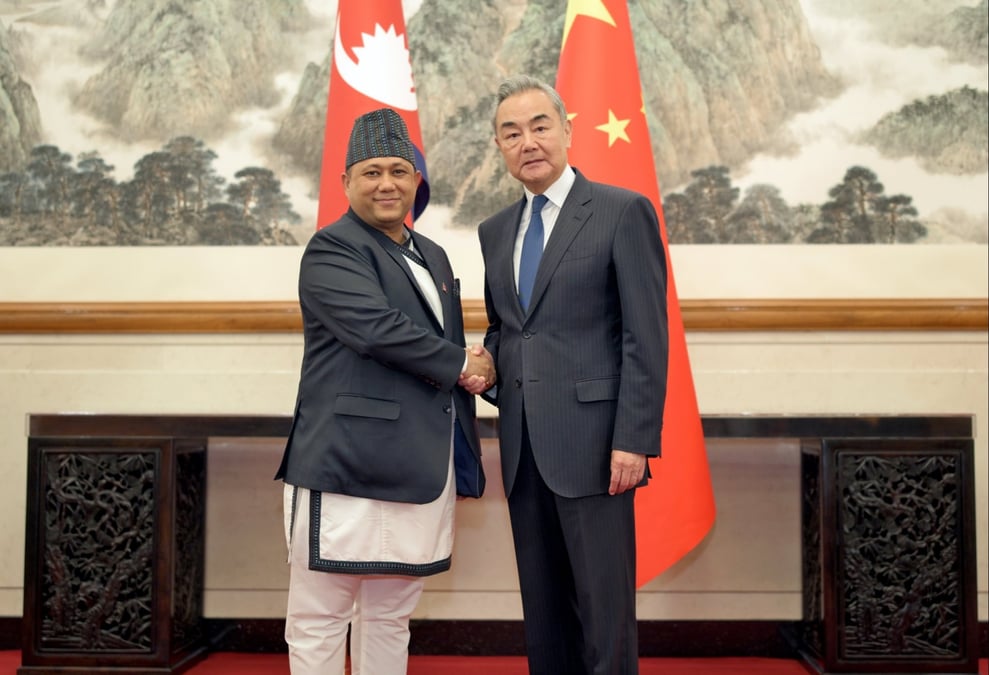
Foreign Minister Shisir Khanal is in Beijing on a three-day visit at the invitation of Chinese Foreign Minister Wang Yi. The main point on the agenda is to reset Sino-Nepal ties and to clear the air about last year’s GenZ protest.
The Chinese have had qualms about how regime change happened in Nepal, and its outcome. More concretely, bilateral discussions focussed on stalled projects under the BRI framework signed by then Prime Minister K P Oli in 2024 such as the Kerung transmission line, the trans-Himalayan railway and other infrastructure.
The Chinese Foreign Ministry said in a statement that Wang raised the issue of allowing a conducive business environment for Chinese investors in Nepal, and hinting at US projects in Nepal said: “Distant relatives are not as good as close neighbours.”
The visit comes immediately after Khanal’s Delhi trip last week, and proves that Nepal is giving continuity to its equidistance doctrine. The visit also coincides with the possible ceasefire agreement between Iran and the United States, and the reopening of the Strait of Hormuz through which China and India both import most of their petroleum.
The erratic behaviour of prime minister has in fact brought Beijing and Delhi together to coordinate policies on Nepal, diplomatic sources say. Both believe that the protests that led to Balendra Shah's premiership is an American-backed colour revolution.
Nepal is overwhelmingly dependent on India for most of its trade and access to the sea, but proximity to China has allowed the country access to the latest advancements in EVs, batteries, and solar panels. Battery-powered vehicles now account for 70% of new four-wheel passenger vehicles, placing Nepal only behind Norway last year in EV uptake.
And yet, Nepal’s understanding of its northern neighbour is so limited that the government and businesses have not been able to make use of even the zero-tariff access since 2009 to over 8,000 Chinese product categories. Nepal’s import-to-export ratio with China is grossly skewed.
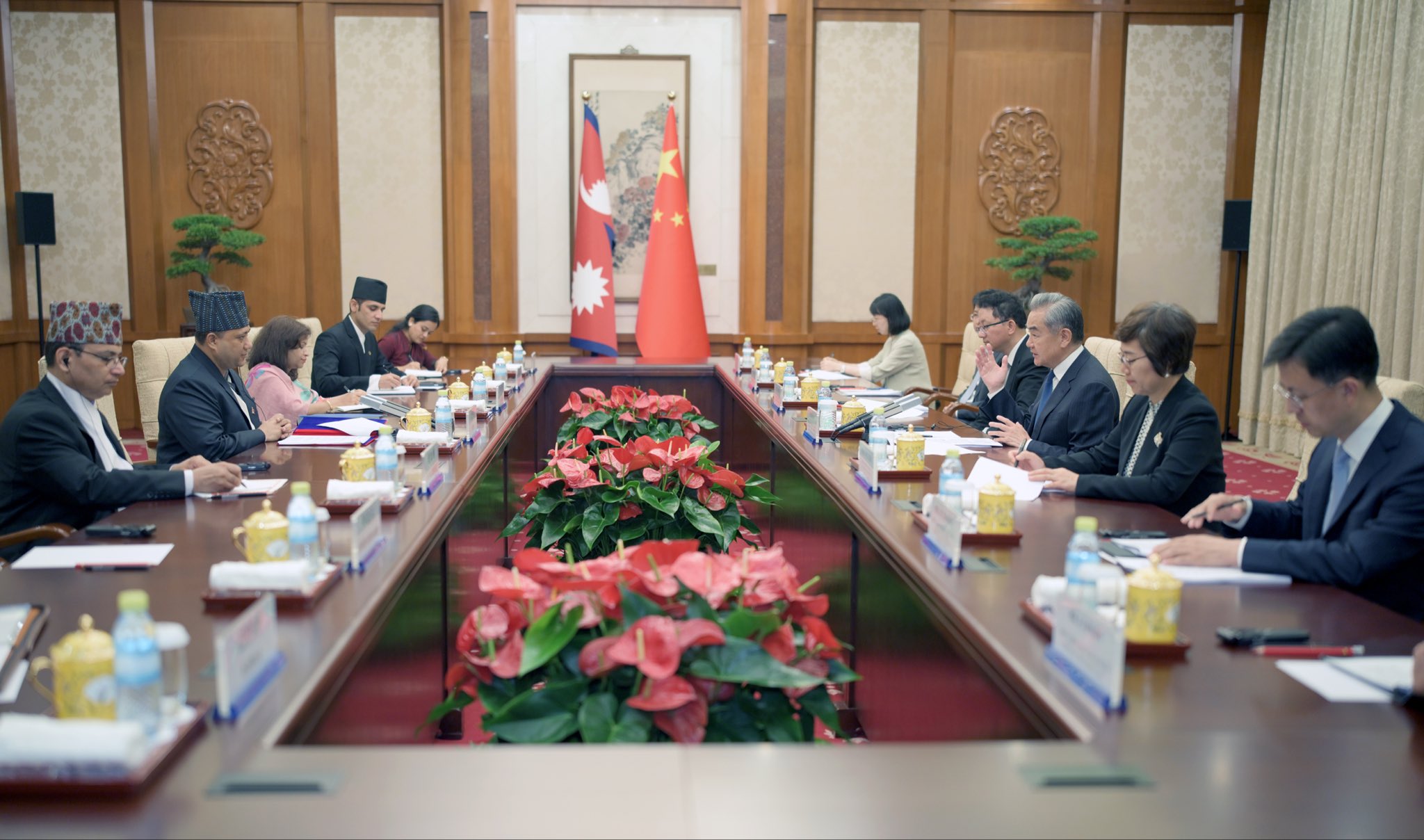
In an interview as a RSP candidate in the March election, Shisir Khanal lamented the foreign ministry's lack of expertise and low institutional capacity on China. Now as foreign minister, he has a chance to set that right. Khanal’s team held bilateral talks with Wang Yi, engaged with members of the Nepali community and Chinese businesses to discuss bolstering bilateral investment and trade.
LETHARGIC STATE
Back in Kathmandu, the Nepal Economic Forum (NEF) has published a cross-sectoral analysis of Nepal-China relations by Nepali researchers. The conclusion is that the main obstacle to progress in improving economic ties are within Nepal itself. Bilateral agreements are signed on many projects, but are never implemented by a lethargic state.
Indeed, Nepal was the first South Asian country to receive Chinese Approved Destination Status in 2002, and yet is still not effectively competing for Chinese tourists nearly a quarter century later. Nepal has no power trade agreement with China despite the demand for electricity across the border that would yield Rs22 per unit against Nepal's power export rate to India of about Rs8 per unit.
One of the authors of the NEF report Arya Awale told Nepali Times: “Our main question was whether Nepalis can BET (Business, Energy, Tourism) on China, but as we progressed we found that a lot of failures are institutional rather than external or geopolitical.”
Nepal imported goods worth $2.67 billion from China in 2025 while its exports stood at only $17.3 million — a ratio of 130:1. In contrast, the trade ratio with India is just 5:1. Nepal exports more in value terms to the United States, Germany, and the United Kingdom than to its northern neighbour.
Nepal continues to approach trade with China using frameworks and assumptions developed primarily for trade with India, despite the Chinese market operating under fundamentally different regulatory, logistical, linguistic, and consumer systems.
For instance, China enforces stringent quarantine measures, administered through a regulatory system led by the General Administration of Customs of China (GACC) which imposes detailed requirements on product safety, traceability, processing conditions, and facility-level inspections that many Nepali producers are just not equipped to meet.
The absence of accredited testing laboratories and SPS facilities at Nepal's northern border points means Nepali exporters must send product samples to laboratories in third countries such as India, Hong Kong, or Thailand for certification, significantly increasing transaction costs, delays, and uncertainty.
“The trade deficit is increasing due to infrastructural and institutional limitations. Border infrastructure, or lack thereof, is also a major limiting factor. We cannot afford to wait for China to build it for us, we have to do it ourselves,” states another of the report’s authors Mahotsav Pradhan.
China has the largest foreign joint venture investment projects to date in Nepal like Hongshi-Shivam Cement, but the company faces operational hurdles despite government assurances of infrastructure support, adds Pradhan.
India has put a 900MW cap on electricity imports from Nepal after subtracting projects in which Chinese contractors or equipment are involved. But the report says Nepal needs a ‘parallel-track strategy for advancing the northern relationship without foreclosing the southern one’.
India's 2018 Cross-Border Electricity Guidelines has meant that Nepal was forced to remove Chinese developers from at least six hydropower projects and award them to export-oriented Indian companies. But Nepalis pay more for their own electricity than what India pays per unit. So, instead of stoking geopolitical tensions, Nepal’s strategy should be to electrify households, domestic industries, tourism, and agriculture.
Another co-author Suyasha Shakya argues that a legal framework for cross-border electricity trade would not require Nepal to abandon its southern relationship. Negotiations with China that started in 2018 have stalled. Nepal has drafted a power trade agreement text and there have been six rounds of bilateral technical group meetings, but things have not moved.
“The power trade agreement has nothing to do with geopolitics, nor does developing our solar and storage potential as well as implementing foreign currency hedging for power purchase agreements," says Shakya, who thinks solar energy has lower political risk than large hydropower projects. Solar installations can use Chinese equipment and expertise, but do not need Chinese equity.
The report adds that pump hydropower storage, in which solar power lifts water uphill to a reservoir for later release through turbines for peak hour generation, is well-suited to Nepal's topography, and in which China has vast expertise.
VISIT NEPAL
Chinese tourists started flooding into Nepal after it became the first South Asian country to receive China’s Approved Destination Status in 2002, and arrivals peaked in 2013/14 before the earthquake. Waiver of visa fees for Chinese citizens in 2016 helped boost figures again to nearly 170,000 in 2019 before the pandemic put a brake on everything.
Last year was Visit Nepal Year in China with a target of bringing half a million Chinese tourists to Nepal, but only 95,480 came. Another co-author of the NEF report Manju von Rospatt explains why: “NTB spends around 70% of its budget on international marketing but very little is deployed to target Chinese tourists. We were also nowhere in Chinese platforms such as RedNote, Weibo, Dǒu yīn or Wechat, making Nepal completely invisible as a tourism destination.”
There are 150 Chinese restaurants and 24 hotels just in Thamel and there are more in Pokhara. The share of fully Chinese-controlled operations in key zones must be capped unless they partner with Nepali firms, notes the report.
Nepal also needs to cater to changing behaviour like solo traveling and spiritual tourism as these are potential longer-stay and higher-spend segments interested in trekking, wellness, and cultural immersion.
Chinese tourists are deterred by negative perceptions about Nepal regarding expensive flights, safety, political stability, and service quality — concerns that were amplified after the September 2025 violence, the report adds.
Foreign Minister Shisir Khanal assured an investment conference organised by the Nepali Embassy in Beijing as well as his counterpart Wang Yi that Nepal is seeking a more balanced approach that allows for maximum benefit for both countries.
A good place to start would be to follow through with past agreements. Says NEF’s Arya Awale: “We are closely observing the outcome of the visit, and expect progress in trade, investment, and infrastructure.”