
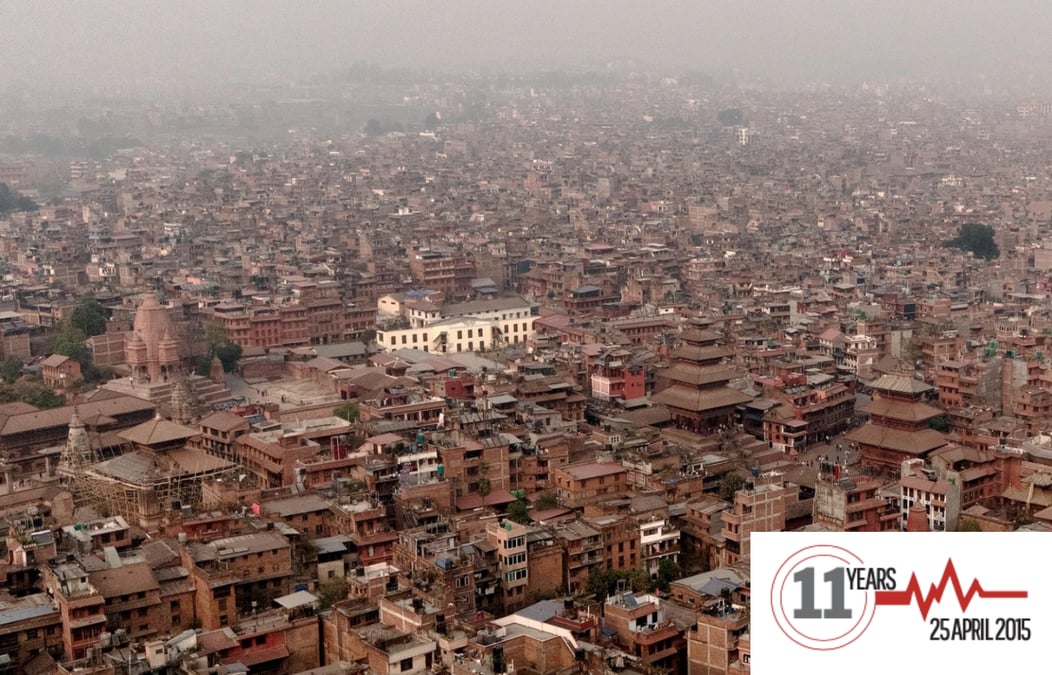
Even 11 years later, 25 April 2015 is etched into the psyche of every Nepali who lived through it.
Some remember the first crack on the walls. Others recall the low, deep rumbling. Many flash back to the silence that followed, when phone lines were jammed, and how the time stood still between aftershocks.
Many remember waiting for news, for help, for certainty that never came. April 25 did not just shake buildings, it exposed some harsh realities of Nepal's disaster management system.
Disasters in Nepal are not isolated events, they are what medicine would call an 'acute on chronic' crisis. They reveal the deeper, long-standing weaknesses: in our road network, our hospitals, governance, and most critically, our lack of preparedness.
Nearly 10,000 lives were lost, entire districts were flattened, thousands of livestock and homes were lost. While attention was drawn to Kathmandu Valley and surrounding areas, most of the devastation was in hard to reach rural areas.
The first responders were not professionals. They were our neighbours who dug through rubble with bare hands. They were mothers who pulled children from collapsed homes. They were communities who organised themselves without training, without equipment, without formal leadership structures.
The first 48-72 hours after a disaster determines who lives and who dies. In Nepal, those hours often pass before outside help can arrive, especially in areas where geography and infrastructure delay response.
If 2015 is too far back to remember, let us look at the 2023 Jajarkot earthquake: a pregnant woman dying from the cold, supplies bottlenecked in district offices instead of reaching villages, and rubble cleared days later.
All of this means that survival depends on communities. And yet, despite having disaster response frameworks on paper, there was no meaningful implementation of community-level preparedness in 2015.
Plans spoke of training, simulations, and local capacity building, but these were not translated into action where they were needed the most. When the earthquake struck, communities responded with courage and improvisation despite their own losses.
But now we have evidence that things can be different. In places like Ramaroshan village in Achham district, community responders have been trained to recognise emergencies, control bleeding, splint fractures, and stabilise patients after road accidents and falls. They are showing us that when communities are equipped, they can deliver emergency care.
This is crucial not only during disasters but every single day. A bus goes off the road, a child is injured, a woman falls from a tree, a landslide cuts off access, and so on. In these moments, the difference between life and death is often what happens before a patient reaches a hospital.
Preparedness is not just about earthquakes. It is about building a system that works during everyday mishaps that quietly define our health outcomes.
Sooner or later, there will be another earthquake in Nepal. It is a geological certainty. The 2015 disaster did not release all the energy and there has not been a major quake in western Nepal in over 500 years.
Besides, we also have to be prepared for floods, landslides, and fires, all of them made worse by the climate crisis.
Community-based responses should not be treated as a backup plan, we need to scale it up. We must build local disaster leadership, conduct real drills, and equip communities with basic tools, first aid, and communication systems.
After a disaster event, people also need reassurance that they have not been abandoned, that their lives matter whether they live in Kathmandu or Jajarkot, and that the system sees them. Because when communities feel neglected long enough, the consequences are not only humanitarian but political.
Rural neglect, lack of opportunity, and absence of state presence have contributed to instability and conflict in the past. The Maoist armed insurgency is an example.
Disasters do not create these fractures, but they deepen them. Hence, preparedness is not just about saving lives, it is also about building trust in a state.
25 April should be a day of remembrance, a day where we hold ourselves accountable. It should also be a day of possibility. Disasters, painful as they are, create opportunities for countries to change their trajectory.
The 2015 earthquake was one such moment. Jajarkot was another reminder. We cannot keep letting these moments pass.
This is a call to our new government to invest in systems that start from the ground up, and to take what has worked in places like Achham and scale it nationally. The government has a real opportunity to build communities, not just for them.
This is also a reminder to communities that preparedness is not a privilege, but a right. As we mark the 2015 disaster and mourn the lives lost, we should honour them through action, through real preparedness.
The next disaster is just waiting to happen, and when it does, it will once again test us and our systems. We can either choose to confront it the way we did in 2015 or with communities that are trained, equipped, connected, and ready.
25 April is not over. But our preparedness will vastly differentiate the outcome.
Ramu Kharel is an emergency medicine specialist and Assistant Professor at Brown University in the USA. Hefounded the non-profit HAPSA Nepal that works to strengthen community based emergency and trauma care in Nepal.