

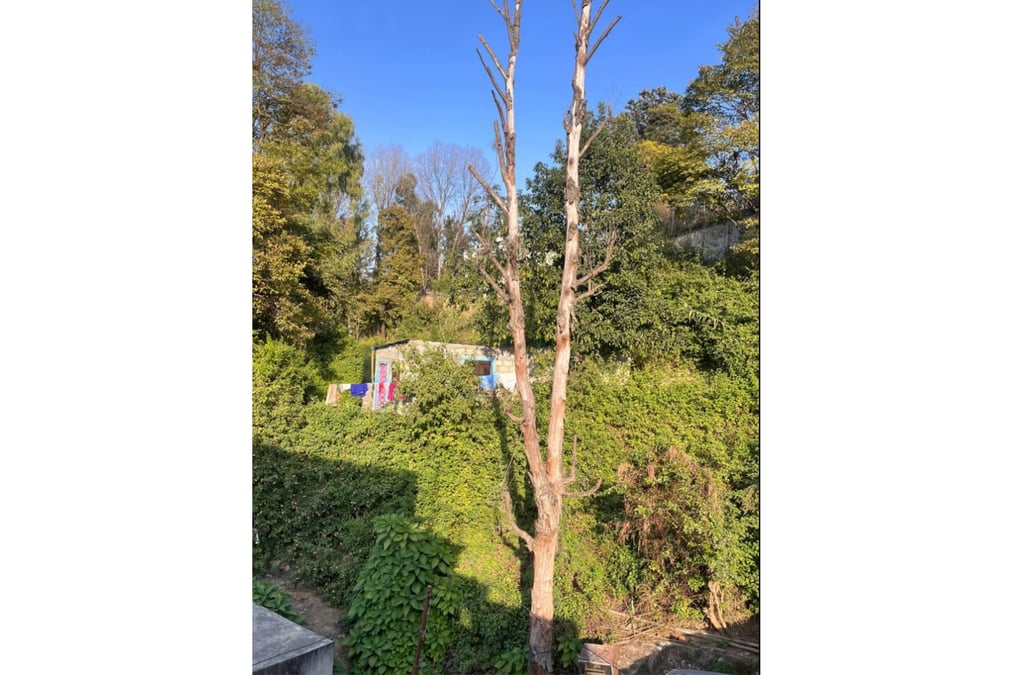
Next to my home in Bhainsepati stood a dead Uttis tree next to a public tap. A nearby water tank built a year earlier had killed its roots.
If the tree collapsed, people living nearby and those queuing up to fetch water at the tap would be hurt. With the storm season approaching, the risk was obvious. The tree could also fall on my own house, so I volunteered to find a way to remove this threat.
Little did I know how difficult it would be. A forest officer acquaintance told me there is a special procedure for cutting risky trees. I contacted the Lalitpur District Forest Office (DFO).
He said a technical report from a field officer was needed, and passed on her number. When I called, she asked for the location, photos, and a video. I send them all.
The ward office also suggested I use Lalitpur Metropolitan City’s mobile app, Lalitpur Alert, to report the problem. I uploaded photos, and submitted the complaint. This seemed to be very easy and efficient.
Indeed, the next day the municipality called me back and I explained the situation. They said they could not act without permission from the DFO. I asked why the app existed if the city could not act on such complaints. The officer said he did not know. My happiness was short-lived.
A couple of days later, the app notified me that my problem had been solved, and the complaint was removed. But the dead tree still stood there defiantly.
A week later, two forest technicians arrived on a scooter to inspect the tree. They looked up at the tree and asked if I had a measuring tape so they could measure its diameter.
“You are the technicians,” I told them. “You came to inspect the tree, and you came without a measuring tape?”
I rummaged at home and found a tape measure. They got the diameter and said they would prepare a technical report, but I would have to obtain a recommendation letter from the ward office and submit it to the DFO.
“This tree is dead,” I told them. “It is on public land. You have seen it with your own eyes. You know it's dangerous, so write a report and arrange for it to be cut. Why do I have to run from office to office to apply for recommendation letters?”
Their answer was simple, yet expected: “Those are the rules.”
They left, and I gave up. Two technicians spent half a day visiting the site. The metropolis runs a complaint system with a mobile app funded with public money. The ward office has staff to solve problems. Yet none of these institutions took the responsibility to remove a dangerous tree.
Everyone is busy citing rules and regulations and passing the buck. Weeks passed. Everyone reacted to the problem, but no one took any responsibility to resolving it.
Then, one bright December morning under a deep blue sky, a few neighbourhood boys were swinging their axes on the trunk. They had no proper equipment, no safety gear, and no professional experience.
I gave the boys some money and so did a neighbour. It took an hour or so for the tree to come crashing down safely. We had paid to have the tree cut illegally, and the matter ended there.
Multiple government offices, technicians, procedures, and mobile apps could not remove a dangerous tree, and we had to break the law to cut it. The tree is gone now, but the real problem remains: an inefficient bureaucracy.
It is perhaps symbolic that the tree is the election sign of the Nepali Congress, which was part of Nepal's governance and bureaucracy for decades and did not perform well in this month's election.
That is the bureaucracy that the new RSP government now has to get to work. But it will not be easy.
I posted on Facebook: ‘When people feel leaders have grown arrogant or corrupt with power, they change their minds and their votes. If those who replace them follow the same path, voters will again change their minds and votes.’
I continued: ‘The strength of democracy lies in this simple principle: the more citizens act as independent voters, the stronger democracy becomes. The more they behave as party loyalists, the weaker it grows. If we want a better system, we must demand deep reform of the state bureaucracy and hold institutions accountable.’
The first responses came from two senior government officials. They told me privately that they agreed by 200% but could not say so publicly.
It is quite normal for a Nepali to get the run around in government offices, it is almost a given to be asked for a bribe. As an environmental reporter and citizen, I have numerous such examples.
It is not just one sector that has been suffering. It is everywhere, and this is just an example of how complicated our bureaucracy is. As a 40 something person, I am old enough to remember the 1990 pro-democracy movement, the Maoist insurgency. Many promises made then by the politicians were broken.
We fought for rights, we fought for regime change. The country has changed political systems several times, from monarchy to multiparty democracy and finally a republic.
Yet one thing that remains largely untouched or reformed is our inefficient and corrupt bureaucracy. The new government, to be led by the youngest prime minister in our history must start this reform if it wants to deliver.
Otherwise, we may have to keep changing governments every few years, and still find ourselves unable to legally cut down even one dead tree.