
|
|
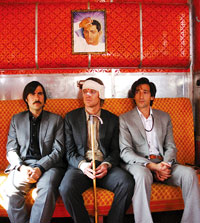
Afilm like The Darjeeling Limited is always suspect. Made by Wes Anderson in his trademark style, the film is showy, vain and utterly insincere. By extension, those of us who love this style are seen as occupying a pretentious and esoteric outpost against the cultural mainstream.
This is a style that Anderson aced first in Rushmore (1998) and then more solidly in The Royal Tenenbaums (2001), perhaps one of the most memorable films of this decade, and the milestone by which all his films will inevitably be measured. Both admired and criticised for an incorrigible obsession with mannerisms and eccentricities, Anderson's films stand out for how profoundly entrenched they are in human emotions. In the unabashedly artificial and decorative world of Anderson, though, these emotions are manifested not in the abstract but in actual, concrete objects, i.e. props, which Anderson uses meticulously.
A quirky materialism, compulsive wit, delicate comedy, a contained melancholy of filial disaffection and a nostalgic longing for reunion are characteristic of his films.
Darjeeling takes you into that world, aboard a fantastically festooned Indian locomotive. It's a story of three brothers who have gathered for the first time since their father's funeral a year before in order to heal themselves with a 'spiritual journey' across India, to bond, to mourn their father, and to find their lost mother. Eldest brother Francis (Wilson) is bandaged from a recent accident yet has an overbearing sense of authority. Peter (Brody) hides under a pair of shades he inherited from the dead father and broods over his marriage and expected baby. Youngest Jack (Schwatzman) lusts after the Indian cabin hostess and writes fiction. Together they travel across Rajasthan with their matching sets of luggage.