
While a graduate student in anthropology at Stanford, Elizabeth Enslin meets fellow student Promod Parajuli from Nepal and falls in love.
Enslin had wanted to study African culture, and had romanticised about working there but romance takes her to Nepal instead. She follows Parajuli to India researching education and the grassroots movement. They briefly visit Parajuli’s family in Nepal after which they return to the US, get married and finish their studies.
They travel back to South Asia, and while Promod goes to India to continue his research, Enslin, pregnant with their first child, stays back with Promod’s family in Nepal. She is not just a daughter-in-law; she is learning and experiencing Nepal’s Brahmin culture up close and personal. As her sociological imagination takes over, you can almost see Enslin taking notes about caste and kinship as her husband’s family goes about its daily chores in a remote Chitwan village.
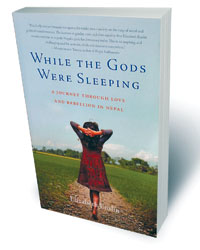
A Journey Through Love and Rebellion in Nepal
by Elizabeth Enslin
Seal Press, 2014
Paperback, 312 pages
Although her in-laws are welcoming and gracious, Elizabeth is still considered culturally impure and is therefore not allowed into the kitchen to cook rice. She feels her outsider status acutely, and often wonders what she is doing there.
Her anthropologist mind admonishes her for following her man to this remote corner of the world. But it is as if her marriage, her life as a Brahmin wife, daughter-in-law and mother are all extensions of an academic fieldtrip, the results of which are documented in her book While the Gods Were Sleeping.
Enslin is interested in why and how women rebel at the local level. She interviews Nepali women who dare to strike out and speak out, and also women who are oppressed by class, caste and tradition. She investigates the cultural roots of domestic violence, the dowry system, child marriage and other manifestations of patriarchy. She records local women’s songs and poems on poverty, gender, inequality and political oppression and translates songs of defiance sung at Tij and Ratauli.