
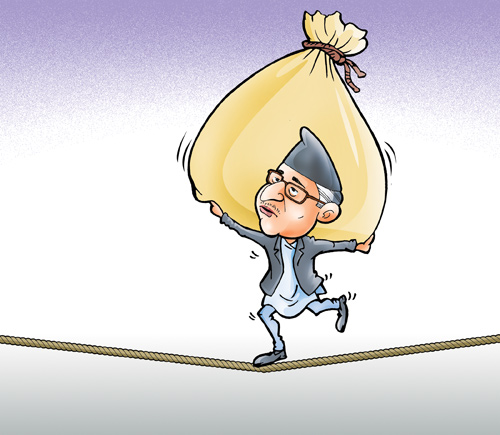
Prime Minister Oli is looking more and more like a man just trying to buy time for his political survival. He came to power with an ambitious game plan of reviving the economy, putting relations with neighbours on an even keel, and resolving the Madhes crisis. Eight months into his term, he seems to have settled for just one objective: not being overthrown.
After having stemmed a coup attempt last month by his own coalition comrade Pushpa Kamal Dahal and the opposition Nepali Congress, he is going all out to prolong his tenure in office so he can go down in history as being the leader who stood up to India. He is also mindful that he is living on borrowed time in terms of his personal health. With nothing left to lose, Oli is stoking New Delhi’s paranoia about China, knowing fully well how Indians get rattled even as talking heads work themselves into a frenzy on television over ‘Chinese inroads’.
Leaders can fool some of the people some of the time, but they cannot fool all of them all the time. Oli is playing the nationalism card to the hilt, but that stratagem has a limited shelf life. The Chinese will go only go so far in provoking the Indians, as we saw during the Blockade. And for Nepal there is no option but to come to terms with our southern neighbour’s insecurities.
Oli is also walking a tight rope between rival power centres in New Delhi — balancing and taking advantage of conflicting signals coming from BJP-RSS politicians and the intelligence bureaucracy over Nepal policy. Ever since Prithvi Narayan Shah compared Nepal to a yam between two boulders, the conventional wisdom has been that we are squeezed between the two giants, to the north and south. We may have to modify the analogy: today Nepal is instead trapped between the interests of the Hindu-right and the rest in New Delhi.
There used to be a time when India had a ‘twin pillar’ strategy to simultaneously back the monarchy and democracy in Nepal. It would have worked to ensure stability, but somewhere along the way that policy lost currency.
Republicanism, secularism and federalism were somehow slipped into the new constitution. After the rise of the BJP, we detect moves to try to dismantle the three -isms: roll back secularism, rework federalism and possibly even restore the monarchy. The ‘twin pillar’ policy has been replaced with ‘twin contradictions’ being played out between proxies on the ground in Nepal.