
 |
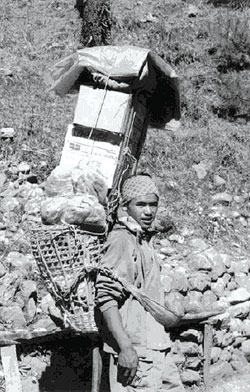
Nepali porters carry extraordinary loads, a 50kg sack of rice plus several cases of beer and fizzy drinks would not be atypical. With a basket ('doko') supported solely by a head-strap ('naamlo') porters can walk for hours resting often as they ascend up the trail. Carrying this heavy load can be potentially dangerous at high altitudes (above 2,500m) where the oxygen level is lower than in their normal work environment in the mid-hills of Nepal (about 1,300m).
Several years ago we set-up a weigh station at an altitude of 2,800 m, about a half-day trek south of Namche (3,440 m), the last major marketplace before Mt. Everest Base Camp. We counted the porters and weighed them and their loads on the day before the weekly Saturday bajar.
A total of 545 male and 97 female porters (and 32 yaks) showed up between 7am to 5pm, and more passed by earlier or later in the day. We took measurements of 113 randomly selected porters. Their average load was 89 percent of their body weight (BW), 88 percent of the men and 71 per cent of the women carried more than 50 per cent of their BW, while 20 per cent of the men carried more than 125 per cent. There were some who were outside our random sample that carried 200 per cent of their body weight (for example, a 50 kg porter carrying a 100 kg load and ascending Namche Hill).