That winter day in January 1664 marked an exceptional event in the reign of King Pratap Malla of Kathmandu. It was 15 Paush 784 of the Nepal Sambat and for the first time, a historical event was being immortalised on canvas for generations to come.
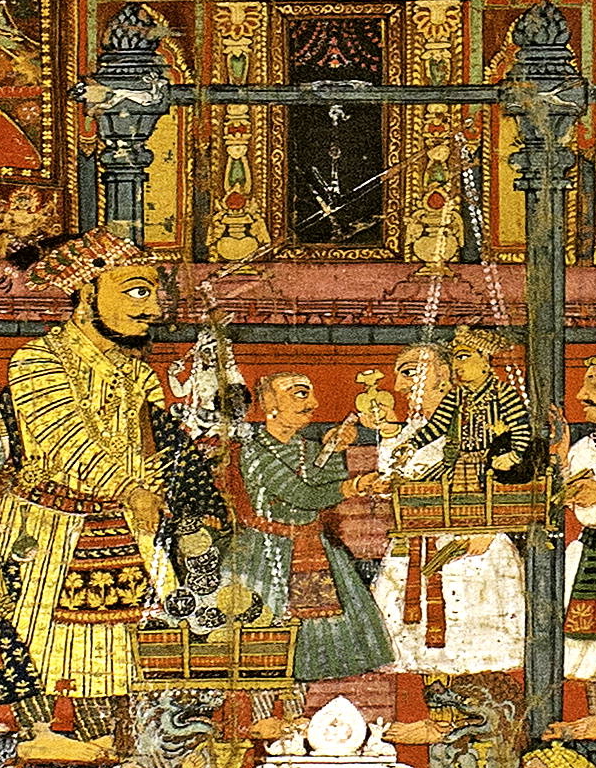
The occasion was the grand Tuladaan ceremony of the King’s youngest son Chakrabartendra Malla from his wife Anantapriya, an Indian princess from Cooch Behar in present-day Assam.
During the ritual, the prince was weighed against gold, silver, pearls, and other precious stones, which were then offered to Goddess Taleju Bhavani, the guardian deity of the Malla dynasty.
The 170 x120cm painting captures the time of King Pratap Malla in all its splendour and is more than a personal tribute to his son: it is a significant visual historical document. It was evidently completed five years later in 1669, and could be considered a photographic record, with retrospective recreation of the event by the unknown artist.
A Tuladaan ceremony is performed to purify one’s karma, quell impending bad luck, or as an act of charity and devotion. Chakrabartendra Malla was not well, and the ritual was performed in hopes of restoring his health. King Pratap Malla had arranged for each of his sons to take turns ruling Kathmandu so they got administrative experience. But Chakrabartendra died just two days after assuming power in 1670 (790 NS).
This painting is considered the earliest known example in which the composition is dominated by an architectural landscape: the Taleju Temple. Given the stylistic features such as side-profile facial depictions and the rendering of human forms, it is believed that the Nepali artist was trained by a Rajput master.
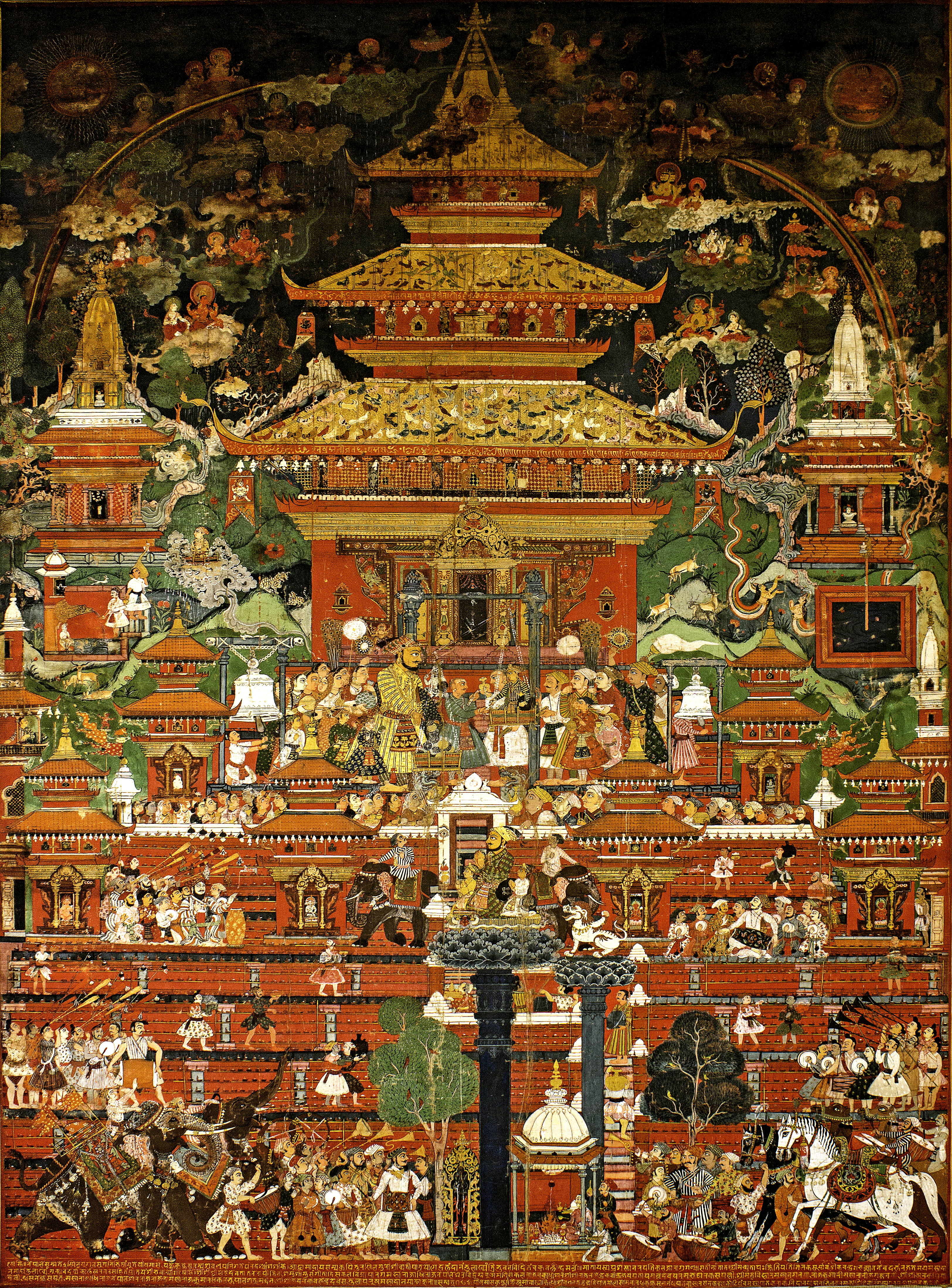
During that era, there were regular exchanges of artists between Northern India and Kathmandu Valley. The painting is also a melding of Nepali, Tibetan, Mughal, and Rajput art styles of the time.
Pratap Malla could have been inspired by a painting of Mughal Emperor Jahangir’s Tuladaan ceremony for his son Khurram in 1607. The Mallas and Mughals shared cordial relations, which is reflected in the cultural influences seen in the art and attire of the period.
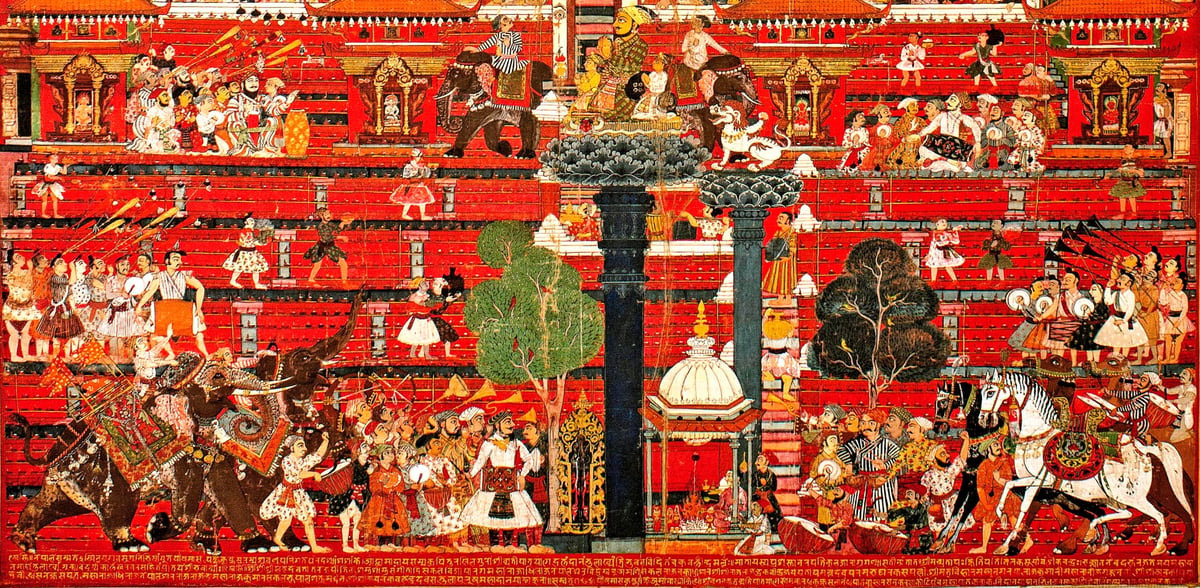
The clothing of the Malla ruling class, in particular, features colourful tunics, turbans, and jewelry that display strong Rajput and Mughal stylistic elements. The musicians in the upper tier are also dressed in Indian-style clothing, while the ensemble on the lower steps wear local attire, notably without turbans. Their hairstyles also differ, with the lower group wearing their hair tied in a bun at the front.
This national treasure is currently in storage at the Collège de France in Paris, and has never been publicly displayed. Nepal’s art scholars like Gautam Vajracharya, Pratap Aditya Pal and Anne Vergati have written about this iconic paubha in the past, but the only detailed study is from the perspective of music history by researcher Richard Widdess who had access to high resolution copies of the original.
Widdess from the Department of Music at the School of Oriental and African Studies (SOAS) in London describes the paubha as the most significant and richly detailed documentation of music in Nepali art. He identifies distinct musical ensembles on the terraces of the temple, and remarkably most of them are actively used today.
One of them reflects the Mughal naqqārakhāna model — a loud outdoor ensemble typically composed of kettledrums, trumpets, and cymbals, traditionally performed from the gateway of the emperor’s palace to announce his entrances and exits. The depiction of such an ensemble in the tulādāna painting is likely the earliest known representation of a complete naqqārakhāna in Nepal — considered the forerunner of the panche baja, the traditional Nepali ensemble.
On the stepped pyramid base of the temple are two groups of musicians playing local instruments: dhimey, bhushya, and dha. They are unmistakably Newar musicians, wearing short skirts and short-sleeved tops, with bare heads and legs—clearly distinguished as local performers.
Higher still on the temple pyramid are musicians of apparently higher status, positioned close to the king, and his courtiers, possibly professional court musicians from India, well-versed in rāga and tāla. A dāphā group is also clearly depicted, identifiable by their characteristic instruments.
Dāphā bhajan is likely the oldest surviving tradition of Newar devotional singing, and this paubha is the oldest visual record of it. Pratap Malla himself is believed to have composed songs that continue to be performed by dāphā groups throughout Kathmandu till today.
The artist’s thorough attention to musical detail may be attributed to King Pratap Malla’s own deep interest in music. His inscriptions on this painting and elsewhere proclaim his mastery of all branches of knowledge, including music. He is also known as the author of dance dramas and poems, penning his name as Kavindra (king of poets).