
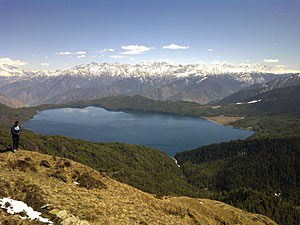
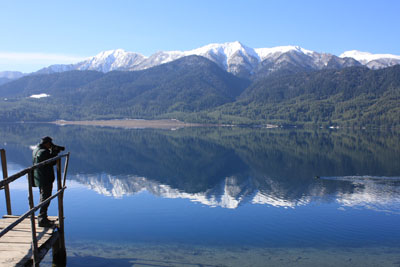
 KUNDA DIXIT View of Rara Lake from 3827m Murma Peak |
After a steep climb through a scented pine forest, suddenly through the curtain of lichen you see the sun flashing on the lake's ripples. On the pebbled shore of Rara, we soak in the sight of the inky blue water reflecting the snow mountains and sky beyond. Words fail you, and you are reduced to clichés: picturesque, magnificent, breath-taking.
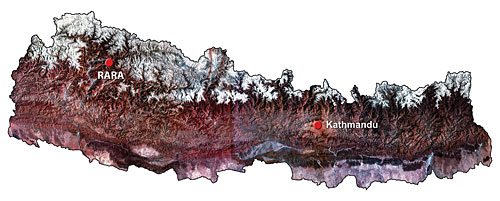
But you understand just how fragile this beauty is because Nepal's largest lake is located in its poorest and most remote district. But a new road is snaking up the ridges and has nearly reached Rara's eastern shore. At the airfield at Talcha, excavators snarl as they claw into the mountainside to lengthen the runway.
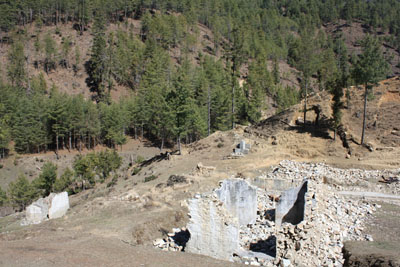 KUNDA DIXIT The army checkpost at Lamachour that was bombed by the Maoists in 2005 is still in ruins. The national park and the army are reinstating the post as well as some others to stop wildlife poaching and illegal logging within the park. |
In 1964 King Mahendra sat under a juniper tree here and penned his famous poem 'Rara ki Apsara', ordering his government to protect the lake. The juniper tree still stands at Mili Chaur today as hundreds of water fowl make a brief stopover before they head off north to the lakes in Tibet.
Rara was declared a National Park in 1975 after more than 1,500 households living in three villages along the shores were translocated to the Tarai, something that would be impossible to do today. In 2007, the lake was declared a Ramsar Site, a wetland of international importance.
The lake has three endemic species of trout found nowhere else in the world. Nearly 270 out of the 867 species of birds found in Nepal nest here. The pine, juniper and spruce forests are a treasure trove for medicinal herbs, and abound in musk deer, red panda and mountain goats.
 |
"If Mahendra hadn't done it, today buffalos would be wallowing in the lake, there would be no fish left, the forest would be gone, and the lake would be filled with instant noodle wrappings," says Durga Poudel, warden of the Rara National Park.
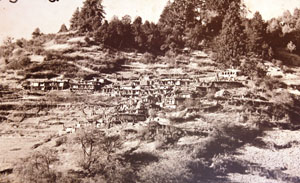 The village of Rara (circa 1974) before estimated 1,500 households from this and two other villages were moved down to Chisapani in the Tarai to make way for the national park. |
Mugu has the lowest life expectancy, the lowest adult literacy rate, and one of the worst infant and maternal mortality
rates among Nepal's 75 districts. The main challenge for conservationists is how to reconcile the district's abject poverty with the need to protect Rara's nature.
In Mugu's district capital of Gamgadi, CDO Rajesh Poudel, feels Rara's tourism potential could lift the district's living standards. "The national park should also be open to the idea of allowing tourism," he says.
Local businessman want to take a motorable road through the park to create "tourism infrastructure". The local leaders of the three main parties are mostly civil contractors, and are pushing strongly for the road.
There is much anticipation in Mugu for the arrival of the Karnali Highway from Jumla next year. "Rice will be cheaper because it won't have to be flown in, and better access will mean better education and health care," says Bhim Thapa of the Nepal Food Corporation.
But on the tranquil shore of the lake itself where the only sound is the whisper of the wind on the pines, warden Durga Poudel looks out at a flock of migratory birds, and worries aloud about how long Rara can retain its wilderness.
"Why should people come here if there are tractors rattling along the lake front?" he asks, "but if the politicians decide to build a road through the park, we won't have a say, and it'll all be finished."
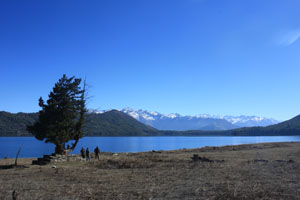 The juniper tree at Mili Chaur where King Mahendra sat and wrote his famous poem in 1964. |
During the war, the threat of Maoist attacks forced the army to abandon all seven of its ranger posts. Poaching of red panda and musk deer went up, and there has been an increase in illegal fishing and logging. Poudel and the army are working to reinstate three of the check-posts this year.
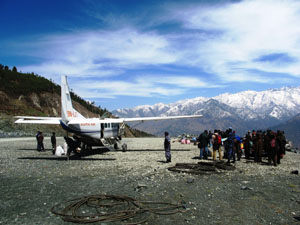 One of the four flights a day that fly into Mugu's Talcha airfield from Surkhet and Nepalganj. |
At Lamachaur, amidst the ruins of an army post that was bombed by the Maoists, the chairman of the buffer zone committee, Laba Bahadur Rokaya shrugs and says: "It's so cold, you have to let them get firewood, if you don't they threaten you with an axe."
The alternative is for the community forests in the buffer zone to collect deadwood and fodder, but the treeline of locally managed forests are receding.
The only way to protect Rara from the future, say conservationists, will be to encourage limited high-value tourism and ensure that tourism provides local employment through services, farm products and handicrafts.
"Socially responsible eco-tourism that values nature is the only way to go," says Hum Gurung of Bird Conservation Nepal (BCN), "mass tourism will kill Rara."
The factors keeping Mugu poor are decades of neglect by faraway Kathmandu, and the lack of unity and accountability of its local leaders. Unless these structural problems are addressed, neither tourism nor the road may not be able to lift the people of Mugu out of poverty.
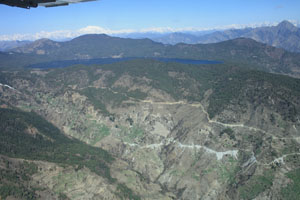 The extension of the |Karnali Highway from Jumla has already reached the eastern shore of Rara and locals want to take it across the national park along the lake to link villages on the other side.
|
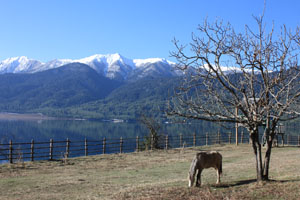
WATCH VIDEOS: Landing at Talcha airfield
RELATED STORIES:
Resplendant and remote Rara, #44
Jewel of the west, #322
More rah-rah for Rara, #524
Kunda Dixit's EastWest Blog:Trans-Karnali Blues
Warden for life
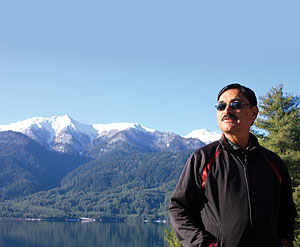 |
In a career spanning 30 years, Poudel served as the first warden of Sagarmatha National Park in 1976, oversaw the creation of Dhorpatan Reserve, helped set up the unique eco-tourism project in Langtang, was in Kosi Tappu, Chitwan, and Bardiya, and did the original survey for Makalu Barun.
"Bardiya was the most challenging," says the soft-spoken Poudel, who was detained by the rebel army there during the conflict. "If it hadn't been for the support of the local people who saved me, I wouldn't be here today."
Poudel says the war and the 2006 Ghunsa helicopter crash set the country's conservation movement back 20 years. "We are back to square one in terms of poaching," he says, "and political protection of poachers was never as bad as it is now." He says the key ingredient in protecting Nepal's parks now is for the wardens and the army to work closely together, as in Rara.
Birder's paradise
Rara Lake was classified as a wetland of international importance and a Ramsar Site in 2007 for the important role it plays in the migration of birds across the Himalaya. A total of 236 bird species (out of the 867 found in Nepal) nest in the lake either permanently or pass through during migration. Rara is the largest lake in Nepal (11 sq km), and is located within the smallest national park (106 sq km).
Rara ma chara- Bird species sited between 21-25 March
 |
Kalij Pheasant
Ruddy Shelduck
Mallard
Himalayan Woodpecker
Tufted Duck
Collared Owlet
Oriental Turtle Dove
Common Coot
Common Redshank
Brown-headed Gull
Black-headed Gull
Black Kite
Himalayana Griffon
Northern Goshawk
Common Buzzard
Common Kestrel
Little Grebe
Great Crested Grebe
Great Cormorant
Yellow-billed Blue Magpie
Red-billed Blue Magpie
Spotted Nutcracker
Large-billed Crow
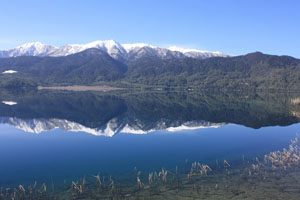 Not a single plastic bag can be seen in the crystal clear waters, how long will it remain so? |
Blue-whistling Thrush
Dark-throated Thrush
Rufous-gorgeted Flycatcher
Orange-flanked Bush Robin
Golden Bush Robin
Common Stonechat
Rusty-flanked Tree-creeper
Blue-fronted Redstart
Grey Bushchat
Winter Wren
Great Tit
Green-backed Tit
Rufous-vented Tit
Black-throated Tit
Greenish Warbler
Grey-hooded Warbler
Streaked Laughingthrush
Variegated Laughingthrush
Black-faced Laughingthrush
Stripe-throated Yuhina
Green-tailed Sunbird
Grey Wagtail
Alpine Accentor
Rufous-breasted Accentor
Rosy Pipit
Eurasian Tree Sparrow
Upland Pipit
Fire-fronted Serin
Yellow-breasted Greenfinch
Common Rosefinch
Rock Bunting
Team members: Dr Hum Gurung, Durga Poudel, Jyotendra Thakuri and Kunda Dixit