
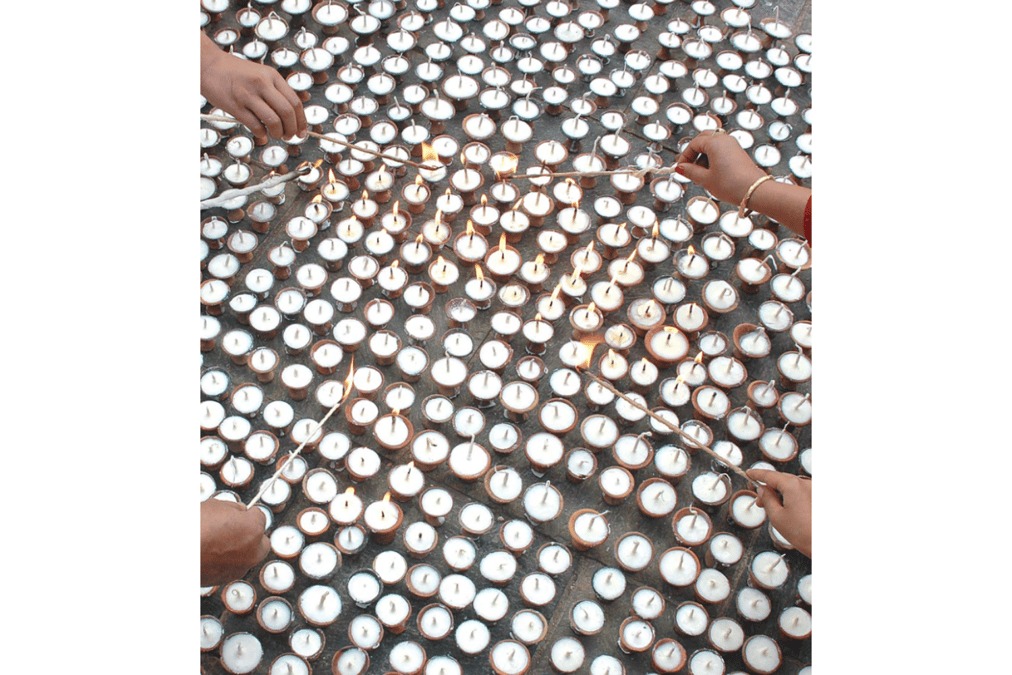
Purified by a lesson in mortality

This festival season, a health emergency reminds photojournalist about impermanence and attachment

Photo: DEEPENDRA MUNI BAJRACHARYA

Just like twilight divides night and day, there is an in-between state between life and death that Tibetan Buddhist teaching describes as ‘bardo’. It is derived from the word ‘gap’ or ‘transition’.

In the West, they call what I went through a ‘near-death experience’, and many have written about a painless bliss with a bright light beckoning from the end of a long tunnel. For me, though, it was an emotional reminder of impermanence and attachment. 

Every year on my birthday on 1 October, I feel a tinge of regret. It is an annual reminder of work unfinished and goals unattained. Birthdays just added a heavy burden on me to achieve those goals. 

Three days before my birthday this year on 27 September, I was standing on a stool trying to drive a nail into the wall to hang a picture when I sensed what seemed like a blast of wind on my right temple. I got down and rested for a bit, thinking it was a hunger-driven dizzy spell.

Still, I was worried enough to video call my wife who had gone for Indra Jatra. She screamed on the phone: “What happened to your face? Go to the hospital immediately.”

In the mirror, my face looked contorted. My speech was slurred. Arriving at the hospital that night, I was wheeled into the ICU where there were many who were in worse shape than me, struggling between life and death.

The harsh glare of lights and bare white walls gave the room a sterile, impersonal look. The whirring and beeping of machines indicated beating hearts and breathing lungs. Nurses and doctors came and went, briefing each other on the condition of their patients. No visitors were allowed, and it felt like a maximum security prison.

The next morning, they shaved my head and prepared to take me in for tests at the cath lab. They poked electrodes into me. In the lab I observed everything from a low angle, and the photojournalist in me instinctively started thinking of composition and negative space. The equipment covered half the room. Four doctors were huddled over an 80-inch monitor, masked nurses in blue hovered about. 

It was a scary sight. But a strange calm overcame me. I went into a meditative trance even before the anaesthesia started taking effect. In that state between consciousness and unconsciousness, I was mentally reciting mantras the guru had taught me. 

What I remember is a blissful sense of resignation enveloping me like a comforting blanket. Later, I described the experience to my spiritual guru. He explained:  “Congratulations, what you experienced was the state of bardo.”

CROSSROADS

It was at the crossroads of life and death. One path led towards rebirth, and the other back to my present existence. I returned to my existing state. As I came to, it was as if I had returned from a great adventure through eternity. Proximity to mortality had a purifying effect on my soul.

I was brought back to the ICU, and my four days there reminded me about just how slender the thread between life and death can be. It taught me a profound lesson in the fragility and impermanence of life—how family, relationships, love, hopes, and life’s dreams can all become nothing in a second. 

A small artery ruptured, cutting off the supply of oxygenated blood to a part of my brain, proving just how tenuously body and soul are joined together. I experienced clearly that our body (काय), mind (चित्त), and speech (वाक) are deeply interconnected. However, they have different functions and work independently at their own pace. 

The woman in the next bed, who would be my mother’s age, died during the night. There was weeping and sobbing from family members outside. It was all happening as I was struggling to understand my own return to this life.

I am no stranger to death. As a boy, I saw a relative take her last breath and waited for her to come back to life. Later, I watched through a window as doctors performed CPR on my grandfather to try to revive him. 

I have witnessed protesters shot by riot police in the 1990 People’s Movement, photographed the cremations after the Royal Massacre of 2001, seen a flight attendant’s body high up on a tree after an air crash and been unable to take any pictures when I was assigned to interview her mother.

During the 2015 earthquake, a neighbour’s house collapsed, a woman was pulled out of the rubble, and given up for dead. But the next day I was surprised to see her alive and walking about. It reminded me how life can end in an instant, or be miraculously restored.

We think we control our bodies. But there are so many involuntary functions over which we have no say. We often take our bodies for granted until a single moment reminds us how fragile, complex, and extraordinary human life truly is. Witnessing death firsthand, I gradually learnt the value of life. 

My guru Yongey Mingyur Rinpoche had tutored me in catechism: about body and soul, about reincarnation, death and rebirth, and about karma. But to personally experience it forced me to rethink the meaning of existence itself. 

Sometimes, life teaches us its deepest lessons not through books, teachings, or meditation, but from experiences that bring us face to face with our own being. What I went through was not just ‘recovery’, it let me peer into the mystery of existence itself and question it. 

Back home, I am learning now to live life differently—not necessarily doing more, but becoming more conscious of what truly matters. Life is precious. Every breath is a gift. Every moment is an opportunity to be aware, to be grateful, and to live with compassion.

Deependra Muni Bajracharya is a photojournalist, photography trainer, and a contributor to Nepali Times.