
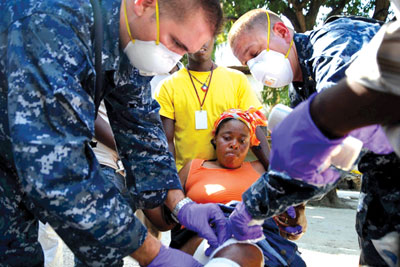
 US GOVERNMENT WORKS |
One thing is for certain, it will be impossible to treat everyone who needs medical care after a severe earthquake in Nepal.
Wherever there are functioning hospitals (many hospitals and nursing homes may be reduced to rubble), a triage team will need to be set up to determine how urgently the patient needs to be admitted to hospital.
The next hitch will be the hospital system's capacity to provide adequate resources to meet the needs of the injured. Crush injuries of muscles (rhabdomyolysis) will be one of the most common medical problems encountered after an earthquake, as was the case in Haiti last year. Rhabdomyolysis leads to acute renal failure because the muscle protein is harmful to the kidneys. Depending on how promptly fluid therapy is started, dialysis (artificial kidney) may be necessary for the patient. Unfortunately dialysis is not widely available in Nepal; so even though the patient may be alive, lack of equipment and expertise will conspire to work against him.
Many patients will arrive at hospital with open infected wounds and fractures. Apart from dealing with proper wound care and fracture repair, the patients will need appropriate antibiotics to fight sepsis, common after this kind of a traumatic injury. In Haiti, those who were rescued late and taken to hospital had maggots in their wounds. Healthcare professionals not used to dealing with new and unusual problems will have to consult others, improvise, and learn on the job.